

This mathematics problem involves applying core mathematical principles and formulas. Below you will find a complete step-by-step solution with detailed explanations for each step, helping you understand not just the answer but the method behind it.
ScanSolve AI Answer
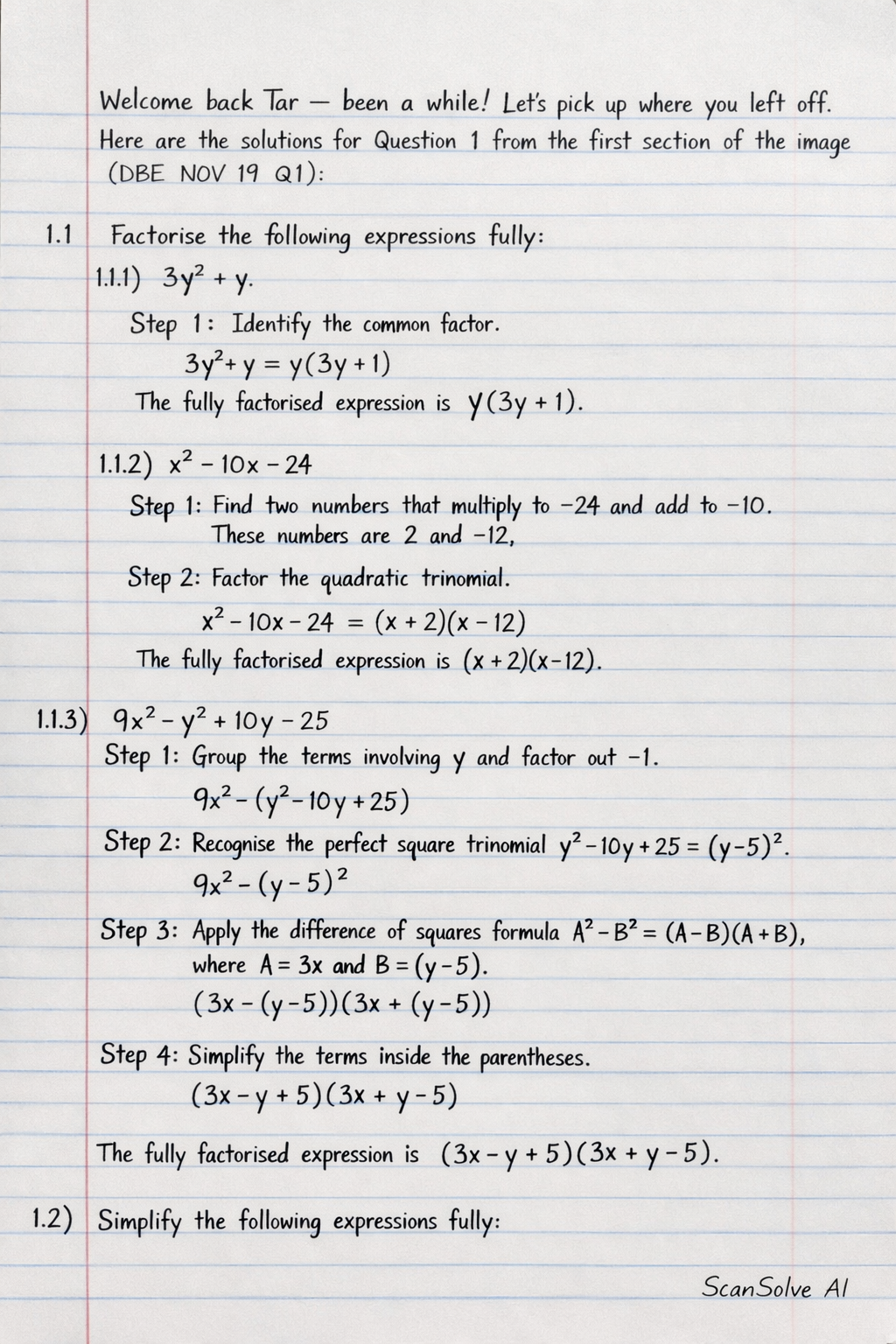
Here are the solutions for Question 1 from the first section of the image (DBE NOV 19 Q1): 1.1 Factorise the following expressions fully: 1.1.1 3y^2+y Step 1: Identify the common factor. 3y^2+y = y(3y+1) The fully factorised expression is y(3y+1). 1.1.2 x^2-10x-24 Step 1: Find two numbers that multiply to -24 and add to -10. These numbers are 2 and -12. Step 2: Factor the quadratic trinomial. x^2-10x-24 = (x+2)(x-12) The fully factorised expression is (x+2)(x-12). 1.1.3 9x^2-y^2+10y-25 Step 1: Group the terms involving y and factor out -1. 9x^2-(y^2-10y+25) Step 2: Recognise the perfect square trinomial y^2-10y+25 = (y-5)^2. 9x^2-(y-5)^2 Step 3: Apply the difference of squares formula A^2-B^2=(A-B)(A+B), where A=3x and B=(y-5). (3x-(y-5))(3x+(y-5)) Step 4: Simplify the terms inside the parentheses. (3x-y+5)(3x+y-5) The fully factorised expression is (3x-y+5)(3x+y-5). 1.2 Simplify the following expressions fully: 1.2.1 (4+(1)/(x))(2-(3)/(x)) Step 1: Expand the expression by multiplying each term. 4(2) + 4(-(3)/(x)) + (1)/(x)(2) + (1)/(x)(-(3)/(x)) Step 2: Perform the multiplications. 8 - (12)/(x) + (2)/(x) - (3)/(x^2) Step 3: Combine like terms. 8 - (10)/(x) - (3)/(x^2) The simplified expression is 8 - (10)/(x) - (3)/(x^2). 1.2.2 (5x-5)/(5x) Step 1: Factor out the common factor in the numerator. (5(x-1))/(5x) Step 2: Cancel out the common factor 5. (x-1)/(x) The simplified expression is (x-1)/(x). 1.2.3 3^n+1+3^n27 · 3^n-1 Step 1: Factor out 3^n from the numerator. (3^n · 3^1 + 3^n)/(27 · 3^n-1) = (3^n(3+1))/(27 · 3^n-1) Step 2: Simplify the numerator and express 27 as a power of 3. (4 · 3^n)/(3^3 · 3^n-1) Step 3: Apply the exponent rule a^m · a^p = a^m+p to the denominator. (4 · 3^n)/(3^3+(n-1)) = (4 · 3^n)/(3^n+2) Step 4: Apply the exponent rule (a^m)/(a^p) = a^m-p. 4 · 3^n-(n+2) = 4 · 3^n-n-2 = 4 · 3^-2 Step 5: Evaluate 3^-2. 4 · (1)/(3^2) = 4 · (1)/(9) = (4)/(9) The simplified expression is (4)/(9).