
We read your photo as:
Vectors OQ = q and OR = r. X divides OQ in ratio 1:2, T divides OR in ratio 3:4. Lines XR and TQ intersect at E. Express OE in terms of q, r, and m if XE = mXR and TE = nTQ.
Mathematics
ScanSolve AI Answer
Answers
4 partsStep-by-step solution
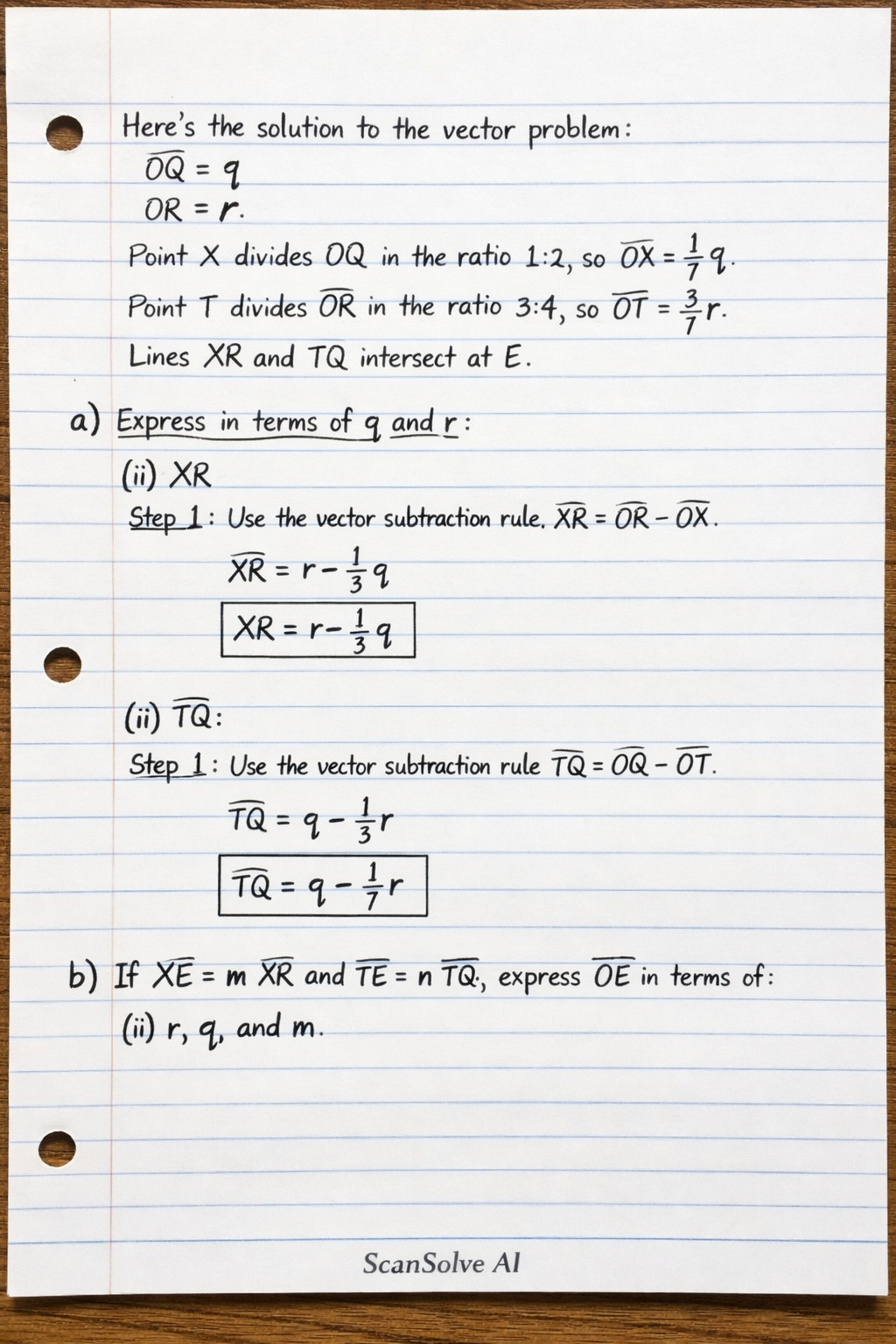
8 stepsHere's the solution to the vector problem:
Given:
Point X divides OQ in the ratio , so .
Point T divides OR in the ratio , so .
Lines XR and TQ intersect at E.
Part a(i)· 1 step
Express in terms of and
Use the vector subtraction rule .
Part a(ii)
Use the vector subtraction rule .
Part b(i)
, and .
If and , express in terms of
Use the given relationship .
Substitute and the expression for from part (a)(i).
Rearrange to solve for .
Part b(ii)
, and .
Use the given relationship .
Substitute and the expression for from part (a)(ii).
Rearrange to solve for .
Was this helpful?
Still stuck on this one?
Ask a follow-up, and the answer starts from this question.
Got a different question?Ask your own question
More Mathematics Questions
QOPQR is a rectangle and O is the origin, M is the midpoint of RQ and PT: TQ = 2:1. Find, in terms of…QThe figure below AO = a and OB = b. P divides OA in the ratio 2:3 while T is on AB such that AT…QIn a circle with center O, angle QOR = 146 degrees and angle QRT = 52 degrees, where RT is a…QGiven vectors OA = 2p, OQ = q, Q is the midpoint of OC, OABP is a straight line, and OA = AB = BP…QIn the diagram, OQR is a tangent to the circle at Q. Find the values of m and n.
Browse by topic:Linear Algebra
Handwritten Step-by-Step Solution
Get this as a handwritten image on WhatsApp — like a tutor wrote it for you.
Try on WhatsApp