
Were is 4,2 and 4,3 4,4 4,5
ScanSolve AI Answer
Answers
2 partsStep-by-step solution
8 stepsI can help you with 4.2, 4.3, and 4.4. I don't have question 4.5 in the images you sent, so please send it if you'd like me to solve it!
Here are the solutions for the questions you asked about:
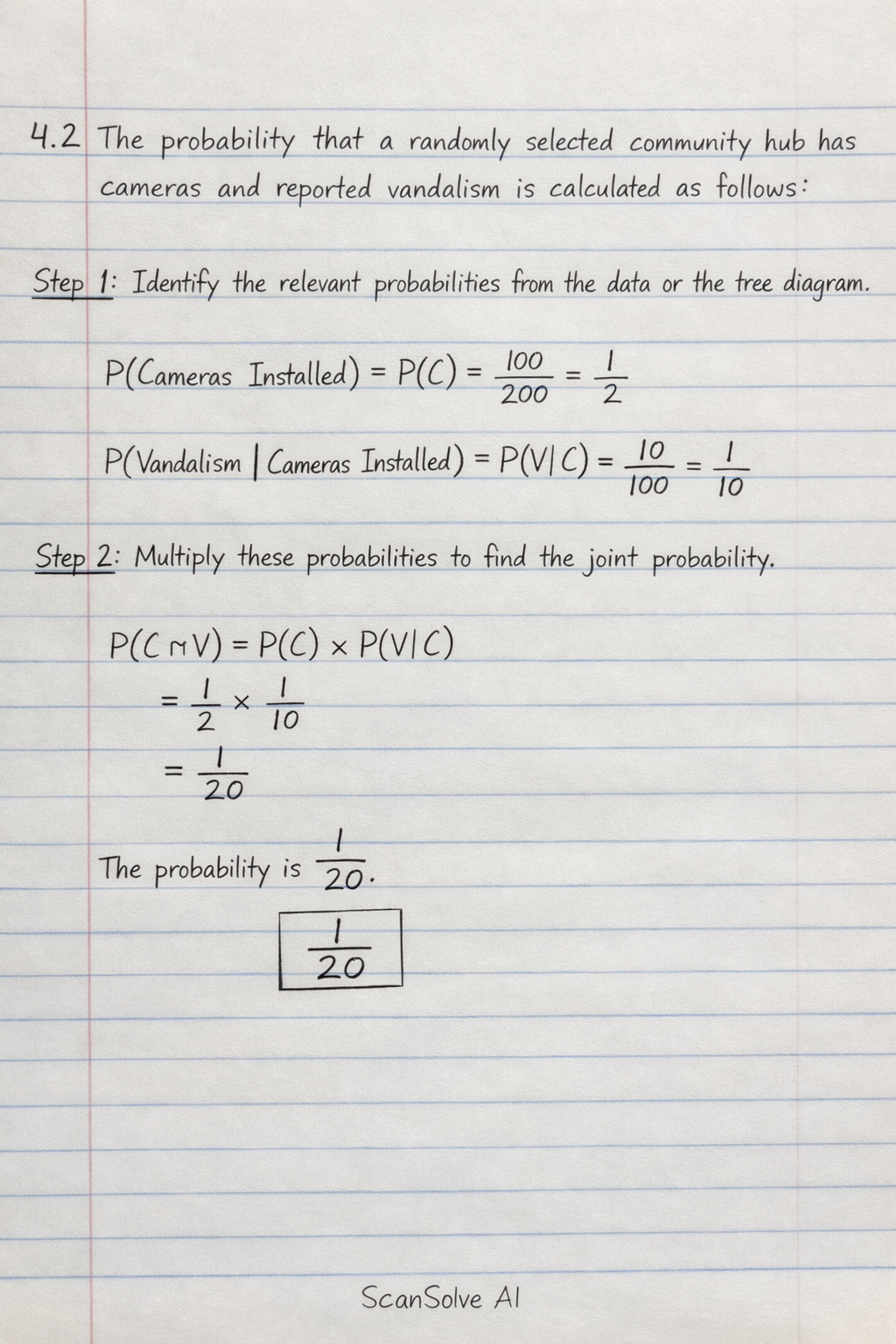
Part 4.2· 2 steps
The probability that a randomly selected community hub has cameras and reported vandalism is calculated as follows
Identify the relevant probabilities from the data or the tree diagram.
Multiply these probabilities to find the joint probability.
The probability is .
Part 4.3
The probability that a community hub did not have cameras and experienced vandalism, as a percentage, is calculated as follows
Identify the relevant probabilities from the data or the tree diagram.
Multiply these probabilities to find the joint probability.
Convert the probability to a percentage.
The probability is .
Part 4.4· 3 steps
To determine which group of community hubs has a higher risk of vandalism, we compare the conditional probabilities of vandalism for each group
State the conditional probability of vandalism given cameras installed.
State the conditional probability of vandalism given no cameras installed.
Compare the two probabilities.
To compare and , we can express as .
Since , the probability of vandalism is higher when no cameras are installed.
The group of community hubs with a higher risk of vandalism is hubs with no cameras installed. This is because the probability of vandalism given no cameras () is greater than the probability of vandalism given cameras ().
Try one yourself
A new problem that tests the same skill.
Still stuck on this one?
Ask a follow-up, and the answer starts from this question.
More Mathematics Questions
Handwritten Step-by-Step Solution
Get this as a handwritten image on WhatsApp — like a tutor wrote it for you.
Try on WhatsApp