
We read your photo as:
x ~ N(580, 12²) with n=12. Find the sample mean of P(X > 550)
ScanSolve AI Answer
Answer
Step-by-step solution
3 stepsThe problem states that , which means the population mean and the population standard deviation .
The sample size is .
We need to find the probability that the sample mean () is greater than 550, i.e., .
Determine the distribution of the sample mean ().
According to the Central Limit Theorem, if the population is normally distributed, the sample mean will also be normally distributed with:
Mean of sample mean:
Standard deviation of sample mean (standard error):So, .
Standardize the value of to a z-score.
The formula for the z-score for a sample mean is:
We want to find .
To rationalize the denominator:
Using :
Find the probability using the standard normal distribution.
We need to find .
Since the standard normal distribution is symmetric and almost all its probability mass lies between -3 and 3, a z-score of -8.66 is extremely far in the left tail. The probability of being greater than such a small z-score is very close to 1.Looking up in a standard normal table or using a calculator, this value is practically 0.
The probability is approximately .
Try one yourself
A new problem that tests the same skill.
Still stuck on this one?
Ask a follow-up, and the answer starts from this question.
More Mathematics Questions
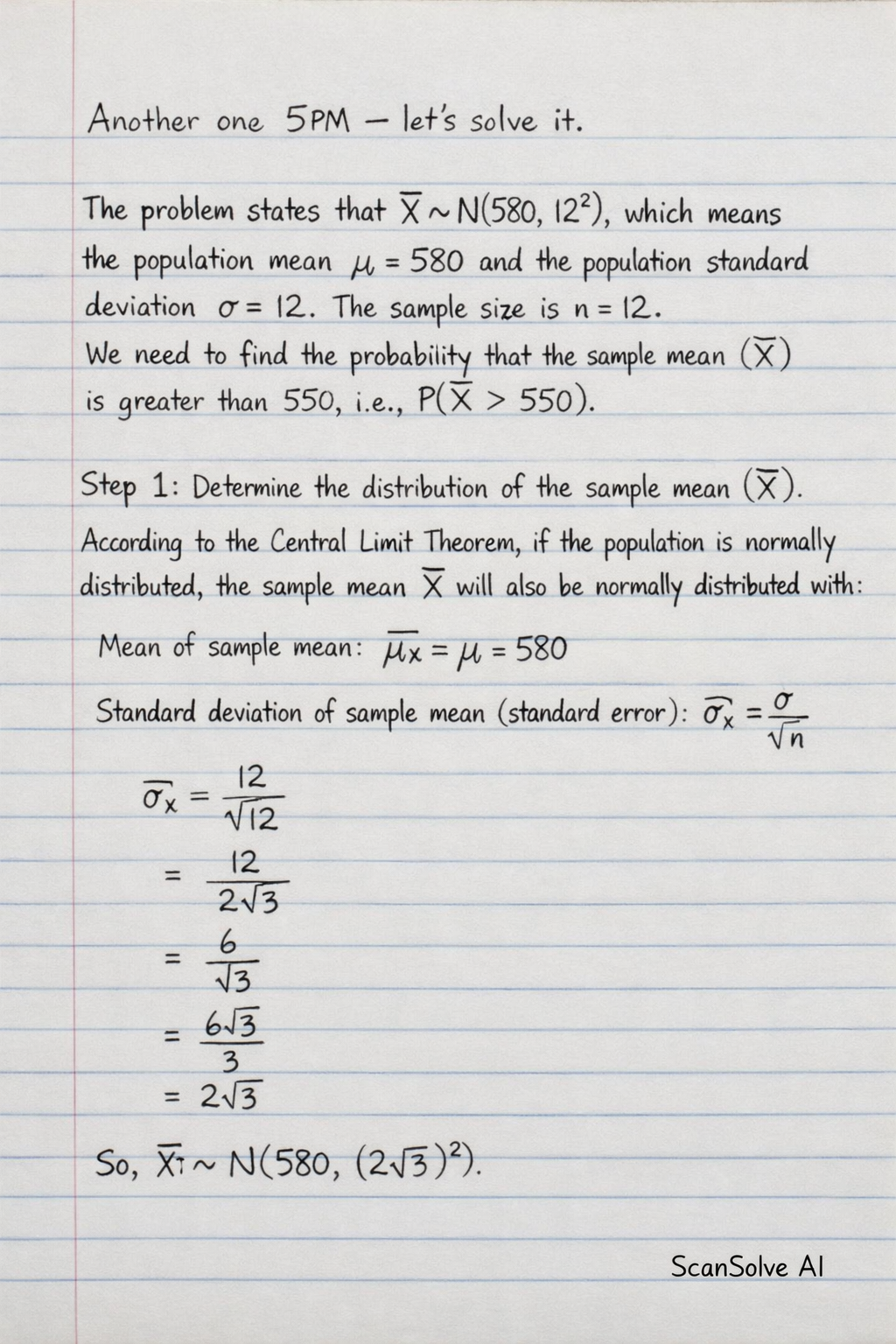
Handwritten Step-by-Step Solution
Get this as a handwritten image on WhatsApp — like a tutor wrote it for you.
Try on WhatsApp