
We read your photo as:
You can go away, or you can keep yourself to yourself. Use a logical connective to describe the statement "If you go away, then you keep yourself to yourself."
ScanSolve AI Answer
Answers
3 partsStep-by-step solution
8 stepsHere are the solutions to the visible questions:
Part 1· 2 steps
Set Union
Given and . Find .
Identify the elements in set and set .
Combine all unique elements from both sets to form the union.
The union includes all elements that are in or in (or both).
This corresponds to option A.
The final answer is .
Part 2
Logical Statement
Let be "You can go away". Let be "You love yourself". Use a logical notation to describe the statement "If you go away then you love yourself".
Identify the propositions and .
: "You can go away"
: "You love yourself"Translate the conditional statement "If ...
then ..." into logical notation.
The phrase "If A then B" is represented by .
Therefore, "If you go away then you love yourself" is represented by .
This corresponds to option C.The final answer is .
Part 3
Probability
A die is rolled once. What is the probability of obtaining a 2 or a 5?
Determine the sample space and total number of outcomes.
When a fair die is rolled once, the possible outcomes are .
The total number of outcomes is 6.Identify the favorable outcomes.
The event is "obtaining a 2 or a 5". The favorable outcomes are .
The number of favorable outcomes is 2.Calculate the probability.
The probability of an event is the ratio of the number of favorable outcomes to the total number of outcomes.
Simplify the probability.
The final answer is .
Note on other questions:
- Question 7 (Truth Table): The last column of the truth table is not visible in the image, which is necessary to determine which logical expression matches it. Therefore, this question cannot be answered.
- Question 8 (Logarithm): The question "If , ..." is incomplete, so it cannot be solved.
Try one yourself
A new problem that tests the same skill.
Still stuck on this one?
Ask a follow-up, and the answer starts from this question.
More Mathematics Questions
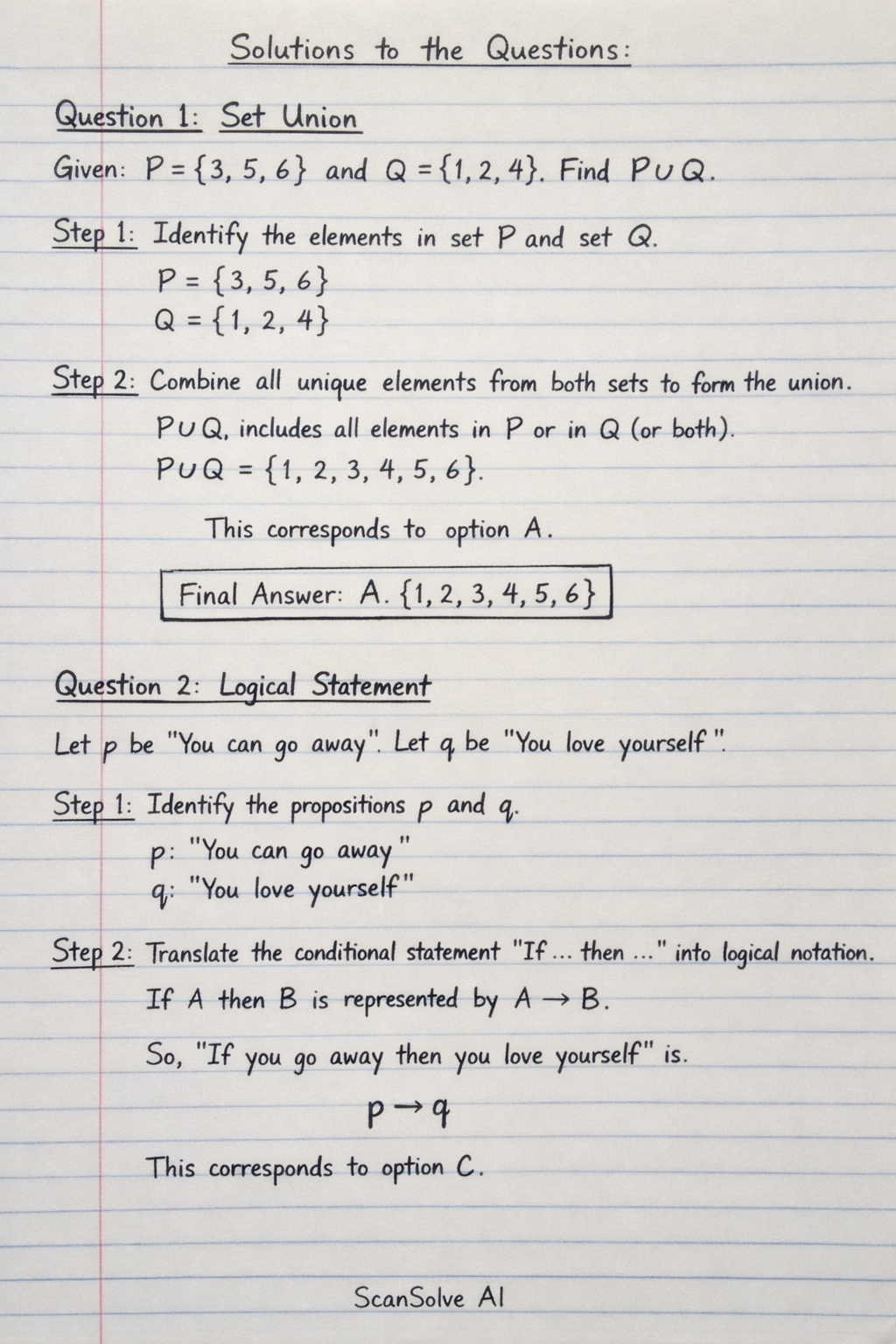
Handwritten Step-by-Step Solution
Get this as a handwritten image on WhatsApp — like a tutor wrote it for you.
Try on WhatsApp