

This geography problem is solved step by step below, with detailed explanations to help you understand the method and arrive at the correct answer.
ScanSolve AI Answer
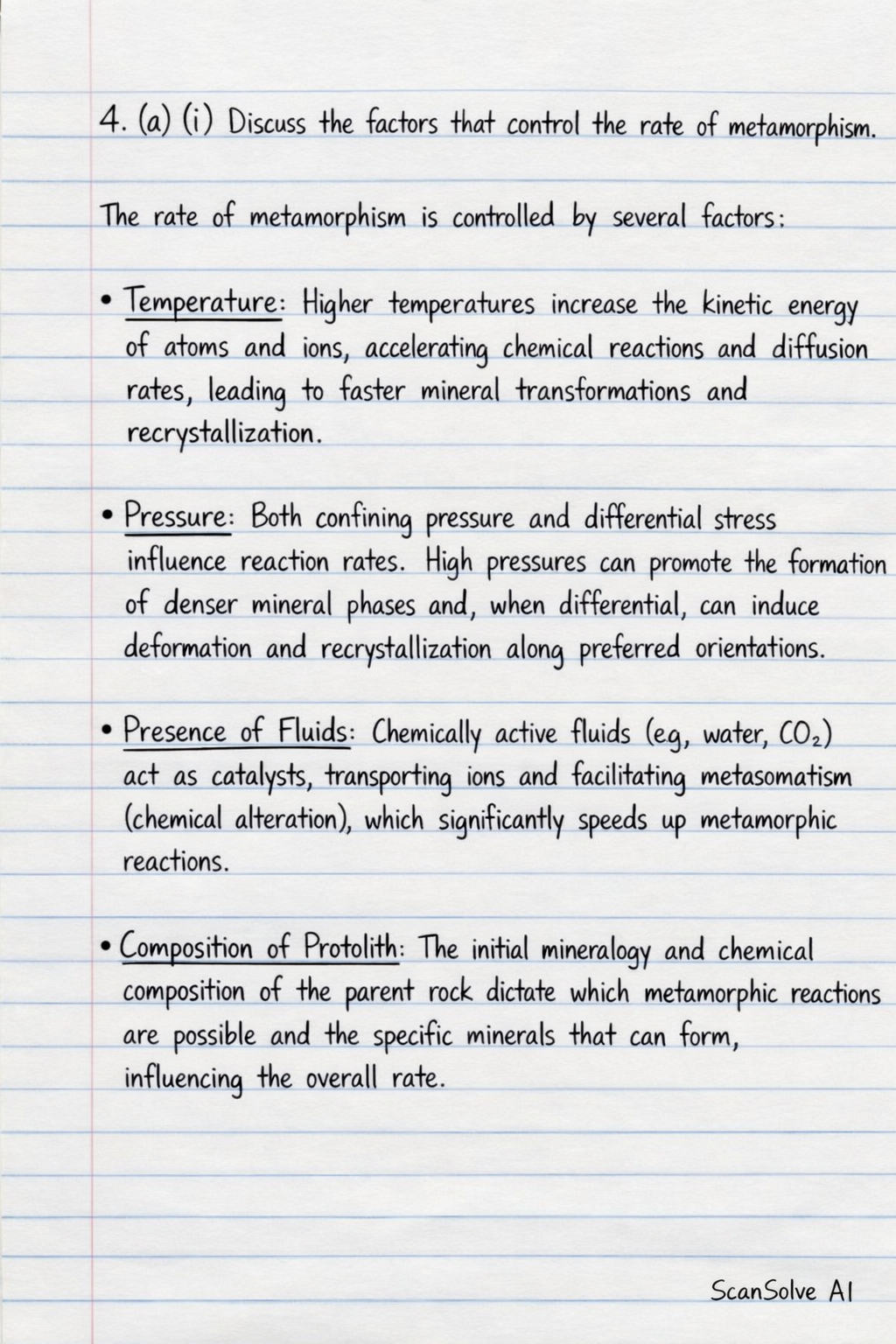
4. (a) (i) Discuss the factors that control the rate of metamorphism. The rate of metamorphism is controlled by several factors: • Temperature: Higher temperatures increase the kinetic energy of atoms and ions, accelerating chemical reactions and diffusion rates, leading to faster mineral transformations and recrystallization. • Pressure: Both confining pressure and differential stress influence reaction rates. High pressures can promote the formation of denser mineral phases and, when differential, can induce deformation and recrystallization along preferred orientations. • Presence of Fluids: Chemically active fluids (e.g., water, CO_2) act as catalysts, transporting ions and facilitating metasomatism (chemical alteration), which significantly speeds up metamorphic reactions. • Composition of Protolith: The initial mineralogy and chemical composition of the parent rock dictate which metamorphic reactions are possible and the specific minerals that can form, influencing the overall rate. • Time: Metamorphic processes are often slow, requiring long geological periods for significant changes to occur. Longer durations allow for more complete reactions, larger crystal growth, and the attainment of equilibrium. • Strain Rate: The rate at which a rock is deformed can influence the development of metamorphic textures, particularly foliation and lineation, by promoting dynamic recrystallization. 4. (a) (ii) Give an account for the effect of high temperatures and pressures on basic igneous rocks? When basic igneous rocks (e.g., basalt, gabbro), which are rich in ferromagnesian minerals like olivine, pyroxene, and calcium-rich plagioclase, are subjected to high temperatures and pressures, they undergo significant metamorphic changes: • Mineral Transformations: Original minerals become unstable and react to form new, more stable minerals under the new conditions. For example, pyroxenes and plagioclase can transform into amphiboles (e.g., hornblende) at moderate grades (amphibolite facies). • Recrystallization: Existing mineral grains may recrystallize into larger, more equant grains, or develop preferred orientations (foliation) under differential stress. • Formation of Denser Assemblages: High pressures favor the formation of denser mineral phases. At very high pressures and temperatures, basic rocks can transform into eclogite, characterized by the dense minerals garnet and omphacite (a sodium-rich pyroxene), with a significant reduction in rock volume. • Textural Changes: The original igneous texture is replaced by a metamorphic texture, often characterized by foliation (e.g., schistosity in amphibolites) or granoblastic texture (e.g., in eclogites). • Hydration/Dehydration: The presence of water can lead to hydration reactions, forming hydrous minerals like amphiboles or chlorite. Conversely, very high temperatures can cause dehydration, leading to the formation of anhydrous minerals. 4. (b) Classify folds based on: 4. (b) (i) Closing or facing direction. Folds are classified based on the direction their limbs close and the relative age of the rocks in their core: • Antiform: A fold that is convex upwards (closes upwards). • Synform: A fold that is concave upwards (closes downwards). • Anticline: A fold with older rocks in its core. • Syncline: A fold with younger rocks in its core. • Neutral fold: A fold that closes horizontally. • Overturned fold: A fold where one limb has been rotated past vertical, causing the strata to be inverted. 4. (b) (ii) Attitude of axial plane. The attitude of the axial plane (its orientation in space) is used to classify folds: • Upright fold: The axial plane is vertical or nearly vertical. • Inclined fold: The axial plane is tilted (dips at an angle between 10^ and 80^). • Overturned fold: The axial plane is inclined, and one limb is overturned (dips in the same direction as the axial plane but at a shallower angle). • Recumbent fold: The axial plane is horizontal or nearly horizontal. 4. (b) (iii) Interlimb angle. The interlimb angle is the angle between the two limbs of a fold, measured perpendicular to the hinge line: • Gentle fold: Interlimb angle between 120^ and 180^. • Open fold: Interlimb angle between 70^ and 120^. • Close fold: Interlimb angle between 30^ and 70^. • Tight fold: Interlimb angle between 10^ and 30^. • Isoclinal fold: Interlimb angle between 0^ and 10^ (limbs are essentially parallel).