
We read your photo as:
A block of mass 5 kg falls from the top of a building and hits the ground, 20 m below, 3 s later. Assuming the resistance experienced by the block is constant throughout the motion, find this resistance.
ScanSolve AI Answer
Answer
Step-by-step solution
4 stepsIdentify the given values and the relevant kinematic equation.
The mass of the block is .
The distance fallen is .
The time taken is .
The initial velocity is (since it falls from rest).
We will use the acceleration due to gravity .
The kinematic equation relating distance, initial velocity, acceleration, and time is:Calculate the acceleration () of the block.
Since , the equation simplifies to .
Substitute the given values:Apply Newton's Second Law to find the resistance force.
The forces acting on the block are the gravitational force () acting downwards and the resistance force () acting upwards. The net force () causes the acceleration . Taking the downward direction as positive:
According to Newton's Second Law, .
So, .
The gravitational force is .Rearrange the equation to solve for :
Substitute the values and calculate the resistance force.
Rounding to one decimal place, the resistance is:
The resistance experienced by the block is .
Try one yourself
A new problem that tests the same skill.
Still stuck on this one?
Ask a follow-up, and the answer starts from this question.
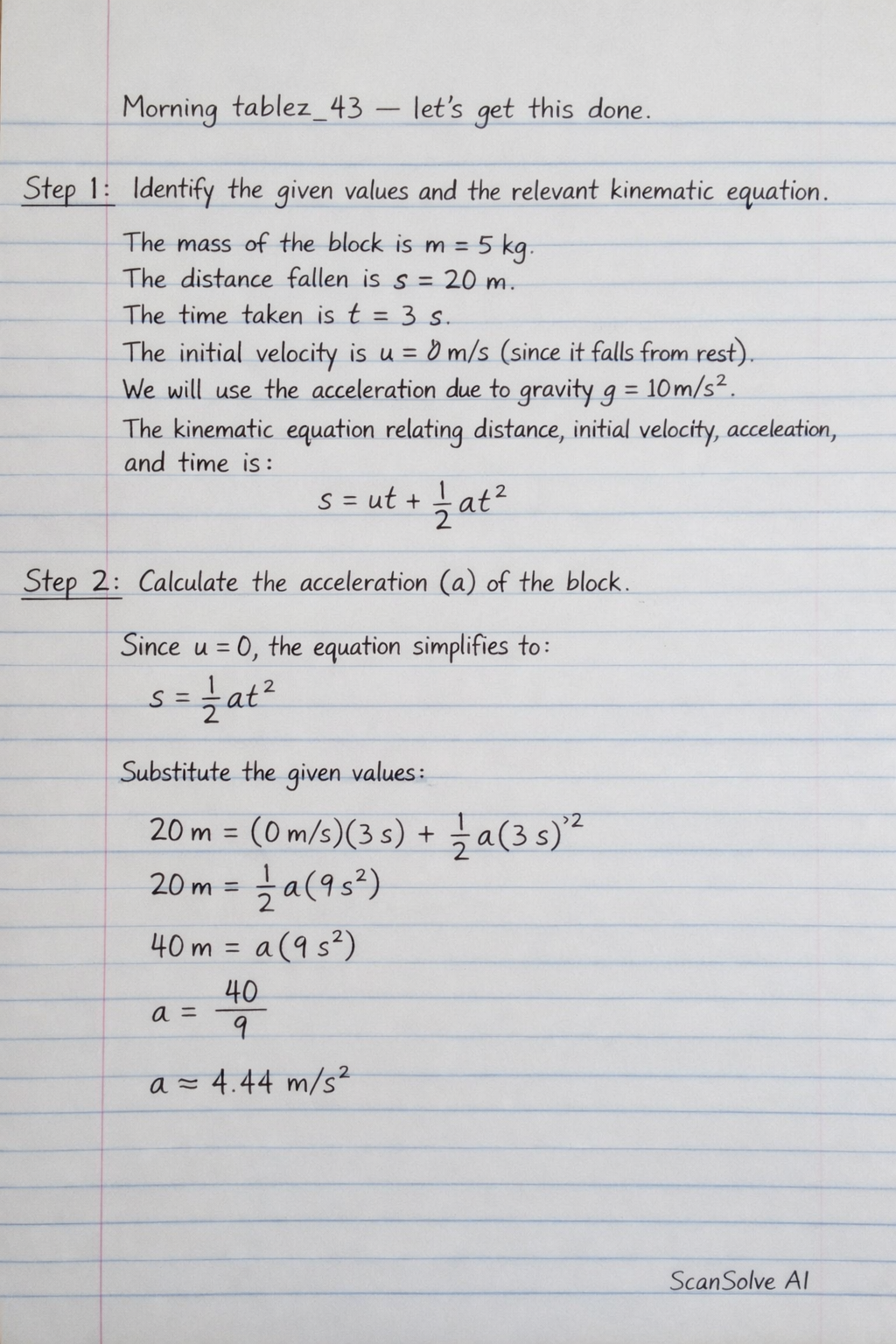
Handwritten Step-by-Step Solution
Get this as a handwritten image on WhatsApp — like a tutor wrote it for you.
Try on WhatsApp