We read your photo as:

A pipeline of diameter 200 mm and length 100 m delivers water at a rate of 0,1 m³/s. Determine: The pressure head lost over the length of the pipe owing to friction. Use a resistance coefficient of 0,005. The hydraulic gradient.

Physics

ScanSolve AI Answer

Answers

2 parts
8.1

1.291 m1.291 \text{ m}

8.2
0.01291

Step-by-step solution

4 steps

Here's the solution for :

Given data:
Diameter, D=200 mm=0.2 mD = 200 \text{ mm} = 0.2 \text{ m}
Length, L=100 mL = 100 \text{ m}
Flow rate, Q=0.1 m3/sQ = 0.1 \text{ m}^3/\text{s}
Resistance coefficient (Darcy friction factor), f=0.005f = 0.005
Acceleration due to gravity, g=9.81 m/s2g = 9.81 \text{ m/s}^2

Part 8.1· 3 steps

The pressure head lost over the length of the pipe owing to friction.

  1. Calculate the cross-sectional area of the pipe.

    A=πD24A = \frac{\pi D^2}{4} A=π(0.2 m)24=π×0.04 m24=0.01π m2≈0.031416 m2A = \frac{\pi (0.2 \text{ m})^2}{4} = \frac{\pi \times 0.04 \text{ m}^2}{4} = 0.01\pi \text{ m}^2 \approx 0.031416 \text{ m}^2
  2. Calculate the velocity of the fluid in the pipe.

    V=QAV = \frac{Q}{A} V=0.1 m3/s0.01π m2=10π m/s≈3.1831 m/sV = \frac{0.1 \text{ m}^3/\text{s}}{0.01\pi \text{ m}^2} = \frac{10}{\pi} \text{ m/s} \approx 3.1831 \text{ m/s}
  3. Calculate the head loss (hfh_f) using the Darcy-Weisbach equation.

    hf=fLDV22gh_f = f \frac{L}{D} \frac{V^2}{2g} hf=0.005×100 m0.2 m×(10π m/s)22×9.81 m/s2h_f = 0.005 \times \frac{100 \text{ m}}{0.2 \text{ m}} \times \frac{(\frac{10}{\pi} \text{ m/s})^2}{2 \times 9.81 \text{ m/s}^2} hf=0.005×500×100π2×19.62h_f = 0.005 \times 500 \times \frac{100}{\pi^2 \times 19.62} hf=2.5×10019.62π2h_f = 2.5 \times \frac{100}{19.62 \pi^2} hf=25019.62×(3.14159)2=25019.62×9.8696=250193.5906h_f = \frac{250}{19.62 \times (3.14159)^2} = \frac{250}{19.62 \times 9.8696} = \frac{250}{193.5906} hf≈1.291 mh_f \approx 1.291 \text{ m}

    The pressure head lost is 1.291 m\boxed{1.291 \text{ m}}.

Part 8.20.01291

The hydraulic gradient.

  1. Calculate the hydraulic gradient (ii) using the head loss and pipe length.

    i=hfLi = \frac{h_f}{L} i=1.291 m100 mi = \frac{1.291 \text{ m}}{100 \text{ m}} i=0.01291i = 0.01291

    The hydraulic gradient is 0.01291\boxed{0.01291}.

Was this helpful?

Try one yourself

A new problem that tests the same skill.

Still stuck on this one?

Ask a follow-up, and the answer starts from this question.

Got a different question?Ask your own question
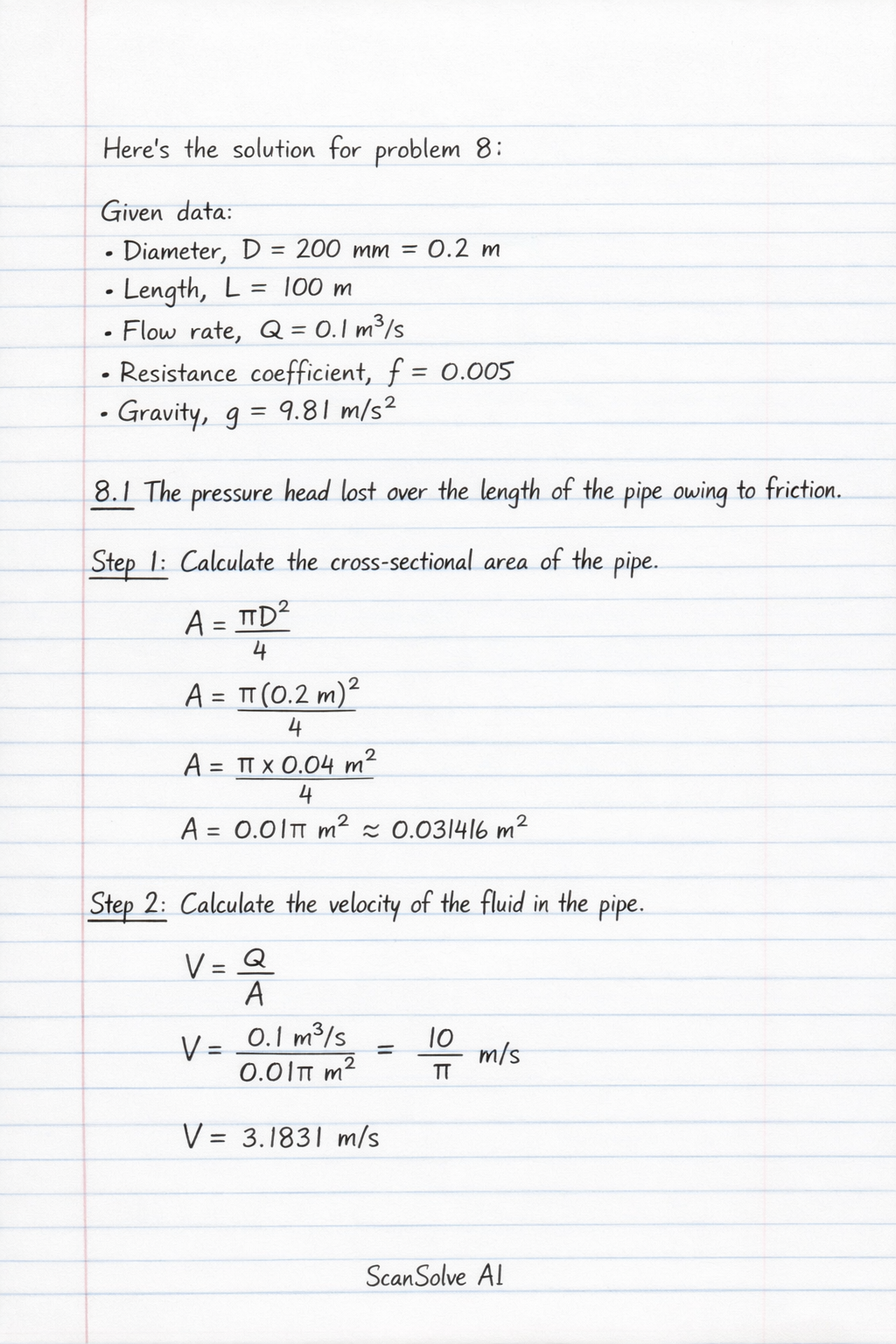
Handwritten step-by-step solution preview

Handwritten Step-by-Step Solution

Get this as a handwritten image on WhatsApp — like a tutor wrote it for you.

Try on WhatsApp