

This English question involves literary analysis, grammar, or writing skills. The detailed response below provides a well-structured answer with supporting evidence and clear explanations.
ScanSolve AI Answer
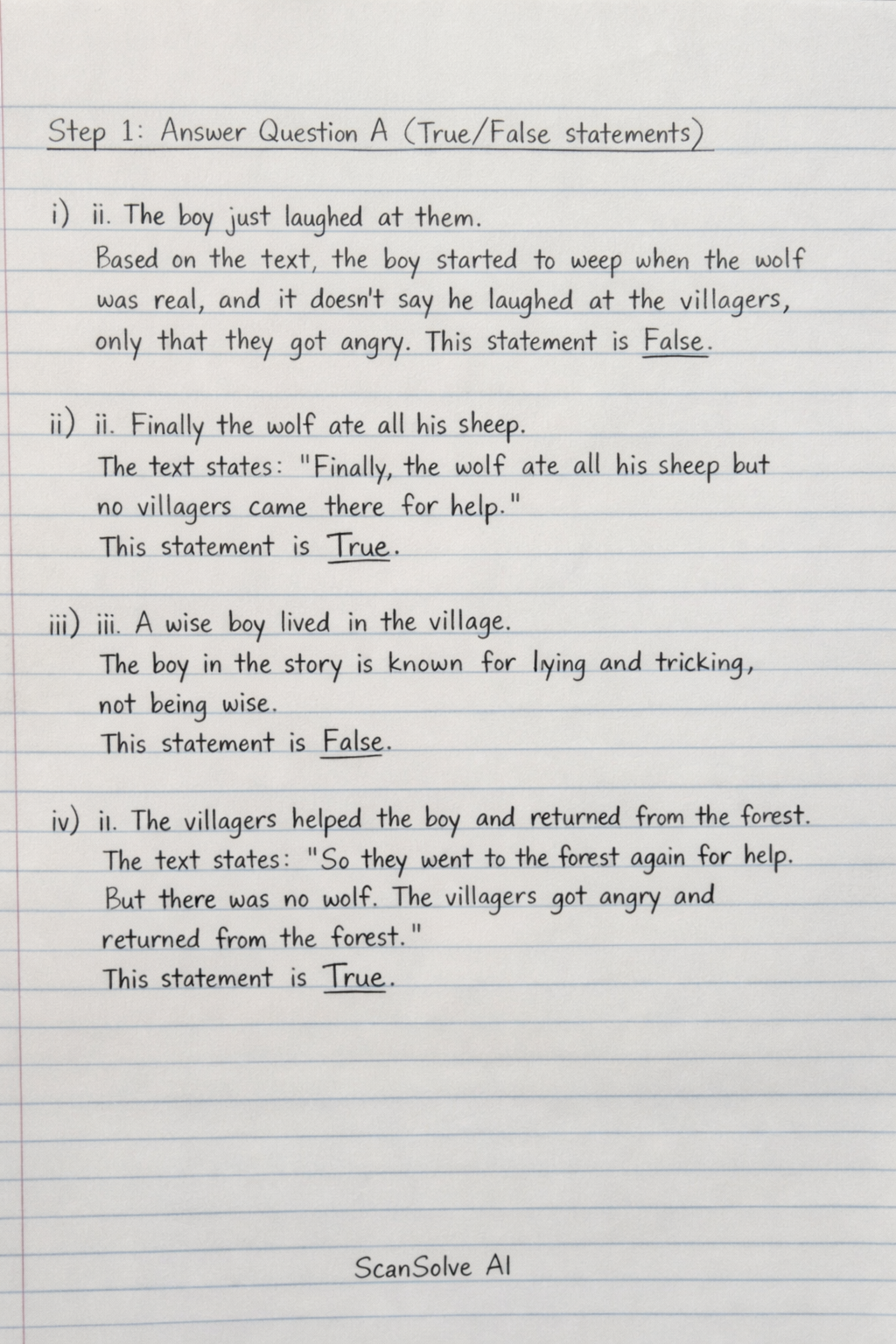
Step 1: Answer Question A (True/False statements). *i) The boy just laughed at them. Based on the provided text, the boy started to weep when the wolf was real, and the text doesn't explicitly state he laughed at the villagers when he tricked them, only that they got angry. So, this statement is False. *ii) Finally the wolf ate all his sheep. The text states: "Finally, the wolf ate all his sheep but no villagers came there for help." This statement is True. *iii) A wise boy lived in the village. The boy in the story is known for lying and tricking, which is not characteristic of a wise boy. This statement is False. *iv) The villagers helped the boy and returned from the forest. The text states: "So they went to the forest again for help. But there was no wolf. The villagers got angry and returned from the forest." This indicates they did go to help and returned. This statement is True. *v) Second time, the wolf really came. The text states: "At last, the wolf really came and started to eat his sheep." This implies the wolf came on the third occasion, not the second. This statement is False. Step 2: Answer Question B (Questions about the story). *i) Why did the boy take his sheep to the jungle? The provided text does not explicitly state why the boy took his sheep to the jungle. However, in the traditional fable, a shepherd boy takes his sheep to graze in the fields or forest. *ii) Why did the villagers become angry with the boy? The villagers became angry with the boy because he repeatedly tricked them by falsely shouting "Wolf!", causing them to come to his aid when there was no actual danger. *iii) Why did the boy start to weep? The boy started to weep because a real wolf had come and was eating his sheep, and no one was coming to help him. *iv) What did the villagers think when he shouted for help third time? When the boy shouted for help the third time, the villagers thought he was trying to fool them again, just like the previous times, and took no notice. *v) What is the moral of the story? The moral of the story is that nobody believes a liar, even when they tell the truth. Step 3: Answer Question 5 (Punctuate the following text). Original text: "once there lived a boy. his name was hari and he lived in bhaktapur. He didnt eat meat but he had kept animals at his home like sheep goat hens ducks etc" Punctuated text: "Once there lived a boy. His name was Hari, and he lived in Bhaktapur. He didn't eat meat, but he had kept animals at his home like sheep, goat, hens, ducks, etc." Step 4: Answer Question 6 (Write a readable story from the clues). Two friends were walking through a dense forest when they suddenly saw a bear. One friend quickly climbed a tree and hid. The other couldn't climb, so he remembered a school lesson that bears do not hunt dead men. He immediately pretended to be dead on the ground. The bear came and smelled him, then went away. The friend who had climbed the tree came down and asked what the bear had said to him. The friend on the ground replied, "The bear advised me to stay away from friends who abandon you in danger." The moral of the story is that a true friend is known in times of adversity.