
We read your photo as:
Define capacitance and state any two factors that affect capacitance.
ScanSolve AI Answer
Step-by-step solution
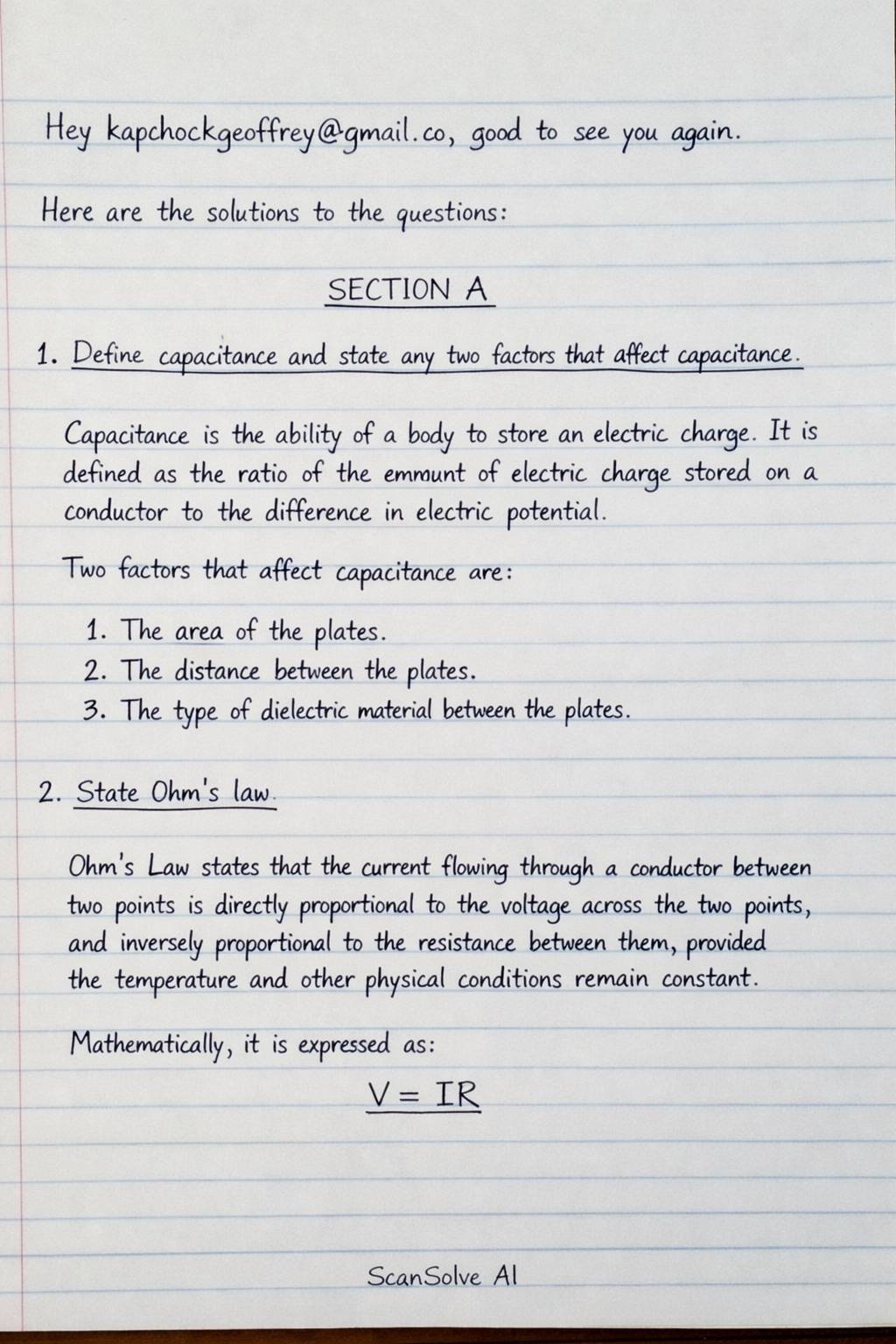
21 stepsHere are the solutions to the questions:
SECTION A
1. Define capacitance and state any two factors that affect capacitance.
Capacitance is the ability of a body to store an electric charge. It is defined as the ratio of the amount of electric charge stored on a conductor to the difference in electric potential.
Two factors that affect capacitance are:
- The area of the plates.
- The distance between the plates.
- The type of dielectric material between the plates.
2. State Ohm's law.
Ohm's Law states that the current flowing through a conductor between two points is directly proportional to the voltage across the two points, and inversely proportional to the resistance between them, provided the temperature and other physical conditions remain constant. Mathematically, it is expressed as .
3. Name at least four basic electrical quantities and state their SI units.
- Electric Current: Ampere (A)
- Voltage (Potential Difference): Volt (V)
- Resistance: Ohm ()
- Electric Charge: Coulomb (C)
- Electric Power: Watt (W)
4. State three effects of electric current.
- Heating effect: Electric current produces heat when it flows through a conductor (e.g., in an electric heater).
- Magnetic effect: Electric current produces a magnetic field around the conductor (e.g., in an electromagnet).
- Chemical effect: Electric current can cause chemical changes when passed through certain liquids (e.g., in electrolysis).
5. Find a force acting vertically downward on a mass of 200g attached to a wire. (g = 9.81 m/s^2)
- Given:
- Mass
- Acceleration due to gravity
Convert mass to kilograms.
Calculate the force (weight).
The force acting vertically downward is the weight, given by .
The force acting vertically downward is .
6. Show that total resistance in series is given by .
State the properties of a series circuit.
In a series circuit, the current () is the same through all resistors, and the total voltage () is the sum of the individual voltage drops across each resistor.
Apply Ohm's Law to each resistor.
According to Ohm's Law (), the voltage drop across each resistor is:
Substitute individual voltages into the total voltage equation.
Factor out the common current :
Apply Ohm's Law to the entire circuit.
For the entire circuit, , where is the total equivalent resistance.
Dividing both sides by gives:
Thus, the total resistance in a series circuit is the sum of the individual resistances.
7. A 100W electric light bulb is connected to a 250V supply. Determine:
-
a) The current flowing in the bulb.
-
b) The resistance of the bulb.
-
Given:
- Power
- Voltage
a) The current flowing in the bulb.
-
Use the power formula to find the current.
The current flowing in the bulb is .
b) The resistance of the bulb.
Use Ohm's Law to find the resistance.
Using the current calculated in part a):
The resistance of the bulb is .
8. a) Differentiate between resistance and conductance.
- Resistance: Resistance is the opposition to the flow of electric current in a circuit. Its SI unit is the Ohm ().
- Conductance: Conductance is a measure of how easily electric current flows through a material. It is the reciprocal of resistance. Its SI unit is the Siemens (S).
b) Find the total capacitance of 3µF, 6µF, and 12µF capacitors connected in series.
- Given:
Apply the formula for capacitors in series.
For capacitors in series, the reciprocal of the total capacitance () is the sum of the reciprocals of individual capacitances:
Find a common denominator and sum the fractions.
The common denominator for 3, 6, and 12 is 12.
Calculate the total capacitance.
The total capacitance is .
9. Two resistors are connected in series across a 50V supply and a current of 5A flows in the circuit. If one of the resistors is 4Ω. Determine:
-
i) The value of the another resistor.
-
ii) The Pd across the 4Ω resistor.
-
Given:
- Total voltage
- Total current (In a series circuit, )
- One resistor
i) The value of the another resistor.
-
Calculate the total resistance of the circuit.
Using Ohm's Law for the entire circuit:
Calculate the value of the second resistor.
For resistors in series, .
The value of the another resistor is .
ii) The Pd across the 4Ω resistor.
Calculate the voltage drop across the 4Ω resistor.
Using Ohm's Law for the 4Ω resistor ():
The potential difference (Pd) across the 4Ω resistor is .
10. State any two factors affecting resistance of the resistor.
- Length of the conductor: Resistance is directly proportional to the length.
- Cross-sectional area of the conductor: Resistance is inversely proportional to the cross-sectional area.
- Nature of the material: Different materials have different resistivities.
- Temperature: For most conductors, resistance increases with temperature.
SECTION B
1. (a) Portable machine requires a force 300N to move it. If it moved a distance of 400cm for a time of 200ms. Determine:
-
i) Work done by machine.
-
ii) Average power utilized.
-
Given:
- Force
- Distance
- Time
i) Work done by machine.
Convert distance to meters.
Calculate the work done.
The formula for work done is .
The work done by the machine is .
ii) Average power utilized.
Convert time to seconds.
Calculate the average power.
The formula for average power is .
The average power utilized is .
1. (b) An electric heater consumes 4.5 MJ when connected to 250V supply for 30 minutes. Determine:
-
i) Power rating of the heater.
-
ii) The current taken from the supply.
-
Given:
- Energy consumed
- Voltage
- Time
i) Power rating of the heater.
-
Convert energy to Joules and time to seconds.
Calculate the power rating.
The formula for power is .
The power rating of the heater is .
ii) The current taken from the supply.
Use the power formula to find the current.
The current taken from the supply is .
1. (c) Five resistors are connected as shown in the diagram below.
This part cannot be solved as the diagram showing the resistor connections is not visible in the provided image.
Still stuck on this one?
Ask a follow-up, and the answer starts from this question.
Handwritten Step-by-Step Solution
Get this as a handwritten image on WhatsApp — like a tutor wrote it for you.
Try on WhatsApp