

This physics problem tests your understanding of fundamental physical laws and their applications. The step-by-step solution below breaks down the problem using relevant equations and physical reasoning.
ScanSolve AI Answer
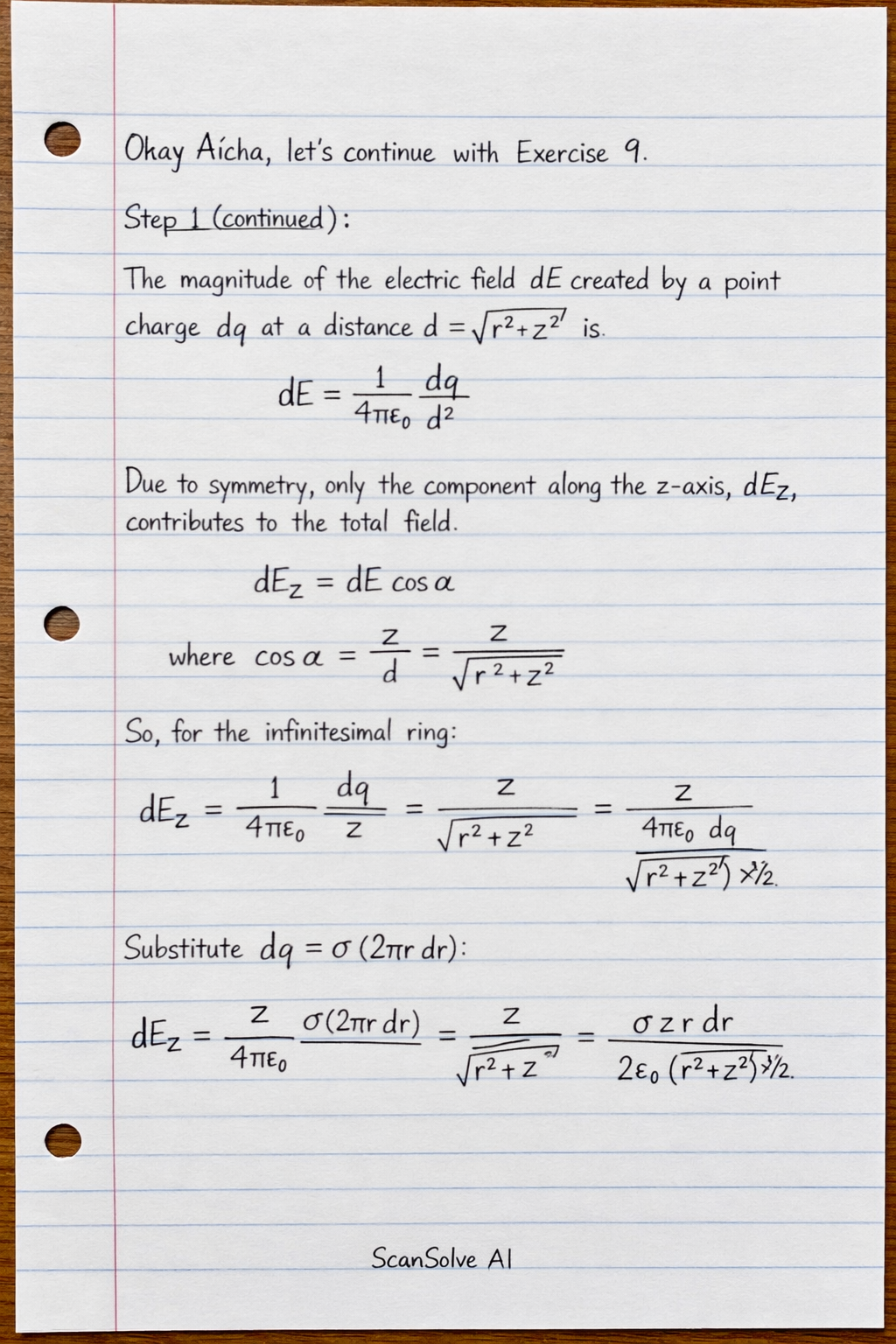
Okay, Aïcha, let's continue with Exercise 9. Step 1 (continued): The magnitude of the electric field dE created by a point charge dq at a distance d = sqrt(r^2 + z^2) is dE = (1)/(4_0) (dq)/(d^2). Due to symmetry, only the component along the z-axis, dE_z, contributes to the total field. dE_z = dE where = (z)/(d) = (z)/(sqrt(r^2 + z^2)). So, for the infinitesimal ring: dE_z = (1)/(4_0) (dq)/(r^2 + z^2) (z)/(sqrt(r^2 + z^2)) = (z)/(4_0) (dq)/((r^2 + z^2)^3/2) Substitute dq = (2 r dr): dE_z = (z)/(4_0) ( (2 r dr))/((r^2 + z^2)^3/2) = ( z r dr)/(2_0 (r^2 + z^2)^3/2) Step 2: Integrate dE_z over the entire disk from r=0 to r=R to find the total electric field E_z. E_z = _0^R ( z r dr)/(2_0 (r^2 + z^2)^3/2) Let u = r^2 + z^2. Then du = 2r dr, so r dr = (1)/(2) du. When r=0, u = z^2. When r=R, u = R^2 + z^2. E_z = _z^2^R^2 + z^2 ( z)/(2_0) (1)/(u^3/2) (1)/(2) du = ( z)/(4_0) _z^2^R^2 + z^2 u^-3/2 du Step 3: Evaluate the integral. E_z = ( z)/(4_0) [ u^-1/2-1/2 ]_z^2^R^2 + z^2 = ( z)/(4_0) [ (-2)/(sqrt(u)) ]_z^2^R^2 + z^2 E_z = ( z)/(4_0) ( (-2)/(sqrt(R^2 + z^2)) - (-2)/(sqrt(z^2)) ) E_z = ( z)/(4_0) ( (2)/(|z|) - (2)/(sqrt(R^2 + z^2)) ) Step 4: Simplify the expression. Assuming z > 0 (point M is on the positive z-axis), then |z|=z. E_z = ( z)/(4_0) ( (2)/(z) - (2)/(sqrt(R^2 + z^2)) ) E_z = ( z)/(2_0) ( (1)/(z) - (1)/(sqrt(R^2 + z^2)) ) E_z = ()/(2_0) ( 1 - (z)/(sqrt(R^2 + z^2)) ) The electric field vector is along the z-axis: E(z) = ()/(2_0) ( 1 - (z)/(sqrt(R^2 + z^2)) ) k