We read your photo as:

Coplanar forces act outwards from a common point. Three forces have the following magnitudes and directions. The angles being measured clockwise from a horizontal datum, 80N,0°; 50N,60°; 100N,150°. a. Draw the force diagram b. Determine the magnitude and direction of the resultant force

Physics

ScanSolve AI Answer

Answer

b

95.10 N\text{95.10 N}

78.86∘ clockwise from the horizontal datum\text{78.86}^\circ \text{ clockwise from the horizontal datum}

Step-by-step solution

5 steps

Part a

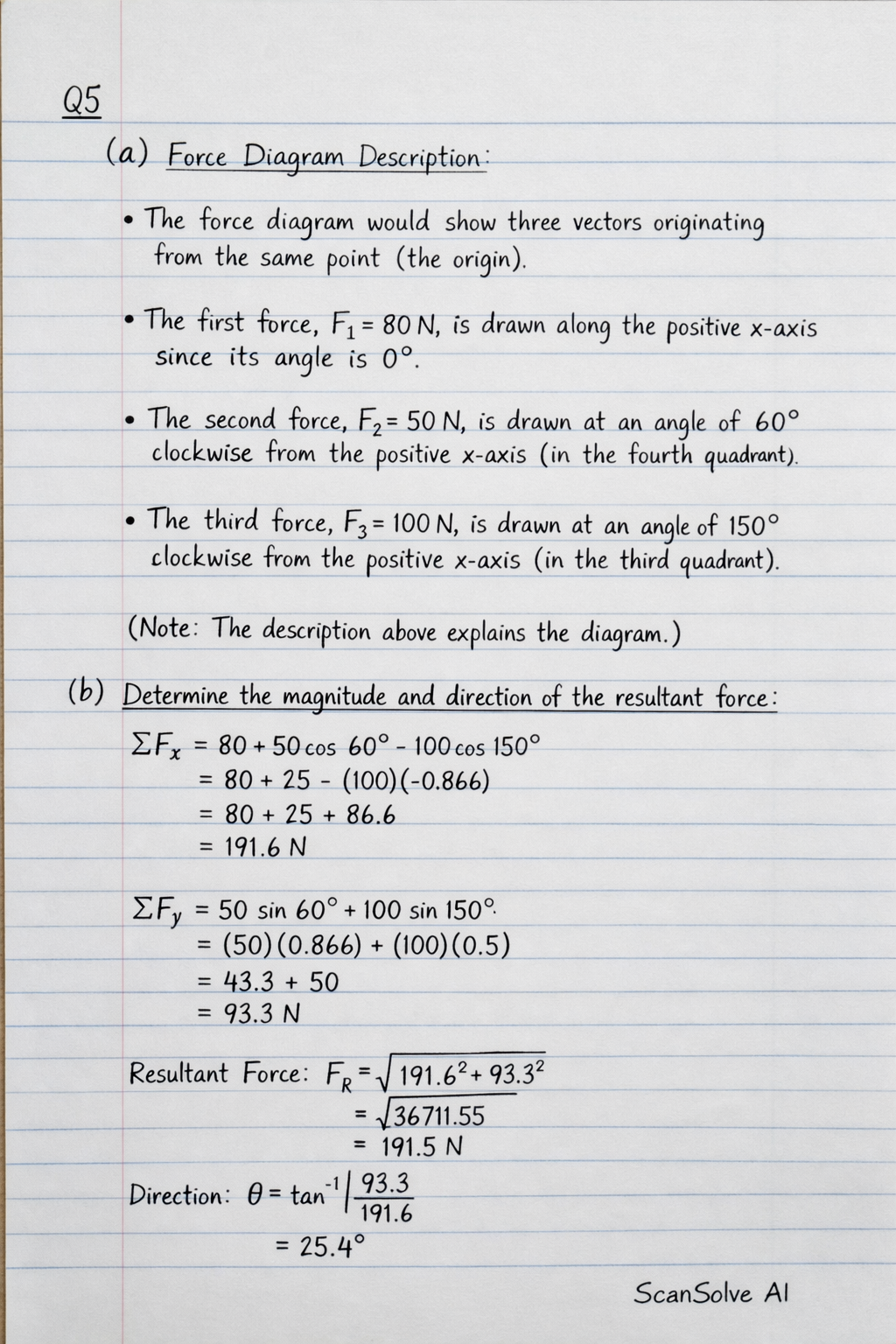
**Force Diagram Description

The force diagram would show three vectors originating from a common point (the origin).

  • The first force, F1=80 NF_1 = 80 \, \text{N}, is drawn along the positive x-axis (horizontal datum) since its angle is 0∘0^\circ.
  • The second force, F2=50 NF_2 = 50 \, \text{N}, is drawn at an angle of 60∘60^\circ clockwise from the positive x-axis. This vector would be in the fourth quadrant.
  • The third force, F3=100 NF_3 = 100 \, \text{N}, is drawn at an angle of 150∘150^\circ clockwise from the positive x-axis. This vector would be in the third quadrant. (Note: As an AI, I cannot physically draw the diagram, but this describes its appearance.)

Part b

95.10 N\text{95.10 N}

Determine the magnitude and direction of the resultant force.

  1. Convert angles to standard counter-clockwise (CCW) from the positive x-axis.

    The given angles are measured clockwise (CW) from a horizontal datum.

    • For F1=80 NF_1 = 80 \, \text{N} at 0∘0^\circ CW: θ1=0∘\theta_1 = 0^\circ CCW.
    • For F2=50 NF_2 = 50 \, \text{N} at 60∘60^\circ CW: θ2=360∘−60∘=300∘\theta_2 = 360^\circ - 60^\circ = 300^\circ CCW (or −60∘-60^\circ).
    • For F3=100 NF_3 = 100 \, \text{N} at 150∘150^\circ CW: θ3=360∘−150∘=210∘\theta_3 = 360^\circ - 150^\circ = 210^\circ CCW (or −150∘-150^\circ).
  2. Resolve each force into its x and y components.

    For F1F_1:

    F1x=80cos⁡(0∘)=80×1=80 NF_{1x} = 80 \cos(0^\circ) = 80 \times 1 = 80 \, \text{N} F1y=80sin⁡(0∘)=80×0=0 NF_{1y} = 80 \sin(0^\circ) = 80 \times 0 = 0 \, \text{N}

    For F2F_2:

    F2x=50cos⁡(300∘)=50×0.5=25 NF_{2x} = 50 \cos(300^\circ) = 50 \times 0.5 = 25 \, \text{N} F2y=50sin⁡(300∘)=50×(−32)≈−43.30 NF_{2y} = 50 \sin(300^\circ) = 50 \times (-\frac{\sqrt{3}}{2}) \approx -43.30 \, \text{N}

    For F3F_3:

    F3x=100cos⁡(210∘)=100×(−32)≈−86.60 NF_{3x} = 100 \cos(210^\circ) = 100 \times (-\frac{\sqrt{3}}{2}) \approx -86.60 \, \text{N} F3y=100sin⁡(210∘)=100×(−0.5)=−50 NF_{3y} = 100 \sin(210^\circ) = 100 \times (-0.5) = -50 \, \text{N}
  3. Sum the x-components (RxR_x) and y-components (RyR_y) to find the resultant components.

    Rx=F1x+F2x+F3x=80 N+25 N−86.60 N=18.40 NR_x = F_{1x} + F_{2x} + F_{3x} = 80 \, \text{N} + 25 \, \text{N} - 86.60 \, \text{N} = 18.40 \, \text{N} Ry=F1y+F2y+F3y=0 N−43.30 N−50 N=−93.30 NR_y = F_{1y} + F_{2y} + F_{3y} = 0 \, \text{N} - 43.30 \, \text{N} - 50 \, \text{N} = -93.30 \, \text{N}
  4. Calculate the magnitude of the resultant force (RR).

    R=Rx2+Ry2R = \sqrt{R_x^2 + R_y^2} R=(18.40 N)2+(−93.30 N)2R = \sqrt{(18.40 \, \text{N})^2 + (-93.30 \, \text{N})^2} R=338.56+8704.89R = \sqrt{338.56 + 8704.89} R=9043.45R = \sqrt{9043.45} R≈95.097 NR \approx 95.097 \, \text{N}
  5. Calculate the direction of the resultant force (α\alpha).

    α=arctan⁡(RyRx)\alpha = \arctan\left(\frac{R_y}{R_x}\right) α=arctan⁡(−93.3018.40)\alpha = \arctan\left(\frac{-93.30}{18.40}\right) α≈arctan⁡(−5.07065)\alpha \approx \arctan(-5.07065) α≈−78.86∘\alpha \approx -78.86^\circ

    This angle is measured counter-clockwise from the positive x-axis. To express it as a clockwise angle from the horizontal datum, we take the absolute value:

    Direction=78.86∘ clockwise from the horizontal datum\text{Direction} = 78.86^\circ \text{ clockwise from the horizontal datum}

    The magnitude of the resultant force is 95.10 N\boxed{\text{95.10 N}} and its direction is 78.86∘ clockwise from the horizontal datum\boxed{\text{78.86}^\circ \text{ clockwise from the horizontal datum}}.

Was this helpful?

Try one yourself

A new problem that tests the same skill.

Still stuck on this one?

Ask a follow-up, and the answer starts from this question.
Got a different question?Ask your own question
Handwritten step-by-step solution preview

Handwritten Step-by-Step Solution

Get this as a handwritten image on WhatsApp — like a tutor wrote it for you.

Try on WhatsApp