
We read your photo as:
Given: Initial velocity u = 0 m/s, acceleration a = 5 m/s2, final velocity v = 25 m/s.
ScanSolve AI Answer
Answers
2 partsStep-by-step solution
7 stepsPart a· 4 steps
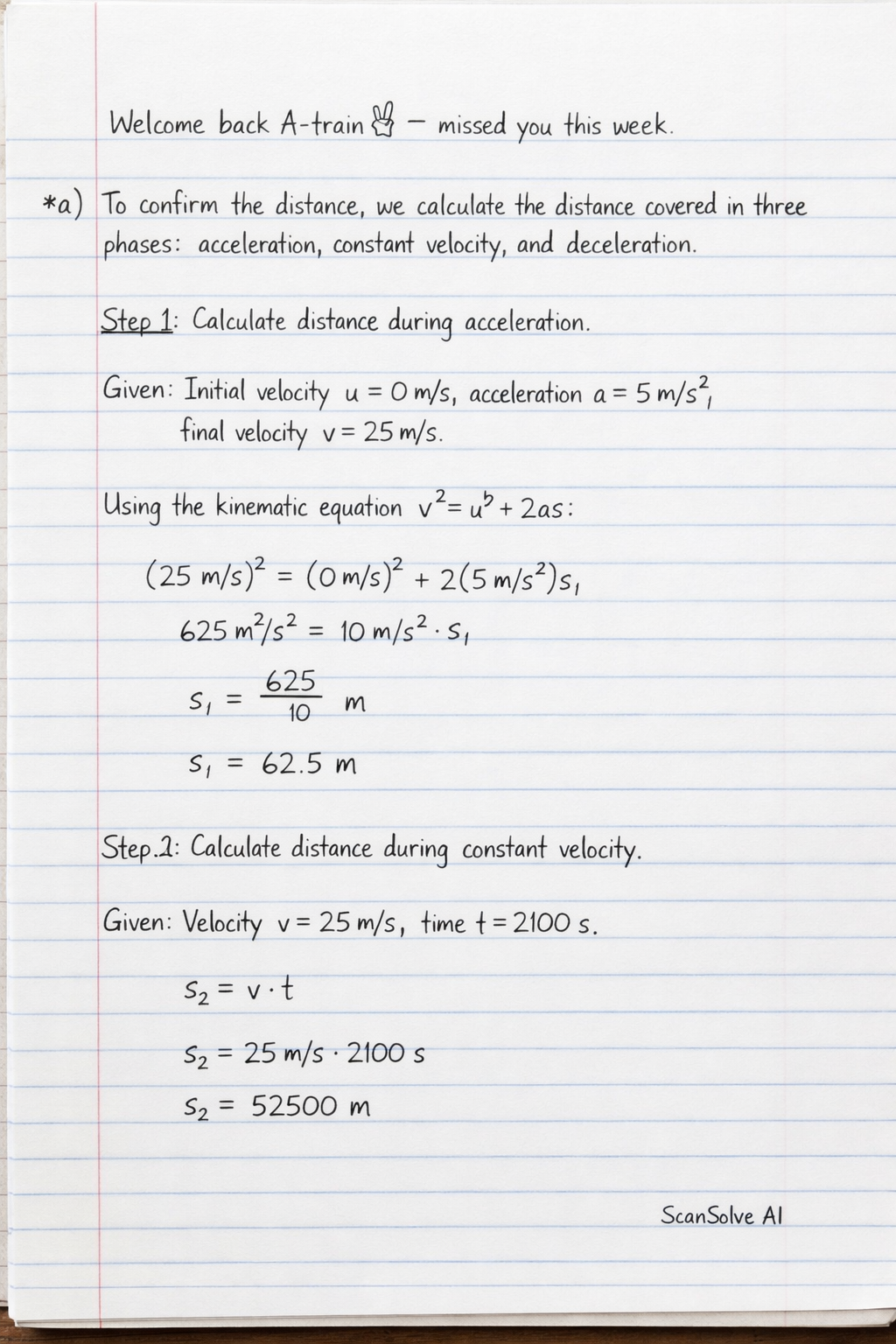
To confirm the distance, we calculate the distance covered in three phases: acceleration, constant velocity, and deceleration.
Calculate distance during acceleration.
Given: Initial velocity , acceleration , final velocity .
Using the kinematic equation :Calculate distance during constant velocity.
Given: Velocity , time .
Calculate distance during deceleration.
Given: Initial velocity , final velocity , time .
Using the kinematic equation :Calculate total distance and convert to kilometers.
Total distance :
Convert meters to kilometers:
The distance from the village to the town is indeed .
Part b
Find the cost of fuel needed for a round trip.
Calculate the total distance for the round trip.
Distance one way = .
Total distance = .
Convert to meters: .Calculate the total fuel consumed.
Fuel consumption rate = per .
Calculate the total cost of fuel.
Cost per litre = .
The cost of fuel needed is .
c) A hydraulic brake system works based on Pascal's principle, which states that pressure applied to an enclosed fluid is transmitted undiminished to every portion of the fluid and the walls of the containing vessel.
An illustration would show:
- A brake pedal connected to a master cylinder containing brake fluid.
- Brake lines extending from the master cylinder to slave cylinders located at each wheel.
- Each slave cylinder has pistons that push brake pads against a brake disc (or brake shoes against a drum).
When the driver presses the brake pedal, a piston in the master cylinder pushes the brake fluid, creating pressure. This pressure is transmitted equally through the brake lines to the slave cylinders at the wheels. The pistons in the slave cylinders are forced outwards, pressing the brake pads against the rotating brake disc. The resulting friction slows down and stops the wheel.
d) The tyre was hot due to the conversion of kinetic energy into heat energy during braking. When the brakes are applied, friction occurs between the brake pads and the brake discs (or shoes and drums). This friction generates a significant amount of heat. This heat is then transferred to the wheel components, including the rims and, subsequently, the tyres through conduction and convection. Additionally, if there was any skidding or hard braking, direct friction between the tyres and the road surface would also generate heat in the tyres.
Try one yourself
A new problem that tests the same skill.
Still stuck on this one?
Ask a follow-up, and the answer starts from this question.
More Physics Questions
Handwritten Step-by-Step Solution
Get this as a handwritten image on WhatsApp — like a tutor wrote it for you.
Try on WhatsApp