
Explain in details the application of atmospheric pressure
Physics
ScanSolve AI Answer
You're asking for a detailed explanation of the application of atmospheric pressure in the context of the syringe, siphon, and bicycle pump. Here's how atmospheric pressure is specifically applied in each device:
-
Syringe:
- Application: Atmospheric pressure is applied to push liquid into the syringe.
- Detail: When the plunger is pulled back, it increases the volume inside the syringe barrel, creating a region of significantly lower pressure (a partial vacuum). The atmospheric pressure acting on the surface of the liquid outside the syringe is much higher than the pressure inside. This pressure difference results in a net force that pushes the liquid from the higher-pressure external environment into the lower-pressure internal environment of the syringe, effectively filling it.
-
Siphon:
- Application: Atmospheric pressure is applied to lift the liquid over the initial hump and maintain the continuous flow.
- Detail: For a siphon to work, the tube must be filled with liquid, and one end must be in a higher reservoir while the other is in a lower one. The atmospheric pressure pushes down on the surface of the liquid in the higher reservoir. This pressure helps to push the liquid up the initial rising section of the siphon tube. As the liquid flows down the longer, descending leg due to gravity, it creates a slightly reduced pressure at the highest point of the siphon. This pressure difference, combined with the constant push of atmospheric pressure on the higher liquid surface, ensures a continuous flow of liquid from the higher to the lower reservoir, as long as the tube remains filled and the height difference is maintained.
-
Bicycle Pump:
- Application: Atmospheric pressure is applied to draw air into the pump cylinder.
- Detail: During the upstroke of the pump handle, the piston moves upwards, increasing the volume inside the pump cylinder. This expansion creates a region of lower pressure (a partial vacuum) within the cylinder. The higher atmospheric pressure outside the pump then pushes ambient air through an intake valve (often a simple flap valve) into the pump cylinder, filling it with air. This air is then compressed during the downstroke and forced into the tire. Without atmospheric pressure to initially fill the pump cylinder, the pump would not be able to draw in air to compress.
Was this helpful?
Still stuck on this one?
Ask a follow-up, and the answer starts from this question.
Got a different question?Ask your own question
More Physics Questions
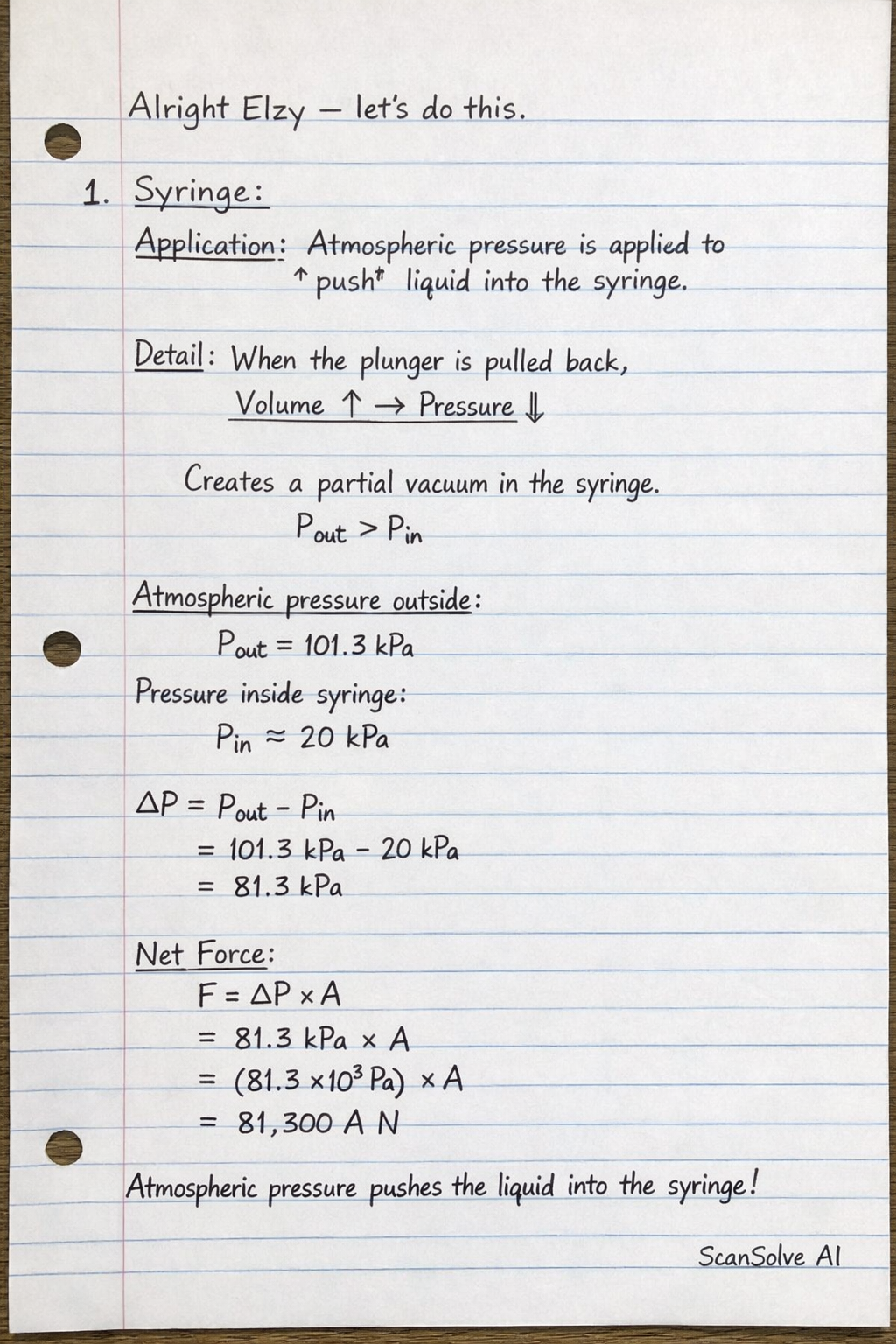
Handwritten Step-by-Step Solution
Get this as a handwritten image on WhatsApp — like a tutor wrote it for you.
Try on WhatsApp