

This physics problem tests your understanding of fundamental physical laws and their applications. The step-by-step solution below breaks down the problem using relevant equations and physical reasoning.
ScanSolve AI Answer
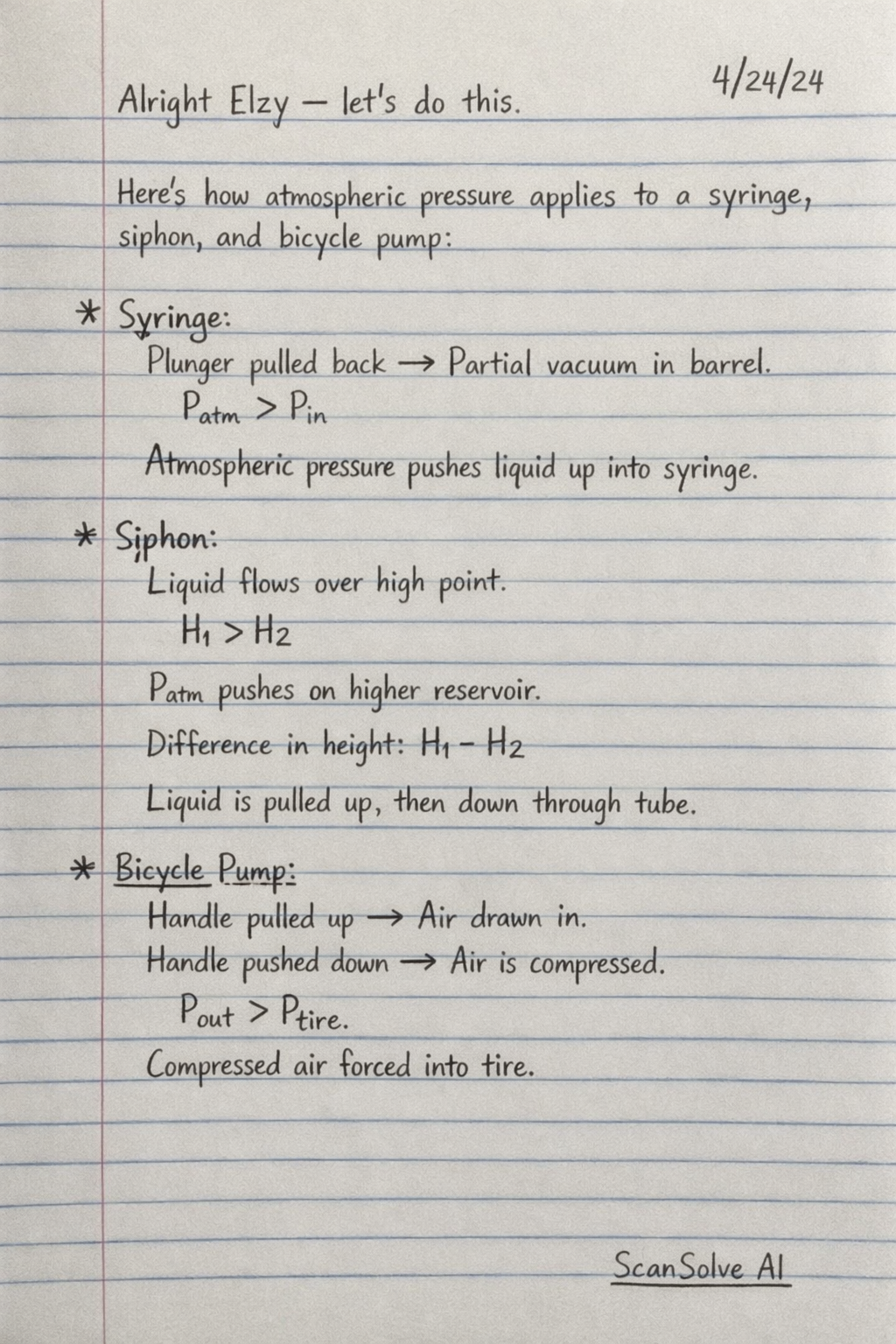
Alright Elzy — let's do this. Here's how atmospheric pressure applies to a syringe, siphon, and bicycle pump: Syringe: When the plunger of a syringe is pulled back, it creates a partial vacuum (low-pressure area) inside the barrel. The higher atmospheric pressure* outside then pushes the liquid up into the syringe to fill this low-pressure space. Siphon: A siphon works by creating a continuous column of liquid that is initially pulled over a high point. The difference in height between the liquid surfaces at the start and end, combined with atmospheric pressure* pushing down on the liquid in the higher reservoir, forces the liquid to flow upwards and then downwards through the tube. Bicycle Pump: When the handle of a bicycle pump is pulled up, air is drawn into the pump cylinder due to atmospheric pressure*. When the handle is pushed down, the air inside is compressed, and this compressed air is then forced into the bicycle tire, overcoming the pressure already inside the tire. Drop the next question.