

This geography problem is solved step by step below, with detailed explanations to help you understand the method and arrive at the correct answer.
ScanSolve AI Answer
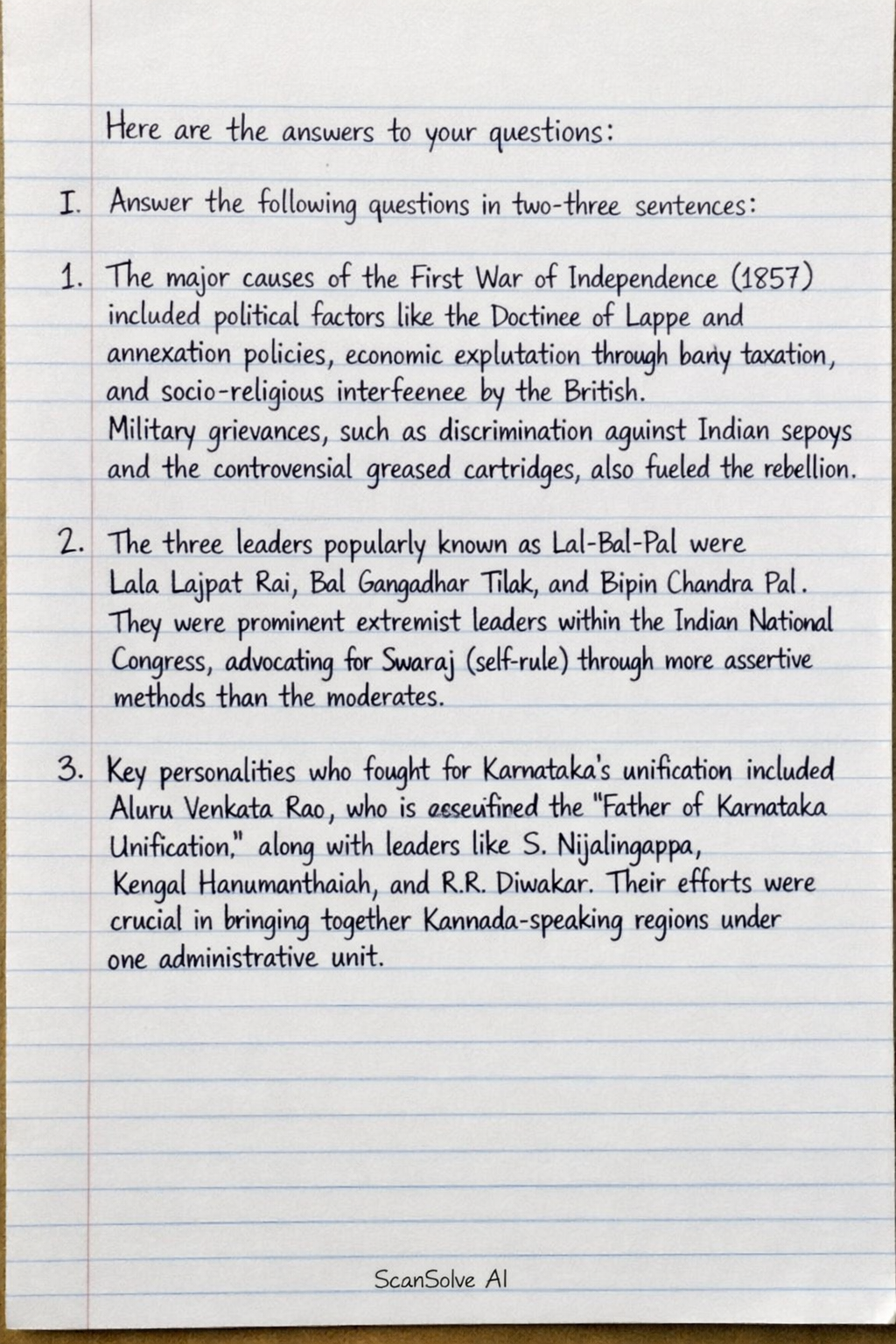
Here are the answers to your questions: I. Answer the following questions in two-three sentences: 1. The major causes of the First War of Independence (1857) included political factors like the Doctrine of Lapse and annexation policies, economic exploitation through heavy taxation, and socio-religious interference by the British. Military grievances, such as discrimination against Indian sepoys and the controversial greased cartridges, also fueled the rebellion. 2. The three leaders popularly known as Lal-Bal-Pal were Lala Lajpat Rai, Bal Gangadhar Tilak, and Bipin Chandra Pal. They were prominent extremist leaders within the Indian National Congress, advocating for Swaraj (self-rule) through more assertive methods than the moderates. 3. Key personalities who fought for Karnataka's unification included Aluru Venkata Rao, who is considered the "Father of Karnataka Unification," along with leaders like S. Nijalingappa, Kengal Hanumanthaiah, and R.R. Diwakar. Their efforts were crucial in bringing together Kannada-speaking regions under one administrative unit. 4. Australia is often called the "flat land" because it has a relatively low average elevation compared to other continents. A significant portion of its landmass consists of vast plains, plateaus, and deserts with minimal topographic variation, lacking major mountain ranges like those found on other continents. 5. Major environmental movements include the Chipko Movement, which focused on forest conservation in the Himalayas, and the Appiko Movement, a similar tree-hugging movement in Karnataka. The Narmada Bachao Andolan protested against large dam projects, while the Silent Valley Movement aimed to protect a rainforest in Kerala. 6. The three major groups of mass media are print media (e.g., newspapers, magazines), electronic media (e.g., radio, television), and digital or new media (e.g., internet, social media platforms). These categories represent different technologies and platforms used to disseminate information to a large audience. 7. The primary responsibilities of the defence forces are to protect the nation's sovereignty and territorial integrity from external aggression. They are also tasked with maintaining internal security, responding to natural disasters, and participating in international peacekeeping missions when required. 8. Issues that cause disharmony between India and Pakistan primarily revolve around the Kashmir dispute, which has led to multiple conflicts. Other significant factors include cross-border terrorism, disputes over water sharing, and historical grievances stemming from the partition of British India. 9. Specialized service agencies of the United Nations include the World Health Organization (WHO), the United Nations Educational, Scientific and Cultural Organization (UNESCO), and the United Nations Children's Fund (UNICEF). Others include the International Labour Organization (ILO) and the World Bank Group. 10. The flora of Antarctica is extremely limited due to its harsh, icy environment. It primarily consists of non-vascular plants such as various species of mosses and lichens. Only two native flowering plants, Antarctic hair grass and Antarctic pearlwort, are found on the Antarctic Peninsula. IV. Answer the following questions in 5 to 6 sentences each (Any Two): 1. Major industries in Karnataka: Karnataka is a leading industrial state in India, with a diverse economic base. The Information Technology (IT) and Biotechnology sectors are particularly prominent, with Bengaluru often referred to as the "Silicon Valley of India" due to its numerous IT companies, startups, and research institutions. The state also has a significant presence in the aerospace and defence industry, housing major public sector undertakings like Hindustan Aeronautics Limited (HAL) and the Indian Space Research Organisation (ISRO). Other important industries include textiles and garments, automobiles, and mining, particularly for iron ore and manganese. 2. Short note on Subhas Chandra Bose: Subhas Chandra Bose was a charismatic and influential Indian nationalist leader who played a crucial role in India's independence movement. Initially a prominent figure in the Indian National Congress, he twice served as its president but later diverged from Mahatma Gandhi's non-violent approach. During World War II, he sought support from the Axis powers, famously escaping house arrest to organize the Indian National Army (INA), also known as Azad Hind Fauj, with the aim of liberating India through armed struggle. His rallying cry, "Give me blood, and I will give you freedom," inspired thousands, and his daring efforts made him a legendary figure in Indian history. 3. Contribution of Sir Syed Ahmad Khan in reforming the Muslim community: Sir Syed Ahmad Khan was a visionary Muslim reformer and educationist who played a pivotal role in the intellectual and social upliftment of the Muslim community in British India. He strongly advocated for modern education, believing it was essential for Muslims to overcome their backwardness and participate effectively in contemporary society. His most significant contribution was the establishment of the Mohammedan Anglo-Oriental College in Aligarh in 1875, which later became the Aligarh Muslim University. This institution aimed to combine Western scientific education with Islamic teachings, fostering a rational and progressive outlook among Muslims and encouraging them to pursue government service and professional careers. V. Draw an outline map of India and locate the places given below: I am unable to draw maps.