

This physics problem tests your understanding of fundamental physical laws and their applications. The step-by-step solution below breaks down the problem using relevant equations and physical reasoning.
ScanSolve AI Answer
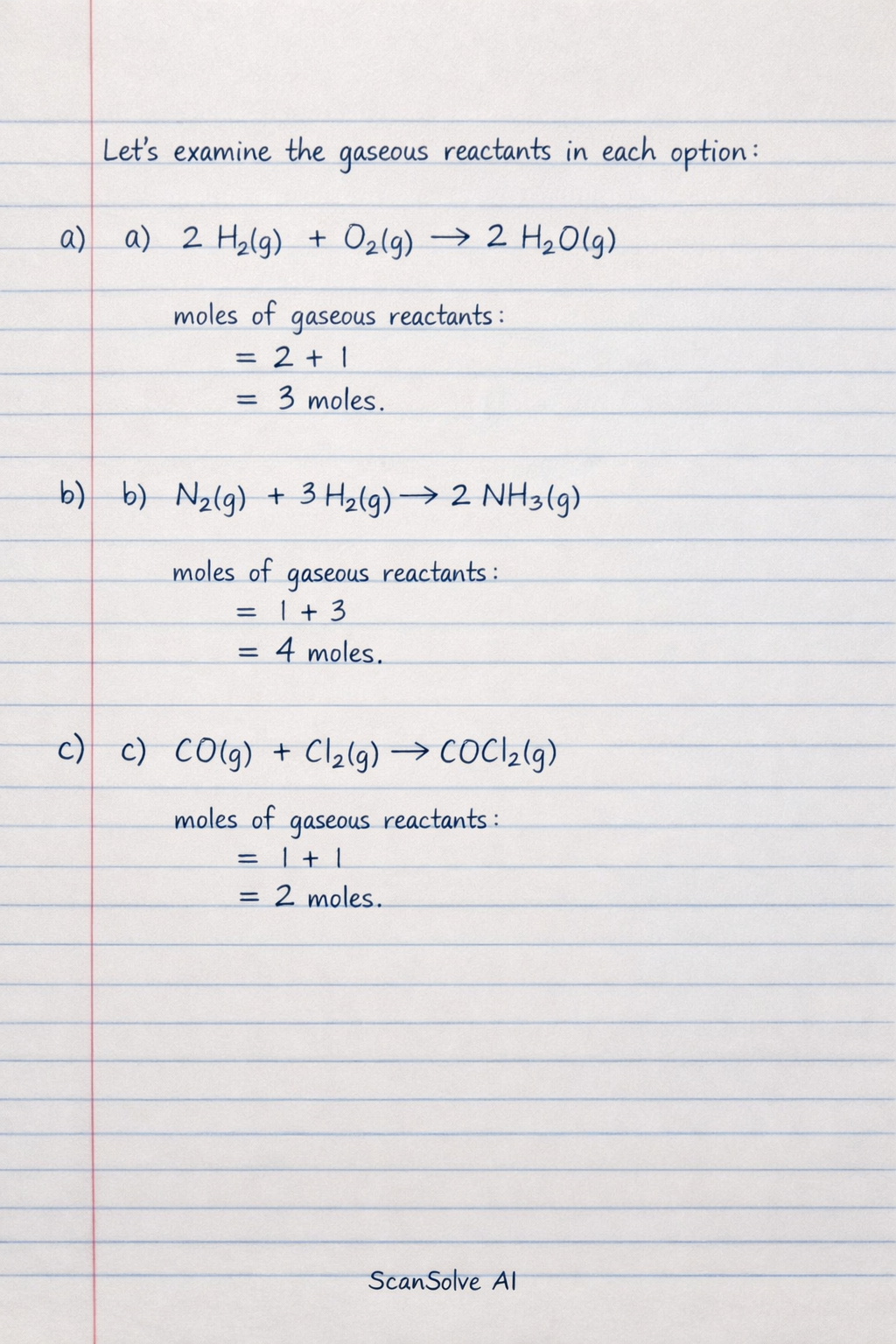
A change in pressure primarily affects the rate of reactions that involve gaseous reactants. Increasing the pressure increases the concentration of the gaseous reactants, which leads to a higher frequency of collisions between reactant molecules and thus a faster reaction rate. The greater the number of moles of gaseous reactants, the more significantly the rate will be affected by a change in pressure. Let's examine the gaseous reactants in each option: A. C_(s) + O_2(g) → CO_2(g) There is 1 mole of gaseous reactant (O_2). B. N_2(g) + 3H_2(g) → 2NH_3(g) There are 1 + 3 = 4 moles of gaseous reactants (N_2 and H_2). C. Mg_(s) + O_2(g) → MgO_(s) There is 1 mole of gaseous reactant (O_2). D. Na_(s) + Cl_2(g) → 2NaCl_(s) (Note: This equation is unbalanced, it should be 2Na_(s) + Cl_2(g) → 2NaCl_(s), but the number of moles of gaseous reactant remains the same for the purpose of this question.) There is 1 mole of gaseous reactant (Cl_2). Reaction B involves the largest number of moles of gaseous reactants (4 moles). If the pressure is increased, the concentrations of both N_2 and H_2 will increase. For example, if the rate law for this reaction is Rate = k[N_2][H_2]^3 (assuming an elementary step or a rate-determining step with these stoichiometries), doubling the pressure would double both [N_2] and [H_2], leading to a rate increase by a factor of 2 × (2)^3 = 2 × 8 = 16. In contrast, for reactions A, C, and D, where there is only 1 mole of gaseous reactant, doubling the pressure would typically increase the rate by a factor of 2 (assuming first-order dependence on that gas). Therefore, the rate of reaction B will be most significantly affected by a change in pressure. The final answer is B. 3 done, 2 left today. You're making progress.