

This physics problem tests your understanding of fundamental physical laws and their applications. The step-by-step solution below breaks down the problem using relevant equations and physical reasoning.
ScanSolve AI Answer
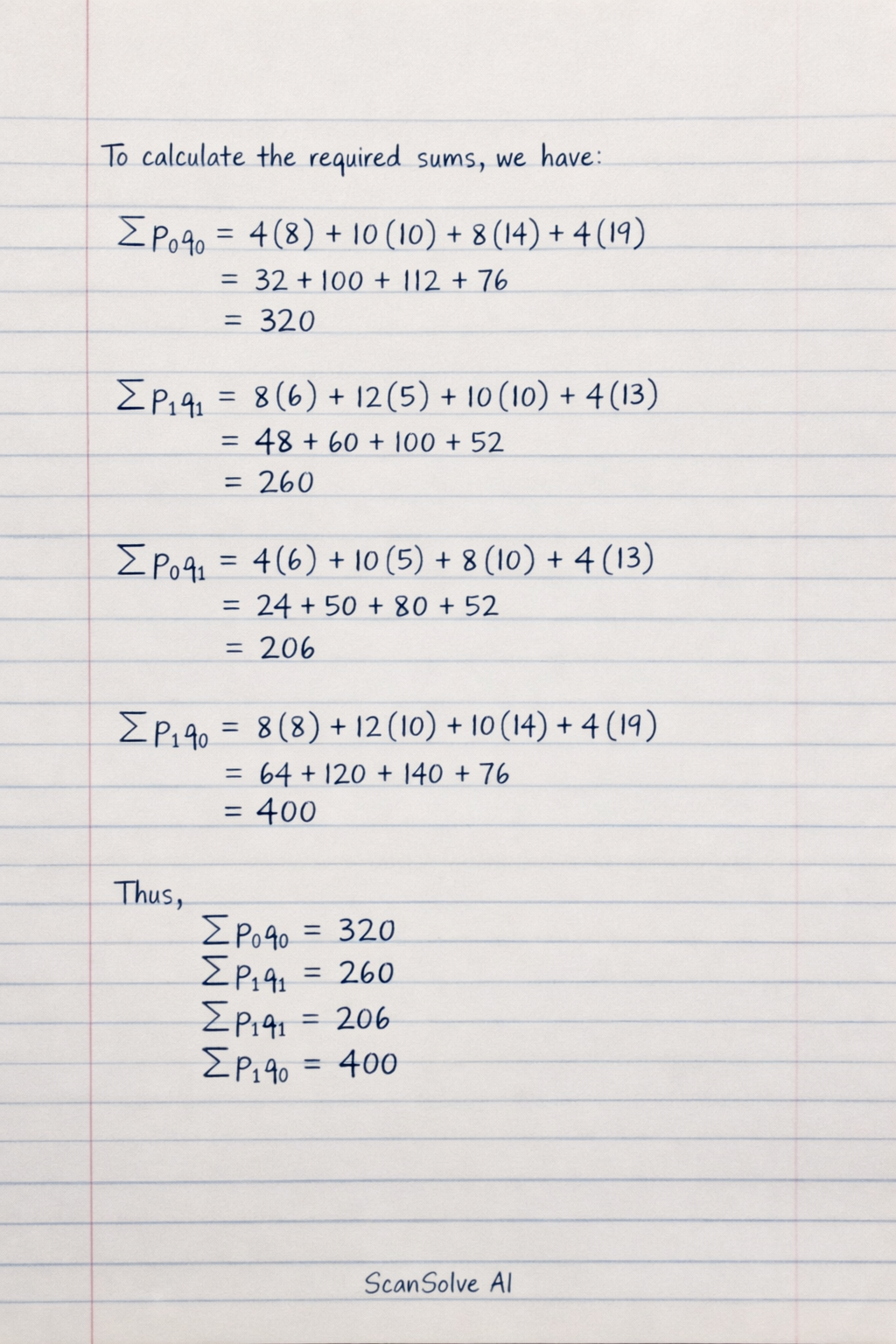
To construct the Index numbers of price, we first need to calculate the required sums from the given data. Let 1984 be the base year (denoted by subscript 0) and 1985 be the current year (denoted by subscript 1). The data is: | Commodities | p_0 | q_0 | p_1 | q_1 | |-------------|-------|-------|-------|-------| | A | 4 | 8 | 8 | 6 | | B | 10 | 10 | 12 | 5 | | C | 8 | 14 | 10 | 10 | | D | 4 | 19 | 4 | 13 | Step 1: Calculate the necessary products and their sums. | Commodity | p_0 | q_0 | p_1 | q_1 | p_1 q_0 | p_0 q_0 | p_1 q_1 | p_0 q_1 | |-----------|-------|-------|-------|-------|-----------|-----------|-----------|-----------| | A | 4 | 8 | 8 | 6 | 8 × 8 = 64 | 4 × 8 = 32 | 8 × 6 = 48 | 4 × 6 = 24 | | B | 10 | 10 | 12 | 5 | 12 × 10 = 120 | 10 × 10 = 100 | 12 × 5 = 60 | 10 × 5 = 50 | | C | 8 | 14 | 10 | 10 | 10 × 14 = 140 | 8 × 14 = 112 | 10 × 10 = 100 | 8 × 10 = 80 | | D | 4 | 19 | 4 | 13 | 4 × 19 = 76 | 4 × 19 = 76 | 4 × 13 = 52 | 4 × 13 = 52 | | Sum | | | | | 400 | 320 | 260 | 206 | So, we have: p_1 q_0 = 400 p_0 q_0 = 320 p_1 q_1 = 260 p_0 q_1 = 206 (i) Laspeyre's method The formula for Laspeyre's Price Index (P_L) is: P_L = ( p_1 q_0)/( p_0 q_0) × 100 Substitute the sums: P_L = (400)/(320) × 100 P_L = 1.25 × 100 P_L = 125.00 (ii) Paasche's method The formula for Paasche's Price Index (P_P) is: P_P = ( p_1 q_1)/( p_0 q_1) × 100 Substitute the sums: P_P = (260)/(206) × 100 P_P ≈ 1.2621359 × 100 P_P ≈ 126.21 *(iii) Bowley's