
We read your photo as:
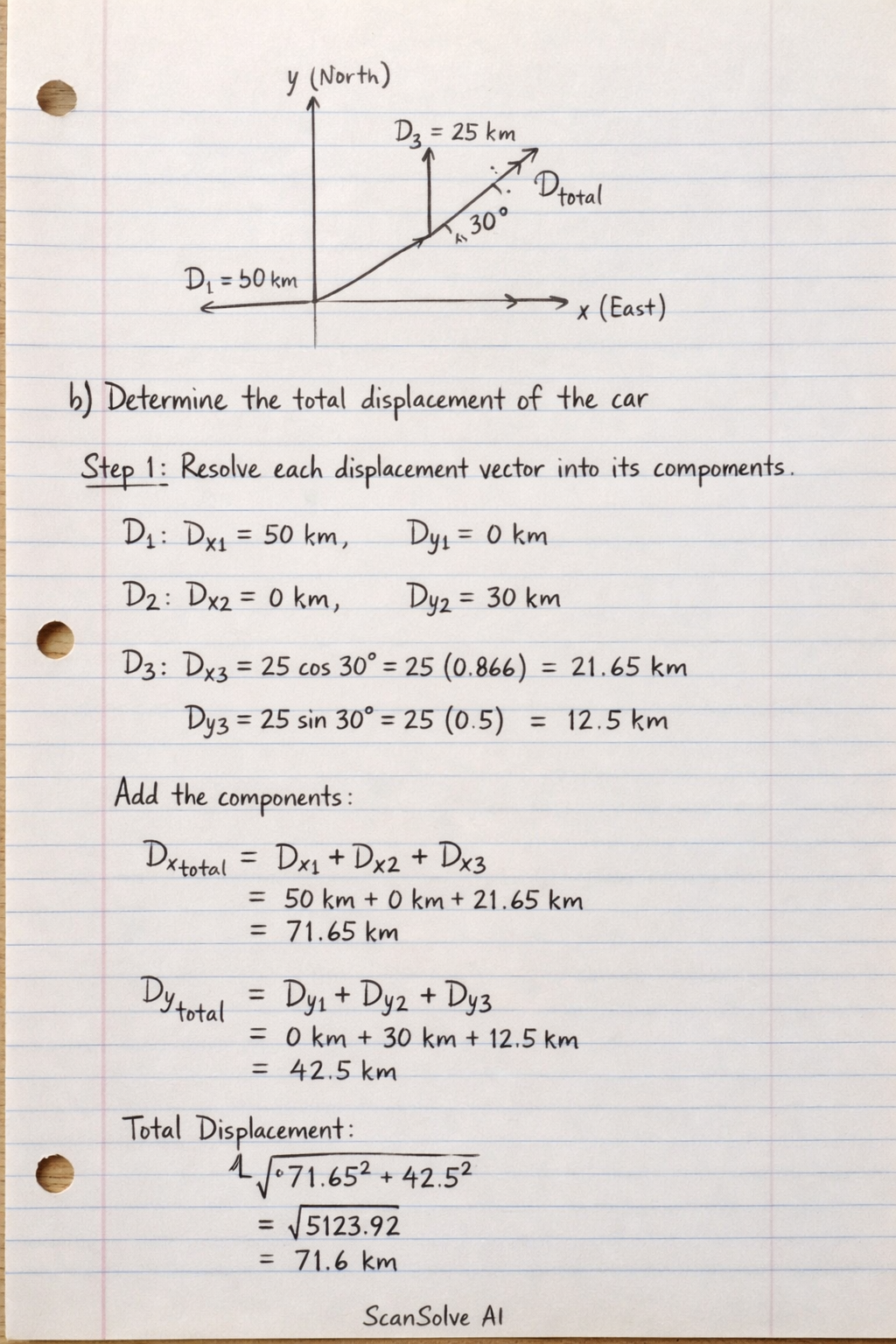
It looks like you've already started sketching the vector diagram in your image, which is a great start! Your sketch correctly shows the three displacement vectors and the resultant total displacement
ScanSolve AI Answer
Answer
Step-by-step solution
4 stepsIt looks like you've already started sketching the vector diagram in your image, which is a great start! Your sketch correctly shows the three displacement vectors and the resultant total displacement.
Here's a detailed breakdown of the solution:
Part a
Sketch the vector diagram
Your sketch accurately represents the three displacement vectors:
- A vector of 50 km pointing East (along the positive x-axis).
- A vector of 30 km pointing North (along the positive y-axis), starting from the end of .
- A vector of 25 km at East of North, starting from the end of . This means the angle is measured from the North axis towards the East.
- The resultant total displacement vector, , drawn from the origin (start of ) to the end of .
Part b
Determine the total displacement of the car
Resolve each displacement vector into its East (x) and North (y) components.
Let East be the positive x-direction and North be the positive y-direction.
For :
For :
For :
The angle is with respect to the North axis.Sum the x-components and y-components to find the total displacement components.
Total East displacement ():
Total North displacement ():
Calculate the magnitude of the total displacement.
The magnitude is found using the Pythagorean theorem:
Calculate the direction of the total displacement.
The direction is found using the arctangent function, measured from the East axis towards the North:
Since both and are positive, the direction is North of East.
The total displacement of the car is .
Try one yourself
A new problem that tests the same skill.
Still stuck on this one?
Ask a follow-up, and the answer starts from this question.
More Physics Questions
Handwritten Step-by-Step Solution
Get this as a handwritten image on WhatsApp — like a tutor wrote it for you.
Try on WhatsApp