
📌 CHEMISTRY WAEC 2026 OBJECTIVE - QUESTIONS & ANSWERS --- SECTION A: BASIC CONCEPTS & ATOMIC STRUCTURE Which of the following particles has the smallest mass? A. Proton B. Neutron C. Electron D. Alpha particle ✅ ANSWER: C (Electron mass = 9.11 × 10⁻³¹ kg, much smaller than proton/neutron) The number of protons in an atom of ²⁷₁₃Al is: A. 13 B. 14 C. 27 D. 40 ✅ ANSWER: A (Atomic number = number of protons = 13) Isotopes of an element have the same number of: A. Neutrons B. Protons C. Nucleons D. Mass number ✅ ANSWER: B (Isotopes have same atomic number but different mass numbers) The maximum number of electrons in the M shell is: A. 2 B. 8 C. 18 D. 32 ✅ ANSWER: C (M shell = n=3, capacity = 2n² = 18) Which of the following is a d-block element? A. Sodium B. Chlorine C. Iron D. Calcium ✅ ANSWER: C (Iron is transition metal in d-block) The electronic configuration 1s² 2s² 2p⁶ 3s² 3p⁴ represents: A. Oxygen B. Sulphur C. Chlorine D. Argon ✅ ANSWER: B (Atomic number 16 = Sulphur) Which scientist proposed the planetary model of the atom? A. John Dalton B. J.J. Thomson C. Ernest Rutherford D. Niels Bohr ✅ ANSWER: D (Bohr model has electrons in fixed orbits) The atomic number of an element is the number of: A. Neutrons in the nucleus B. Protons in the nucleus C. Nucleons in the nucleus D. Electrons in the outermost shell ✅ ANSWER: B (Atomic number = number of protons) Which of the following orbitals is spherical in shape? A. s B. p C. d D. f ✅ ANSWER: A (s-orbitals are spherical) The relative atomic mass of chlorine is 35.5 because: A. It has 35 protons and 35.5 neutrons B. It has 35.5 protons C. It is an average of isotopes Cl-35 and Cl-37 D. It contains 17.5 neutrons ✅ ANSWER: C (Chlorine has isotopes ³⁵Cl and ³⁷Cl in 3:1 ratio) --- SECTION B: PERIODIC TABLE & PERIODICITY Which of the following elements has the highest electronegativity? A. Chlorine B. Fluorine C. Oxygen D. Nitrogen ✅ ANSWER: B (Fluorine has highest electronegativity = 4.0) Atomic radius across a period: A. Increases B. Decreases C. Remains constant D. Increases then decreases ✅ ANSWER: B (Increased nuclear pull reduces atomic radius) Which group contains the halogens? A. Group 1 B. Group 2 C. Group 7 D. Group 8 ✅ ANSWER: C (Group 7 elements: F, Cl, Br, I, At) Which of the following is NOT a property of alkali metals? A. Low melting point B. High electronegativity C. React vigorously with water D. Form basic oxides ✅ ANSWER: B (Alkali metals have low electronegativity) The most reactive non-metal in group 7 is: A. Iodine B. Bromine C. Chlorine D. Fluorine ✅ ANSWER: D (Reactivity decreases down group 7) Elements in the same group have the same number of: A. Electron shells B. Valence electrons C. Neutrons D. Protons ✅ ANSWER: B (Same group = same valence electron configuration) Which period contains the first transition series? A. Period 2 B. Period 3 C. Period 4 D. Period 5 ✅ ANSWER: C (Period 4: Sc to Zn)a The oxide of which element is amphoteric? A. Sodium B. Magnesium C. Aluminium D. Silicon ✅ ANSWER: C (Al₂O₃ reacts with both acids and bases) REACT, SHARE AND FORWARD TO EVERYONE ❤️🔥
Physics
ScanSolve AI Answer
Answer
C
Ernest Rutherford
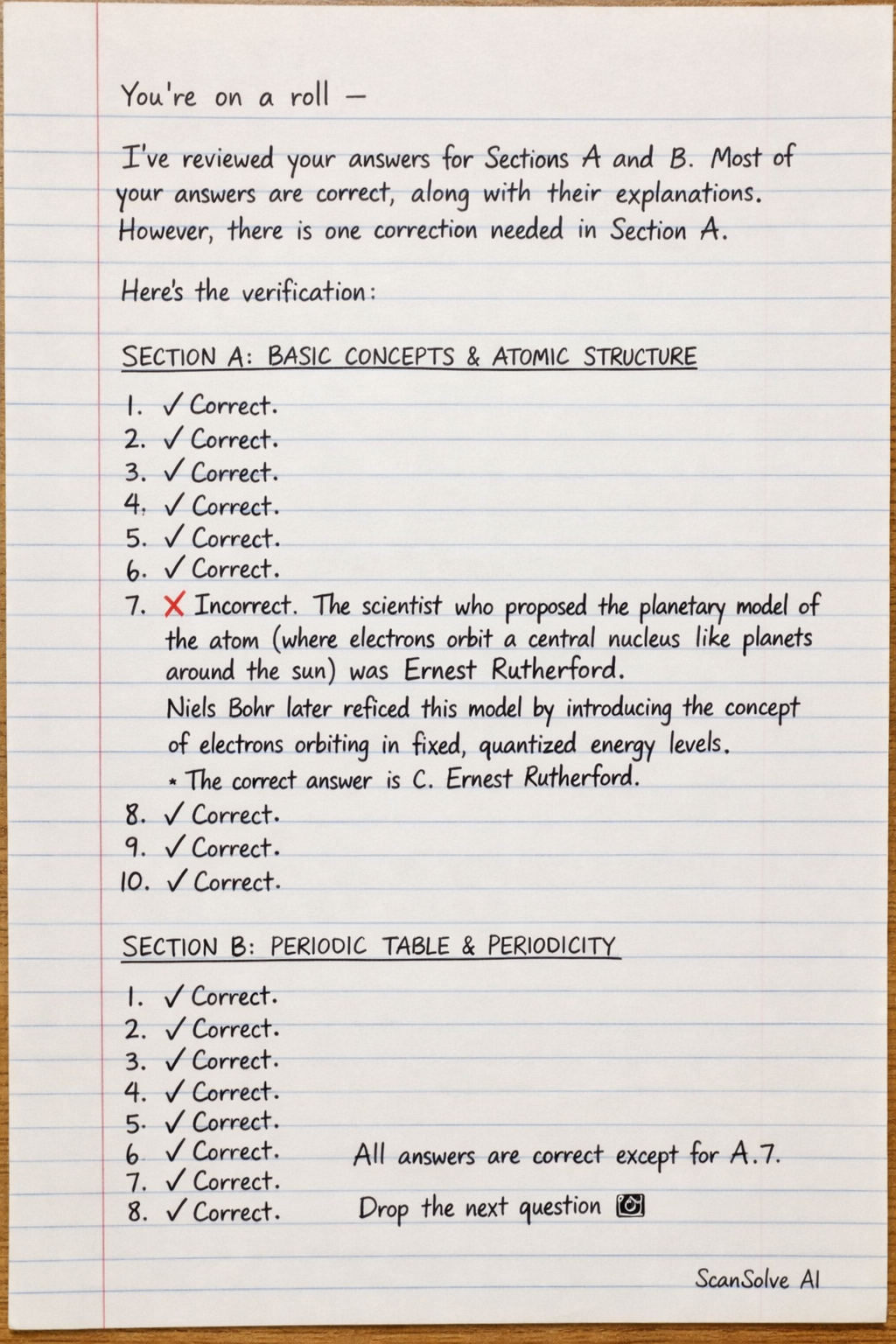
I've reviewed your answers for Sections A and B. Most of your answers are correct, along with their explanations. However, there is one correction needed in Section A.
Here's the verification:
SECTION A: BASIC CONCEPTS & ATOMIC STRUCTURE
- ✅ Correct.
- ✅ Correct.
- ✅ Correct.
- ✅ Correct.
- ✅ Correct.
- ✅ Correct.
- ❌ Incorrect. The scientist who proposed the planetary model of the atom (where electrons orbit a central nucleus like planets around the sun) was Ernest Rutherford. Niels Bohr later refined this model by introducing the concept of electrons orbiting in fixed, quantized energy levels.
- The correct answer is C. Ernest Rutherford.
- ✅ Correct.
- ✅ Correct.
- ✅ Correct.
SECTION B: PERIODIC TABLE & PERIODICITY
- ✅ Correct.
- ✅ Correct.
- ✅ Correct.
- ✅ Correct.
- ✅ Correct.
- ✅ Correct.
- ✅ Correct.
- ✅ Correct.
All answers are correct except for A.7.
Was this helpful?
Try one yourself
A new problem that tests the same skill.
Still stuck on this one?
Ask a follow-up, and the answer starts from this question.
Got a different question?Ask your own question
More Physics Questions
QChemistry Jamb questions 1. Which particle determines the identity of an element? A. Neutron B…QAbsolutely. Here are 30 objective questions suitable for a Year 6/7 learner, covering physical and…QJune 2026 50 O-Level Chemistry MCQs The number of protons in an atom is called its A. Mass number B…QJAMB MOCK CHEMISTRY QUESTIONS: 1. H₂S(g) + Cl₂(g) → 2HCl(g) + S(s) - the oxidizing agent is? A. S B…Q10 𝗝𝗔𝗠𝗕 𝗖𝗛𝗘𝗠𝗜𝗦𝗧𝗥𝗬 𝗣𝗔𝗦𝗧 𝗤𝗨𝗘𝗦𝗧𝗜𝗢𝗡𝗦 — 𝘊𝘈𝘕 𝘠𝘖𝘜 𝘚𝘊𝘖𝘙𝘌 8/10? React…
Handwritten Step-by-Step Solution
Get this as a handwritten image on WhatsApp — like a tutor wrote it for you.
Try on WhatsApp