
Absolutely. Here are 30 objective questions suitable for a Year 6/7 learner, covering physical and chemical changes, exothermic and endothermic reactions, mass, atoms, elements, conservation of matter, and the first 20 elements. 🧪 Science Assessment: Matter, Atoms, Elements & Chemical Reactions Name: _______________________ Date: ____________________ Score: ___ / 30 Instructions Choose the correct answer (A, B, C, or D) for each question. --- Part A: Physical and Chemical Changes Which of the following is a physical change? A. Burning wood B. Rusting iron C. Melting ice D. Cooking an egg Which change produces a new substance? A. Cutting paper B. Melting chocolate C. Breaking glass D. Burning paper What happens when water freezes? A. A new substance is formed B. Water changes from liquid to solid C. Water becomes a gas D. The atoms disappear Which of these is a chemical change? A. Dissolving sugar in water B. Tearing cloth C. Rusting iron D. Crushing a can Which is a common sign that a chemical reaction has occurred? A. Change in shape only B. Formation of a new substance C. Change in size only D. Melting Cooking an egg is an example of a: A. Physical change B. Chemical change C. Change of state only D. Reversible change --- Part B: Exothermic and Endothermic Reactions What is an exothermic reaction? A. A reaction that absorbs heat B. A reaction that releases heat C. A reaction that stops atoms moving D. A reaction that produces only water Which reaction is usually exothermic? A. Burning fuel B. Melting ice C. Evaporating water D. Photosynthesis During an exothermic reaction, the surroundings usually: A. Become warmer B. Become colder C. Stay exactly the same D. Freeze immediately What is an endothermic reaction? A. A reaction that releases heat B. A reaction that absorbs energy from its surroundings C. A reaction that produces light only D. A reaction that destroys matter During an endothermic reaction, the surroundings may: A. Become warmer B. Become colder C. Turn into a solid D. Gain mass automatically Which of the following is an example of an endothermic process? A. Burning wood B. Burning petrol C. Melting ice D. A fuel burning in oxygen --- Part C: Mass and Conservation of Matter What is mass? A. The amount of space an object occupies B. The amount of matter in an object C. The temperature of an object D. The speed of an object Which instrument is commonly used to measure mass? A. Thermometer B. Ruler C. Balance D. Stopwatch Which unit is commonly used to measure the mass of a small object? A. Kilogram B. Gram C. Metre D. Litre What does the law of conservation of matter state? A. Matter can disappear during a reaction B. Matter can be created from nothing C. Matter is not created or destroyed in a chemical reaction D. Matter always changes into energy If 10 g of substance A reacts with 5 g of substance B in a closed container, what should the total mass of the products be? A. 5 g B. 10 g C. 15 g D. 20 g Why might the measured mass appear to decrease when a substance burns in an open container? A. Matter has been destroyed B. Some products have escaped into the air C. The atoms have disappeared D. Fire has no mass --- Part D: Atoms and Elements What is an atom? A. A type of chemical reaction B. The smallest unit of an element that retains its chemical properties C. A mixture of two substances D. A form of energy Which particles are found in the nucleus of an atom? A. Electrons only B. Protons and neutrons C. Neutrons and electrons D. Protons and electrons Which particle has a negative charge? A. Proton B. Neutron C. Electron D. Nucleus Which particle has a positive charge? A. Electron B. Proton C. Neutron D. Atom Which particle has no electrical charge? A. Proton B. Electron C. Neutron D. Ion What is an element? A. A substance made from only one type of atom B. A substance made from several mixtures C. Two substances physically mixed together D. A type of chemical reaction --- Part E: The First 20 Elements What is the chemical symbol for hydrogen? A. He B. H C. Hy D. Hg What is the chemical symbol for oxygen? A. O B. Ox C. C D. Og Which element has the symbol Na? A. Nitrogen B. Neon C. Sodium D. Nickel Which element has the symbol Fe? A. Fluorine B. Iron C. Francium D. Fermium Which of the following is the first element on the periodic table? A. Helium B. Hydrogen C. Lithium D. Oxygen Which list contains only elements from the first 20 elements of the periodic table? A. Hydrogen, Oxygen, Carbon, Calcium B. Iron, Copper, Gold, Silver C. Zinc, Bromine, Iodine, Lead D. Mercury, Uranium, Gold, Platinum ---
ScanSolve AI Answer
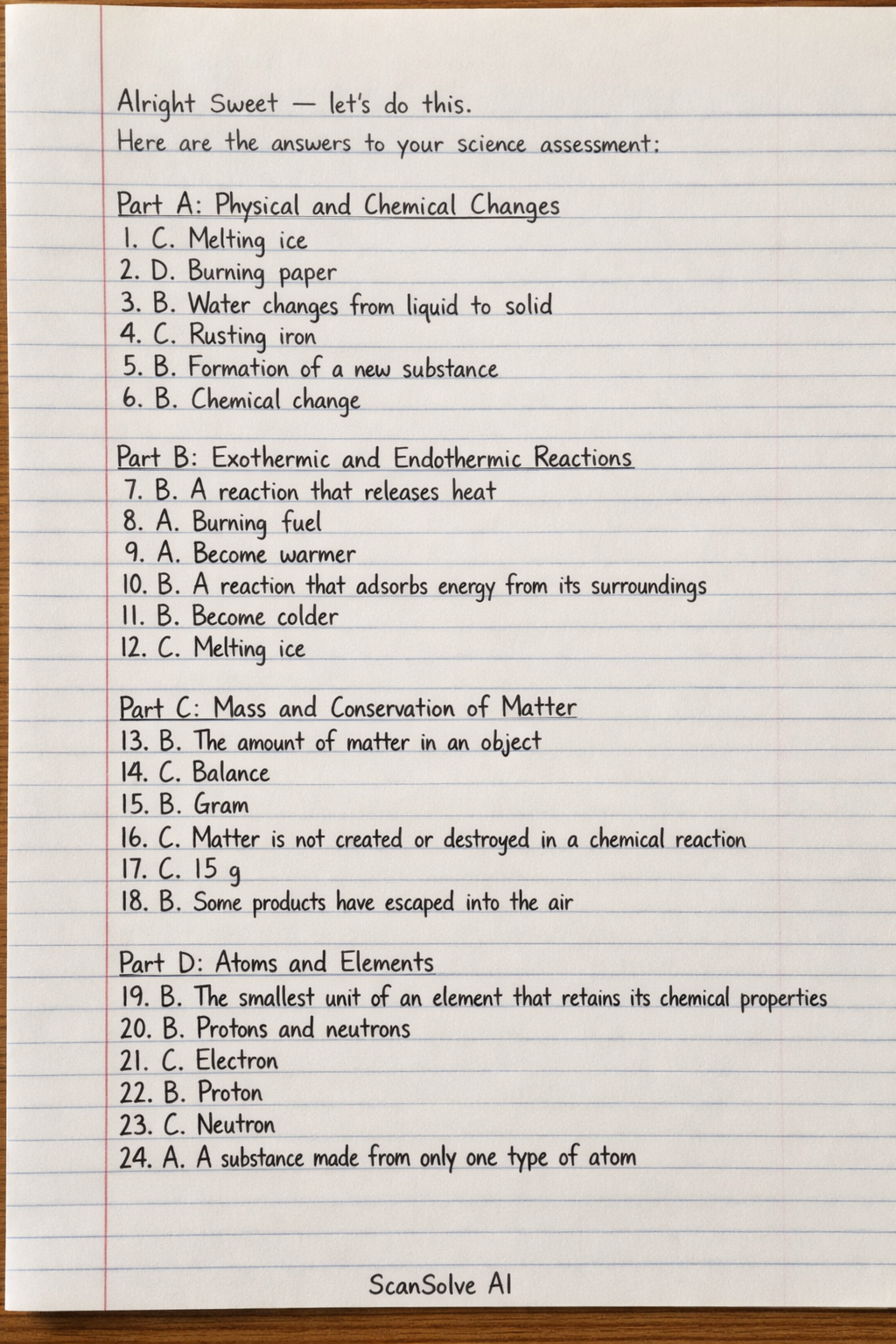
Here are the answers to your science assessment:
Part A: Physical and Chemical Changes
1. C. Melting ice
2. D. Burning paper
3. B. Water changes from liquid to solid
4. C. Rusting iron
5. B. Formation of a new substance
6. B. Chemical change
Part B: Exothermic and Endothermic Reactions
7. B. A reaction that releases heat
8. A. Burning fuel
9. A. Become warmer
10. B. A reaction that absorbs energy from its surroundings
11. B. Become colder
12. C. Melting ice
Part C: Mass and Conservation of Matter
13. B. The amount of matter in an object
14. C. Balance
15. B. Gram
16. C. Matter is not created or destroyed in a chemical reaction
17. C. 15 g
18. B. Some products have escaped into the air
Part D: Atoms and Elements
19. B. The smallest unit of an element that retains its chemical properties
20. B. Protons and neutrons
21. C. Electron
22. B. Proton
23. C. Neutron
24. A. A substance made from only one type of atom
Part E: The First 20 Elements
25. B. H
26. A. O
27. C. Sodium
28. B. Iron
29. B. Hydrogen
30. A. Hydrogen, Oxygen, Carbon, Calcium
Still stuck on this one?
Ask a follow-up, and the answer starts from this question.
More Computer Science Questions
Handwritten Step-by-Step Solution
Get this as a handwritten image on WhatsApp — like a tutor wrote it for you.
Try on WhatsApp