
We read your photo as:
What are the answers to these multiple-choice questions about elements, molecules, radioactivity, chemical changes, and the periodic table?
ScanSolve AI Answer
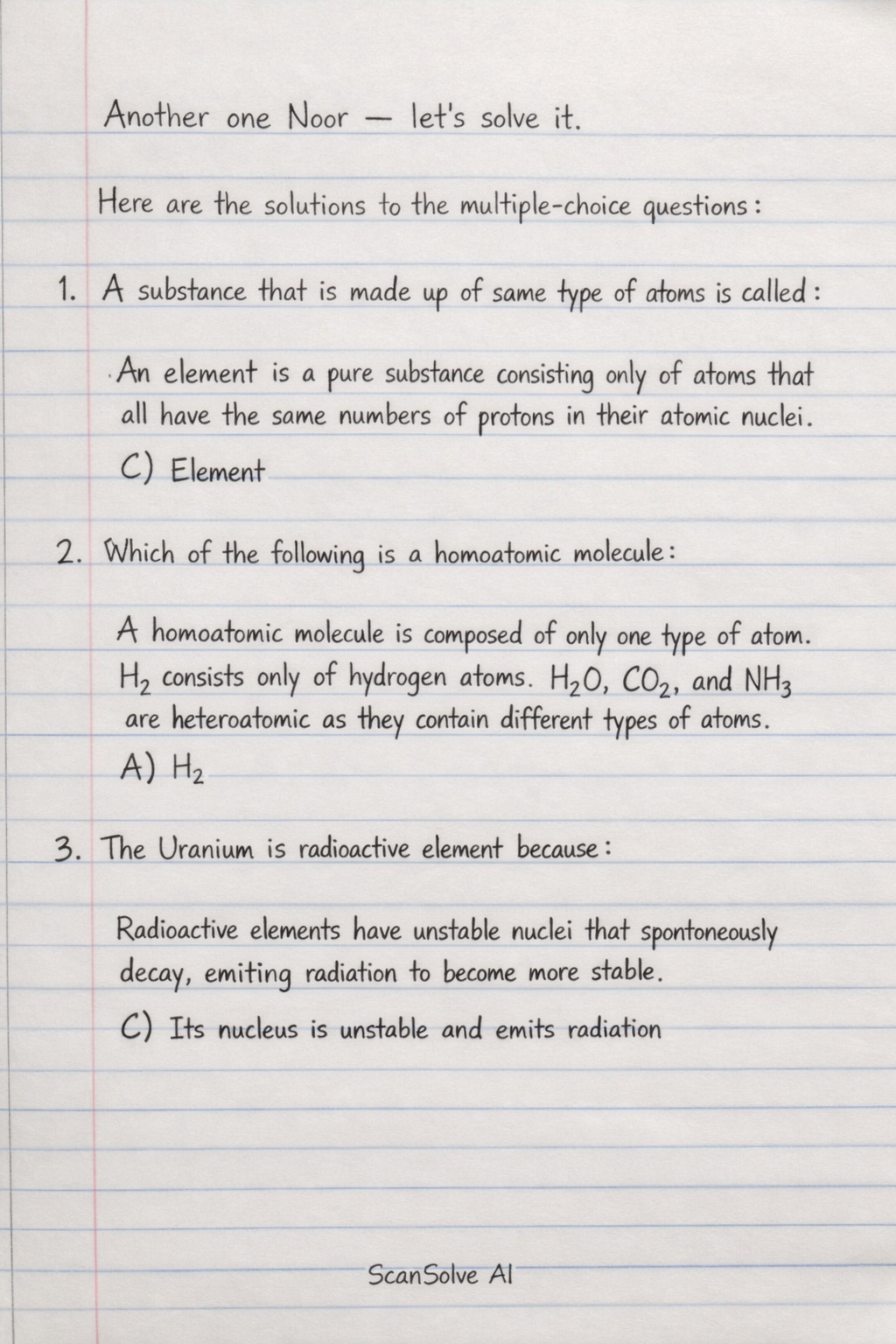
Here are the solutions to the multiple-choice questions:
-
A substance that is made up of same type of atoms is called:
- An element is a pure substance consisting only of atoms that all have the same numbers of protons in their atomic nuclei.
- C) Element
-
Which of the following is a homoatomic molecule?
- A homoatomic molecule is composed of only one type of atom. consists only of hydrogen atoms. , , and are heteroatomic as they contain different types of atoms.
- A)
-
The Uranium is radioactive element because:
- Radioactive elements have unstable nuclei that spontaneously decay, emitting radiation to become more stable.
- C) It nucleus is unstable and emits radiation
-
Which of the following is a chemical change:
- Rusting of iron is a chemical change where iron reacts with oxygen and water to form iron oxides (rust), creating new substances. Melting, dissolving, and boiling are physical changes as they do not alter the chemical composition.
- B) Rusting of iron
-
The demarcation of periodic table has been divided in to:
- The periodic table is divided into four main blocks based on the electron configuration of the elements: s-block, p-block, d-block, and f-block.
- D) Four blocks
-
An alloy is that homogenous mixture of:
- An alloy is a homogeneous mixture of two or more metals, or a metal and a non-metal, where the components are uniformly distributed.
- D) Two solids
-
The formula that indicates actual number and type of atoms in a molecule is called:
- A molecular formula shows the exact number of atoms of each element in a molecule.
- C) Molecular formula
-
Name the material of screen which is used in Rutherford atomic model:
- In Rutherford's gold foil experiment, a zinc sulfide () screen was used to detect the scattered alpha particles, as fluoresces when struck by alpha particles.
- B) Zinc Sulphide
-
Bond formed by mutual sharing of electrons is:
- A covalent bond is formed when two atoms share one or more pairs of electrons to achieve a stable electron configuration.
- C) Covalent bond
-
The density of gases increases when it's:
- Density is mass per unit volume (). For a fixed mass of gas, increasing pressure compresses the gas, reducing its volume and thus increasing its density. Decreasing temperature also reduces volume (at constant pressure), increasing density.
- A) Pressure increased
-
A saturated solution of on heating becomes:
- When a saturated solution is heated, its solubility generally increases, meaning it can dissolve more solute. Therefore, a saturated solution on heating becomes unsaturated as it can now accommodate more solute.
- A) Unsaturated
-
What is the particle size in suspension?
- Suspensions are heterogeneous mixtures with large solute particles that eventually settle out. Their particle size is generally greater than (or ).
- D) Greater than
Still stuck on this one?
Ask a follow-up, and the answer starts from this question.
More Chemistry Questions
Handwritten Step-by-Step Solution
Get this as a handwritten image on WhatsApp — like a tutor wrote it for you.
Try on WhatsApp