
We read your photo as:
What are the answers to the following chemistry exam questions covering isotopes, atomic models, and electron capacities?
ScanSolve AI Answer
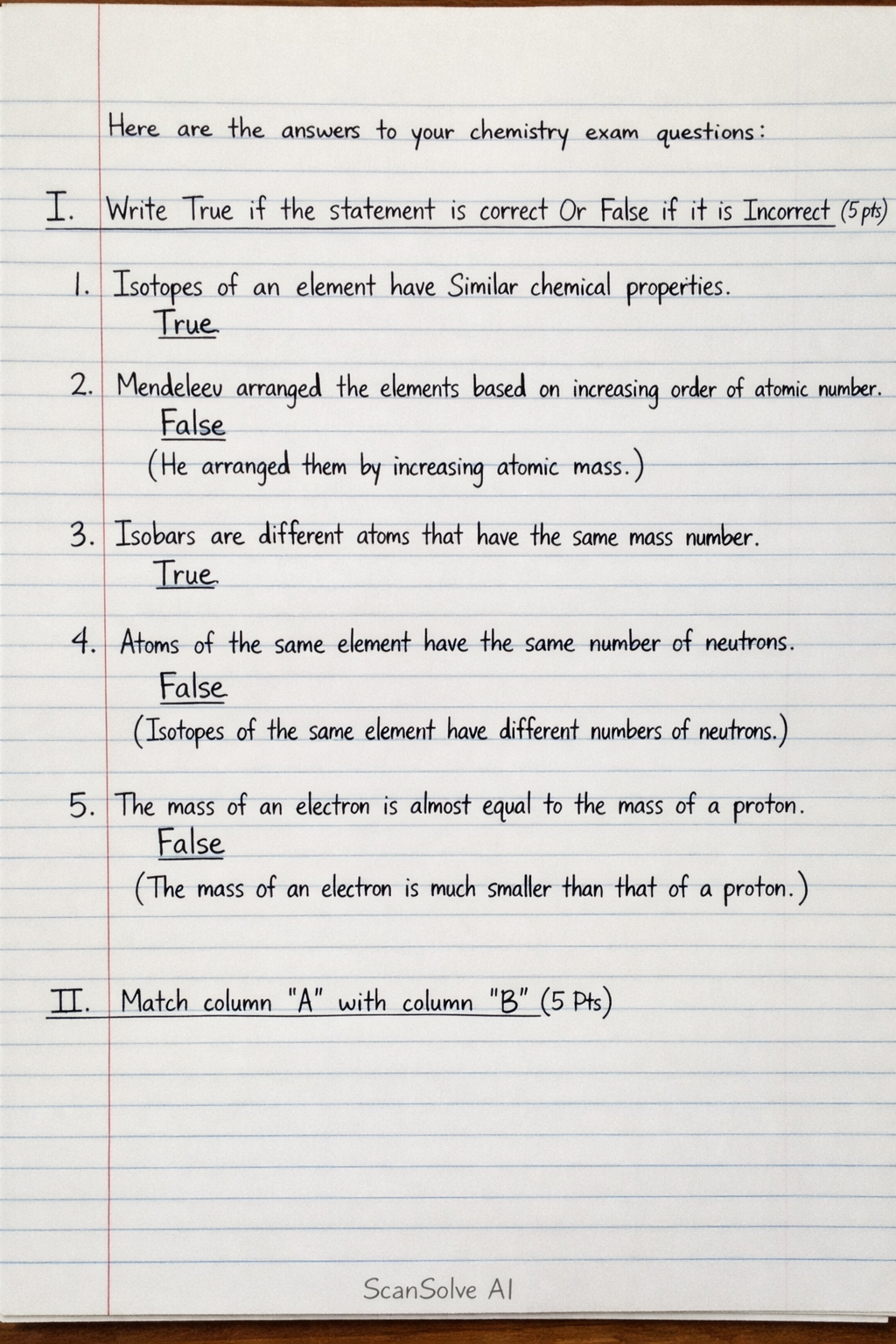
Here are the answers to your chemistry exam questions:
I. Write True if the statement is correct Or False if it is Incorrect (5 pts)
- Isotopes of an element have Similar chemical properties.
- True
- Mendeleev arranged the elements based on increasing order of atomic number.
- False (He arranged them by increasing atomic mass.)
- Isobars are different atoms that have the same mass number.
- True
- Atoms of the same element have the same number of neutrons.
- False (Isotopes of the same element have different numbers of neutrons.)
- The mass of an electron is almost equal to the mass of a proton.
- False (The mass of an electron is much smaller than that of a proton.)
II. Match column 'A' with column 'B' (5 Pts)
- Dalton's Atomic Model C. Billiard Model
- J.J. Thomson Atomic Model D. Plum-pudding Model
- Rutherford's Atomic Model B. Planetary Model
- Bohr's Atomic Model A. Orbit
- Democritus Atomic Model E. Solid sphere
III. Choose The Correct Answer from the following alternatives (10 pts)
-
The Energy level in the third principal quantum number can accommodate electrons.
- Explanation: For a principal quantum number , the maximum number of electrons is given by . For , the maximum is .
-
The mass of an atom is concentrated in .
- Explanation: The nucleus contains protons and neutrons, which account for almost all of an atom's mass.
-
Which fundamental particle does not present in the hydrogen atom? .
- Explanation: The most common isotope of hydrogen (H, protium) has one proton and one electron but no neutrons.
-
What is the average atomic mass of an element which Isotopic composition is 90% of X and 10% of X? .
- Calculation:
-
Nucleus was discovered by .
- Explanation: Ernest Rutherford discovered the atomic nucleus through his gold foil experiment.
-
is an electronic configuration of .
- Explanation: The given electron configuration has electrons, which corresponds to Sulfur (S). However, Sulfur is not an option. Assuming there is a typo in the question and the configuration should have been (18 electrons), then it would correspond to Argon (Ar).
-
How many Protons, electrons and neutrons are found in an atom of Br respectively? .
- Explanation:
- Atomic number (Z) = 35, so there are 35 protons.
- For a neutral atom, the number of electrons equals the number of protons, so there are 35 electrons.
- Mass number (A) = 80.
- Number of neutrons = A - Z = .
- Explanation:
-
An element has the valence shell electron configuration of to which group and period does it belong? .
- Explanation:
- The highest principal quantum number is 2, so it belongs to Period 2.
- The total number of valence electrons is . Elements with 5 valence electrons are in Group VA (or Group 15).
- Explanation:
-
The earliest of the attempts to classify elements was that of .
- Explanation: Dobereiner's triads (1829) were among the first attempts to group elements with similar properties.
-
How many elements
Still stuck on this one?
Ask a follow-up, and the answer starts from this question.
More Chemistry Questions
Handwritten Step-by-Step Solution
Get this as a handwritten image on WhatsApp — like a tutor wrote it for you.
Try on WhatsApp