
We read your photo as:
What are the answers to these chemistry questions?
ScanSolve AI Answer
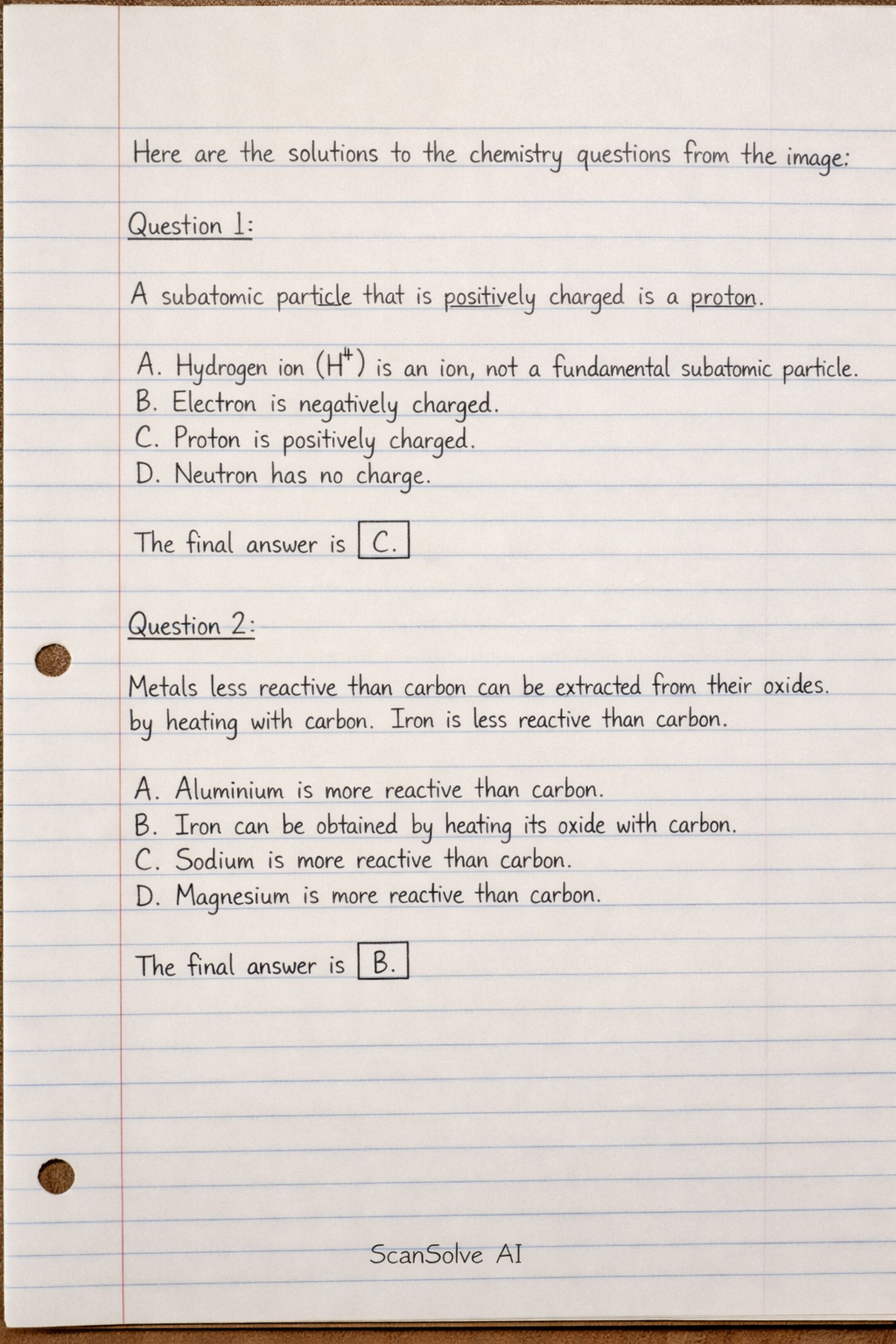
Here are the solutions to the chemistry questions from the image:
Question 1:
A subatomic particle that is positively charged is a proton.
- A. Hydrogen ion () is an ion, not a fundamental subatomic particle.
- B. Electron is negatively charged.
- C. Proton is positively charged.
- D. Neutron has no charge.
The final answer is .
Question 2:
Metals less reactive than carbon can be extracted from their oxides by heating with carbon. Iron is less reactive than carbon.
- A. Aluminium is more reactive than carbon.
- B. Iron can be obtained by heating its oxide with carbon.
- C. Sodium is more reactive than carbon.
- D. Magnesium is more reactive than carbon.
The final answer is .
Question 3:
Transition metals typically form coloured ions in solution. Manganese is a transition metal.
- A. Manganese forms coloured ions (e.g., is pale pink, is purple).
- B. Nitrogen is a non-metal.
- C. Sulphur is a non-metal.
- D. Magnesium is an alkaline earth metal and forms colourless ions ().
The final answer is .
Question 4:
Sublimation is the process where a solid turns directly into a gas without passing through a liquid phase.
- A. Limestone () decomposes on heating.
- B. Sodium Chloride () melts.
- C. Copper (II) sulphate pentahydrate loses water of crystallization.
- D. Ammonium chloride () sublimes on heating.
The final answer is .
Question 5:
The kinetic theory of matter states that matter is composed of tiny particles that are in constant random motion.
- A. This describes general properties of matter.
- B. This describes atomic structure.
- C. This statement accurately describes the core idea of the kinetic theory.
- D. This describes states of matter, not the theory itself.
The final answer is .
Question 6:
Alkanes are saturated hydrocarbons and primarily undergo substitution reactions, where a hydrogen atom is replaced by another atom.
- A. Hydrogenation is for unsaturated compounds.
- B. Substitution is a characteristic reaction of alkanes (e.g., halogenation).
- C. Addition is for unsaturated compounds.
- D. Combustion is a general reaction for many organic compounds.
The final answer is .
Question 7:
The manufacture of sulphuric acid (Contact Process) involves several steps.
- A. This is a use of sulphuric acid, not a manufacturing step.
- B. Dissolving sulphur trioxide in water to give oleum is incorrect; is dissolved in concentrated to form oleum.
- C. Burning of sulphur dioxide to give sulphur trioxide () is a key step in the Contact Process.
- D. Oleum is diluted with water to give sulphuric acid, not catalytically oxidized.
The final answer is .
Question 8:
When sodium is dropped in ethanol, it reacts to produce hydrogen gas (causing effervescence) and sodium ethoxide (), which is a strong base.
- A. Sodium reacts, it doesn't just dissolve.
- B. Effervescence occurs, but hydrogen gas is not pungent.
- C. The resulting solution is alkaline due to sodium ethoxide, so it turns red litmus paper blue. This is a correct observation.
- D. Sodium ethoxide is produced, not sodium hydroxide.
The final answer is .
Question 9:
Polythene (polyethylene) is widely used for making plastic bags and is also an excellent electrical insulator.
- A. Terylene is used for fabrics and bottles.
- B. Polythene is suitable for packaging bags and electrical insulation.
- C. Polystyrene is used for disposable cups and insulation boards.
- D. Nylon is used for fibers and ropes.
The final answer is .
Question 10:
Electrolysis is a key process in the manufacture of certain heavy chemicals, particularly strong bases and reactive metals/non-metals.
- A. Sodium hydroxide () is manufactured by the electrolysis of brine (chlor-alkali process).
- B. Sulphuric acid () is made by the Contact Process, which does not involve electrolysis.
- C. Nitric acid () is made by the Ostwald process, which does not involve electrolysis.
- D. Copper () is extracted from ores, often refined by electrolysis, but is a more direct fit for "manufacture involves electrolysis" as a primary production method for the bulk chemical.
The final answer is .
Question 11:
- "Evolve steamy white fumes with " indicates the presence of an -OH group (alcohol or carboxylic acid).
- "Equally evolve a colourless gas with sodium carbonate" indicates the presence of a carboxylic acid group (-COOH), as carboxylic acids react with carbonates to produce gas. Alcohols do not react with sodium carbonate. Therefore, we are looking for a carboxylic acid.
- A. is an alcohol.
- B. is an unstable enol.
- C. $\text{CH
Still stuck on this one?
Ask a follow-up, and the answer starts from this question.
More Chemistry Questions
Handwritten Step-by-Step Solution
Get this as a handwritten image on WhatsApp — like a tutor wrote it for you.
Try on WhatsApp