
Write the mechanism for the following 1 friedel craft alkylation 2 friedel craft acylation 3 nitration of benzene
ScanSolve AI Answer
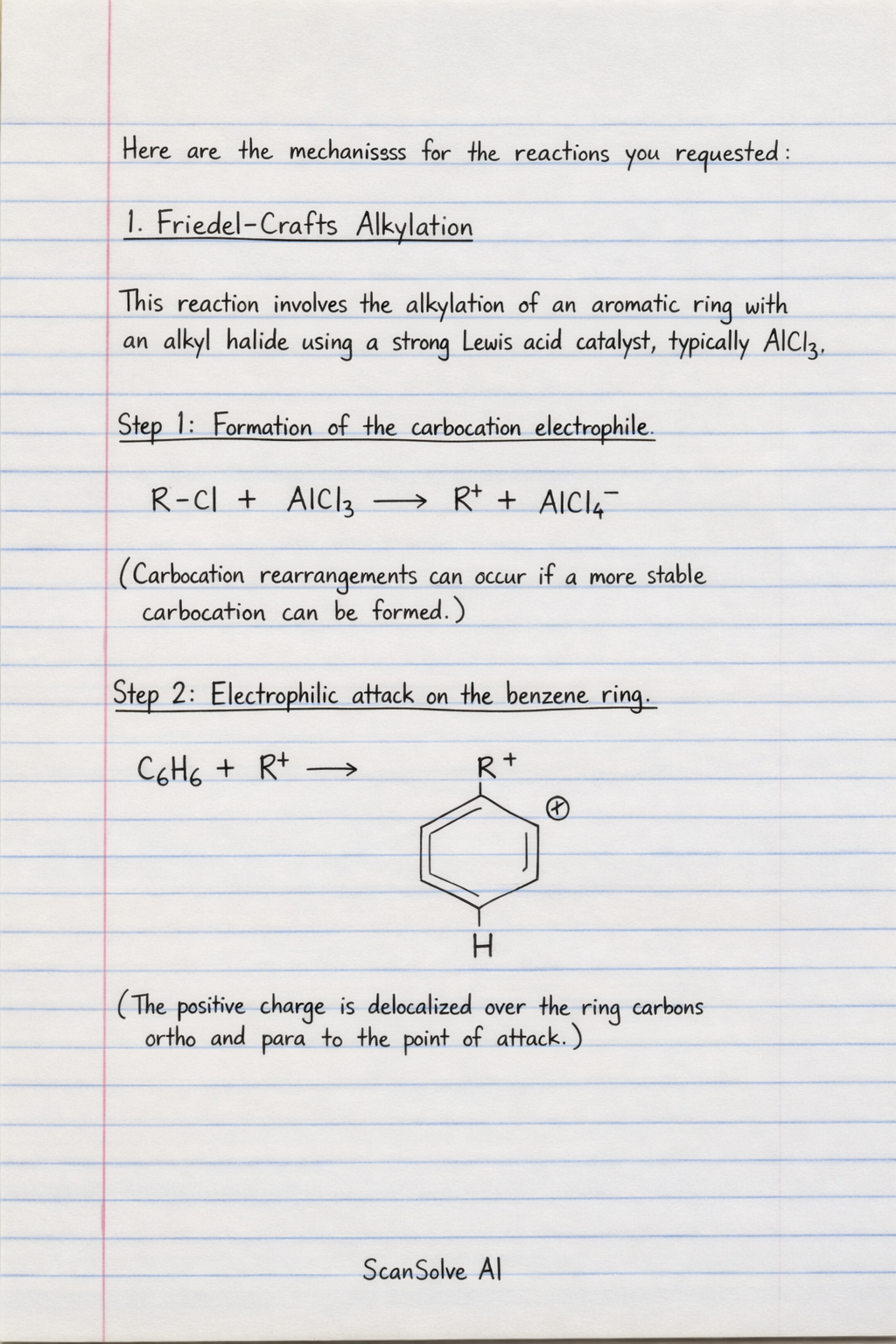
Here are the mechanisms for the reactions you requested:
1. Friedel-Crafts Alkylation
This reaction involves the alkylation of an aromatic ring with an alkyl halide using a strong Lewis acid catalyst, typically .
-
Step 1: Formation of the carbocation electrophile. The alkyl halide reacts with the Lewis acid to form a carbocation.
(Note: Carbocation rearrangements can occur if a more stable carbocation can be formed.)
-
Step 2: Electrophilic attack on the benzene ring. The carbocation attacks the electron-rich benzene ring, forming a sigma complex (arenium ion), which temporarily disrupts the aromaticity.
(The positive charge is delocalized over the ring carbons ortho and para to the point of attack.)
-
Step 3: Deprotonation and restoration of aromaticity. A base (e.g., ) removes a proton from the sigma complex, restoring the aromaticity of the ring and regenerating the catalyst.
2. Friedel-Crafts Acylation
This reaction involves the acylation of an aromatic ring with an acyl halide (or anhydride) using a strong Lewis acid catalyst, typically .
-
Step 1: Formation of the acylium ion electrophile. The acyl halide reacts with the Lewis acid to form a resonance-stabilized acylium ion.
-
Step 2: Electrophilic attack on the benzene ring. The acylium ion attacks the electron-rich benzene ring, forming a sigma complex (arenium ion).
-
Step 3: Deprotonation and restoration of aromaticity. A base (e.g., ) removes a proton from the sigma complex, restoring the aromaticity of the ring.
(The ketone product forms a complex with .)
-
Step 4: Hydrolysis. Aqueous workup is required to release the ketone product from its complex with .
3. Nitration of Benzene
This reaction involves the introduction of a nitro group () onto an aromatic ring using a mixture of concentrated nitric acid and sulfuric acid.
-
Step 1: Formation of the nitronium ion electrophile. Nitric acid is protonated by sulfuric acid, and then water is eliminated to form the nitronium ion (), which is the active electrophile.
Overall:
-
Step 2: Electrophilic attack on the benzene ring. The nitronium ion attacks the electron-rich benzene ring, forming a sigma complex (arenium ion).
-
Step 3: Deprotonation and restoration of aromaticity. A base (e.g., or ) removes a proton from the sigma complex, restoring the aromaticity of the ring.
Still stuck on this one?
Ask a follow-up, and the answer starts from this question.
More Chemistry Questions
Handwritten Step-by-Step Solution
Get this as a handwritten image on WhatsApp — like a tutor wrote it for you.
Try on WhatsApp