
We read your photo as:
Give an example of a chemical change you might observe in everyday life. What evidence tells you it is a chemical change?
ScanSolve AI Answer
Answer
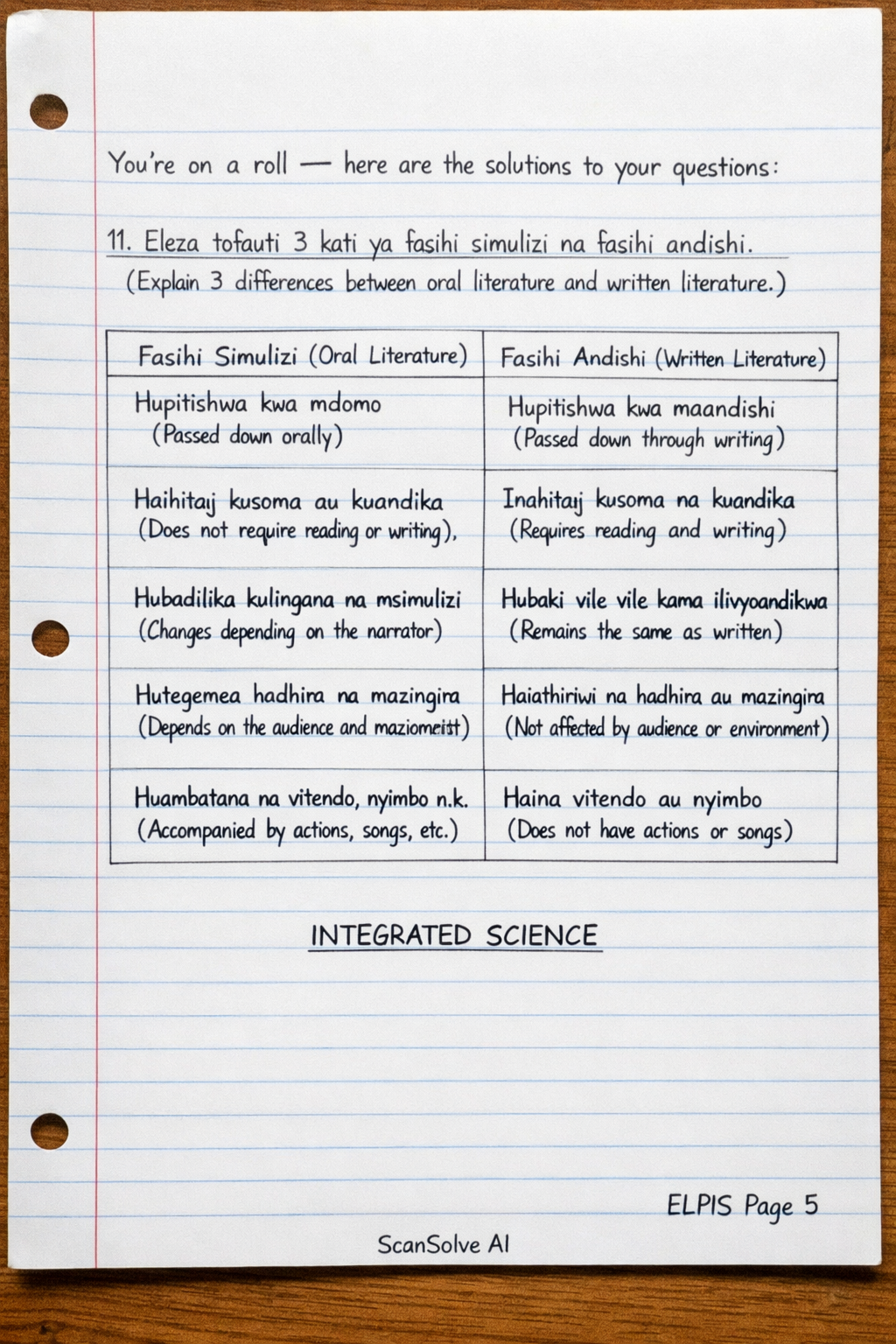
here are the solutions to your questions:
11. Eleza tofauti 3 kati ya fasihi simulizi na fasihi andishi.
(Explain 3 differences between oral literature and written literature.)
| Fasihi Simulizi (Oral Literature) | Fasihi Andishi (Written Literature) |
|---|---|
| Hupitishwa kwa mdomo (Passed down orally) | Hupitishwa kwa maandishi (Passed down through writing) |
| Haihitaji kusoma au kuandika (Does not require reading or writing) | Inahitaji kusoma na kuandika (Requires reading and writing) |
| Hubadilika kulingana na msimulizi (Changes depending on the narrator) | Hubaki vile vile kama ilivyoandikwa (Remains the same as written) |
| Hutegemea hadhira na mazingira (Depends on the audience and environment) | Haiathiriwi na hadhira au mazingira (Not affected by audience or environment) |
| Huambatana na vitendo, nyimbo, n.k. (Accompanied by actions, songs, etc.) | Haina vitendo au nyimbo (Does not have actions or songs) |
INTEGRATED SCIENCE
1. Give an example of a chemical change you might observe in everyday life. What evidence tells you it is a chemical change?
- Example: Burning wood.
- Evidence: The formation of ash (a new substance), the production of heat and light, and the fact that the change is irreversible (you cannot turn the ash back into wood).
2. Describe an application of the change of state from liquid to solid that is useful in food preservation.
- The application is freezing. When water (liquid) in food or around food changes to ice (solid), it slows down the growth of microorganisms and enzymatic reactions, thus preserving the food for longer periods. For example, freezing meat or vegetables or using ice to keep drinks cold.
3. When a perfume bottle is opened at one end of a room, people at the other end can soon smell it. What process does this demonstrate? Explain what is happening at the particle level.
- This process demonstrates diffusion.
- At the particle level: The perfume particles (which are in a gaseous state) move randomly from an area of high concentration (near the open bottle) to an area of low concentration (the other end of the room). They collide with air particles and spread out until they are evenly distributed throughout the room.
4. Burning a piece of paper is a chemical change. List two observable signs that indicate a new substance has been formed.
- a) Formation of ash (a new solid substance with different properties from paper).
- b) Production of smoke/gas (e.g., carbon dioxide and water vapor, which are new gaseous substances).
5. Why is it important to understand physical and chemical changes when cooking?
- It is important because understanding these changes allows us to control the cooking process to achieve desired textures, flavors, and safety. Physical changes (like melting or boiling) alter the state of ingredients, while chemical changes (like browning, baking, or cooking an egg) create new substances, making food digestible, palatable, and safe to eat by destroying harmful bacteria.
6. For a fire to start and continue burning, which three components must be present?
The three components are Fuel, Heat, and Oxygen (often referred to as the fire triangle).
The correct answer is .
7. Class A fires involve which type of materials?
Class A fires involve ordinary combustibles like wood, paper, cloth, and plastics.
The correct answer is .
Try one yourself
A new problem that tests the same skill.
Still stuck on this one?
Ask a follow-up, and the answer starts from this question.
Handwritten Step-by-Step Solution
Get this as a handwritten image on WhatsApp — like a tutor wrote it for you.
Try on WhatsApp