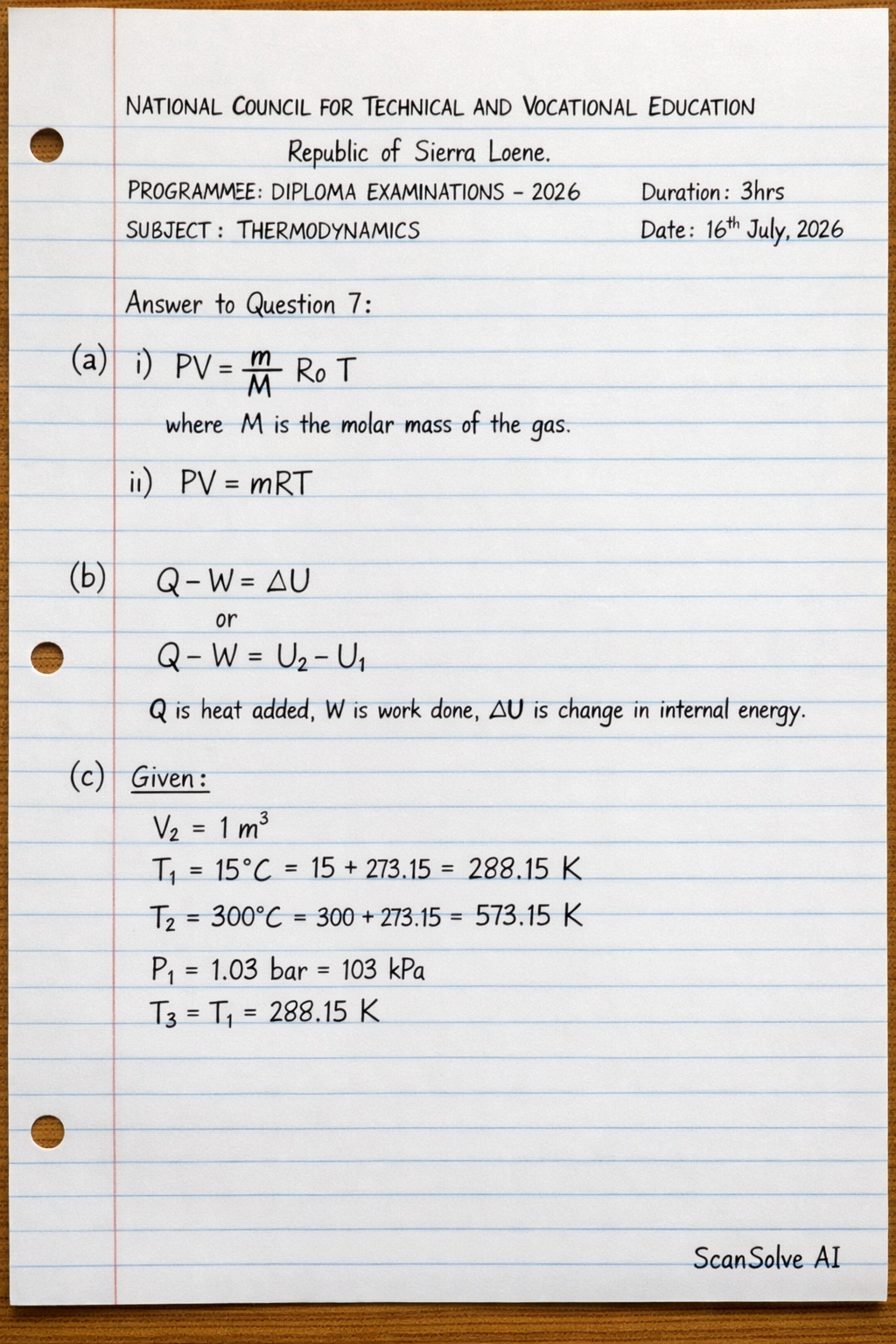
We read your photo as:

State the perfect gas equation for a mass m of a gas at temperature T, pressure P and volume V interms of (i) Universal gas constant to Ro and (ii) the constant R of the gas.

Physics

ScanSolve AI Answer

Answer

ii

101.90 kJ101.90 \text{ kJ}

Step-by-step solution

4 steps

Here's the solution for question 7:

7.a)
The perfect gas equation for a mass mm of a gas at temperature TT, pressure PP, and volume VV:

Part i

In terms of Universal gas constant RoR_o

PV=mMRoTPV = \frac{m}{M} R_o T

where MM is the molar mass of the gas.

Part ii

101.90 kJ101.90 \text{ kJ}

In terms of the specific gas constant RR

PV=mRTPV = mRT

7.b)
The non-flow energy equation (First Law of Thermodynamics for a closed system) for a working fluid in a thermodynamic system between two states is:

Q−W=ΔUQ - W = \Delta U

or

Q−W=U2−U1Q - W = U_2 - U_1

where QQ is the heat transfer to the system, WW is the work done by the system, and ΔU\Delta U is the change in internal energy of the system.

7.c)
Given:
Initial volume V1=1 m3V_1 = 1 \text{ m}^3
Initial temperature T1=15∘C=15+273.15=288.15 KT_1 = 15^\circ \text{C} = 15 + 273.15 = 288.15 \text{ K}
Final temperature for heating T2=300∘C=300+273.15=573.15 KT_2 = 300^\circ \text{C} = 300 + 273.15 = 573.15 \text{ K}
Initial pressure P1=1.03 bar=103 kPaP_1 = 1.03 \text{ bar} = 103 \text{ kPa}
Final temperature for cooling T3=T1=288.15 KT_3 = T_1 = 288.15 \text{ K}

Assume air as an ideal gas with:
Specific gas constant R=0.287 kJ/(kg⋅K)R = 0.287 \text{ kJ/(kg}\cdot\text{K)}
Specific heat at constant pressure cp=1.005 kJ/(kg⋅K)c_p = 1.005 \text{ kJ/(kg}\cdot\text{K)}
Specific heat at constant volume cv=0.718 kJ/(kg⋅K)c_v = 0.718 \text{ kJ/(kg}\cdot\text{K)}

  1. Calculate the mass of air (mm).

    Using the ideal gas law P1V1=mRT1P_1V_1 = mRT_1:

    m=P1V1RT1m = \frac{P_1V_1}{RT_1} m=103 kPa×1 m30.287 kJ/(kg⋅K)×288.15 Km = \frac{103 \text{ kPa} \times 1 \text{ m}^3}{0.287 \text{ kJ/(kg}\cdot\text{K)} \times 288.15 \text{ K}} m=10382.69905≈1.24549 kgm = \frac{103}{82.69905} \approx 1.24549 \text{ kg}
  2. Calculate the heat flow during the constant pressure heating process (Process 1-2).

    For a constant pressure process, the heat transfer is given by Q12=mcp(T2−T1)Q_{12} = mc_p(T_2 - T_1).

    Q12=1.24549 kg×1.005 kJ/(kg⋅K)×(573.15−288.15) KQ_{12} = 1.24549 \text{ kg} \times 1.005 \text{ kJ/(kg}\cdot\text{K)} \times (573.15 - 288.15) \text{ K} Q12=1.24549×1.005×285 kJQ_{12} = 1.24549 \times 1.005 \times 285 \text{ kJ} Q12≈357.00 kJQ_{12} \approx 357.00 \text{ kJ}
  3. Calculate the heat flow during the constant volume cooling process (Process 2-3).

    The air is cooled back to the initial temperature, so T3=T1=288.15 KT_3 = T_1 = 288.15 \text{ K}.
    For a constant volume process, the heat transfer is given by Q23=mcv(T3−T2)Q_{23} = mc_v(T_3 - T_2).

    Q23=1.24549 kg×0.718 kJ/(kg⋅K)×(288.15−573.15) KQ_{23} = 1.24549 \text{ kg} \times 0.718 \text{ kJ/(kg}\cdot\text{K)} \times (288.15 - 573.15) \text{ K} Q23=1.24549×0.718×(−285) kJQ_{23} = 1.24549 \times 0.718 \times (-285) \text{ kJ} Q23≈−255.10 kJQ_{23} \approx -255.10 \text{ kJ}
  4. Calculate the net heat flow.

    The net heat flow is the sum of the heat transfers in each process.

    Qnet=Q12+Q23Q_{net} = Q_{12} + Q_{23} Qnet=357.00 kJ+(−255.10 kJ)Q_{net} = 357.00 \text{ kJ} + (-255.10 \text{ kJ}) Qnet=101.90 kJQ_{net} = 101.90 \text{ kJ}

    The net heat flow is 101.90 kJ\boxed{101.90 \text{ kJ}}.

Was this helpful?

Try one yourself

A new problem that tests the same skill.

Still stuck on this one?

Ask a follow-up, and the answer starts from this question.
Got a different question?Ask your own question
Handwritten step-by-step solution preview

Handwritten Step-by-Step Solution

Get this as a handwritten image on WhatsApp — like a tutor wrote it for you.

Try on WhatsApp