
We read your photo as:
Calculate the potential difference across a 10 resistor carrying current of 2 A.
ScanSolve AI Answer
Step-by-step solution
11 stepsHere are the solutions to the problems:
:
Calculate the potential difference across a 10 resistor carrying current of 2 A.
Identify the given values.
Resistance
CurrentUse Ohm's Law to calculate the potential difference .
The formula for Ohm's Law is .
:
The potential difference across a 3 resistor is 12 V. What is the current flowing?Identify the given values.
Resistance
Potential differenceUse Ohm's Law to calculate the current .
Rearranging Ohm's Law for :
:
Find the potential difference across a conductor of resistance 2 if the charge of 180 C flows for 2 minutes.Identify the given values and convert units.
Resistance
Charge
TimeCalculate the current using the formula .
Use Ohm's Law to calculate the potential difference .
The formula for Ohm's Law is .
:
A current of 4 A flows through an electric kettle. The p.d. across it is 8 V. Find the resistance.Identify the given values.
Current
Potential differenceUse Ohm's Law to calculate the resistance .
Rearranging Ohm's Law for :
:
The potential difference across a 2 k resistor is 4 V. Determine the current flowing in the circuit.Identify the given values and convert units.
Resistance
Potential differenceUse Ohm's Law to calculate the current .
Rearranging Ohm's Law for :
This can also be expressed in milliamperes:
Still stuck on this one?
Ask a follow-up, and the answer starts from this question.
More Physics Questions
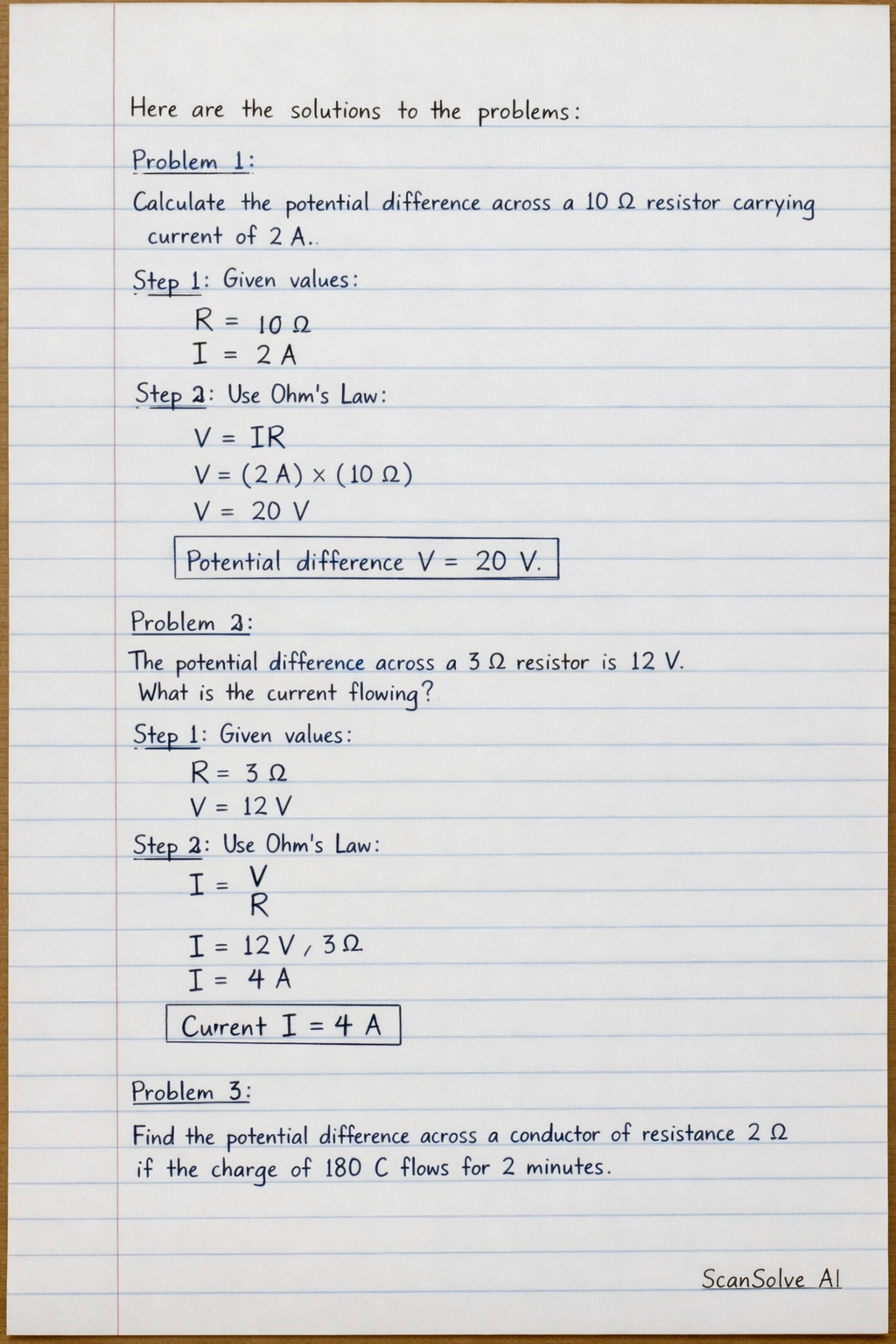
Handwritten Step-by-Step Solution
Get this as a handwritten image on WhatsApp — like a tutor wrote it for you.
Try on WhatsApp