We read your photo as:

Q7. Coplanar forces act outwards from a common point. Three forces have the following magnitudes and directions. The angles being measured clockwise from a horizontal datum, 80N,0°; 500,60°; 100N, 150°. a. Draw the force diagram b. Determine the magnitude and direction of the resultant force

Physics

ScanSolve AI Answer

Step-by-step solution

4 steps

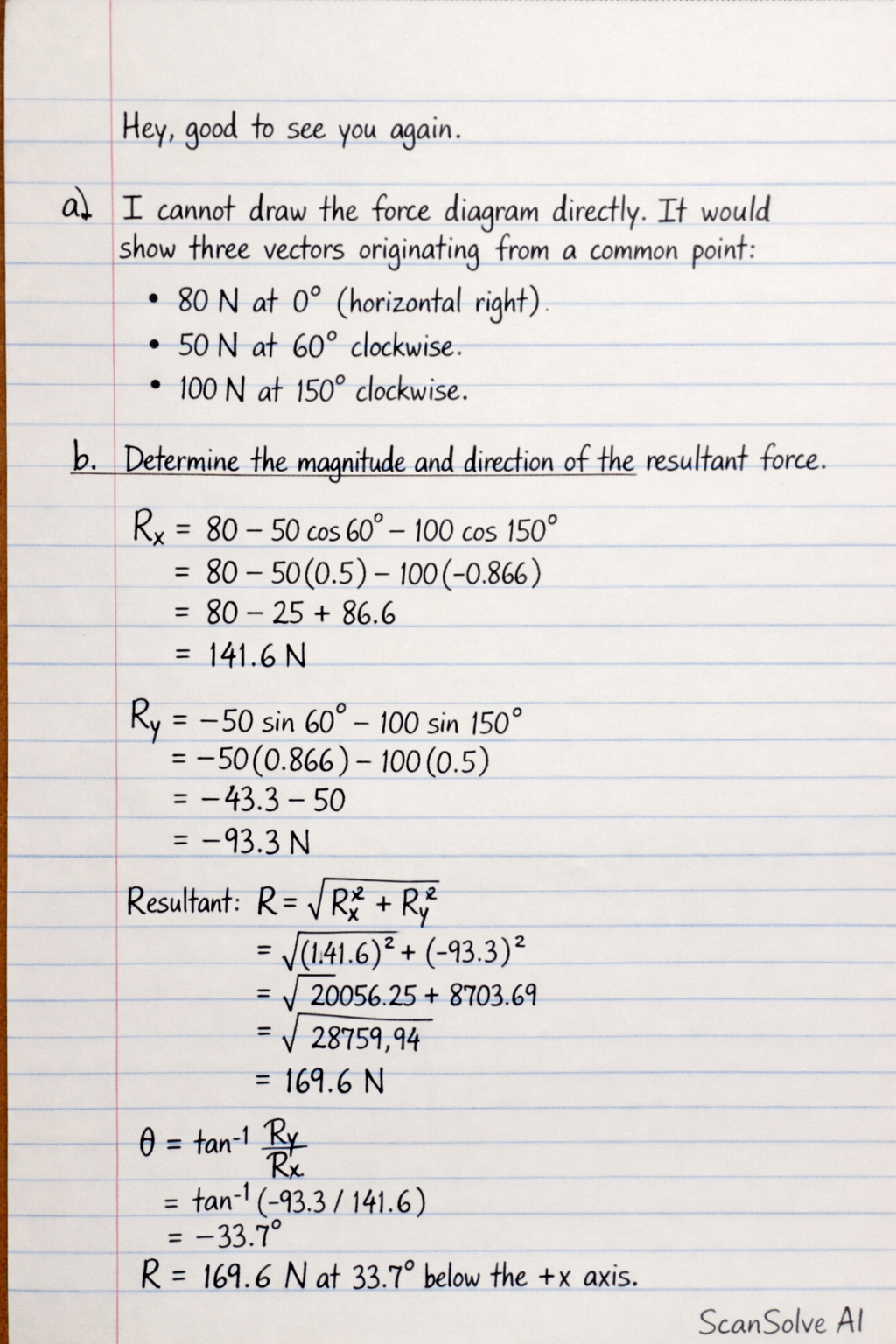
a. I cannot draw the force diagram directly. It would show three vectors originating from a common point, with their respective magnitudes and directions as described: 80 N80 \, \text{N} at 0∘0^\circ (horizontal right), 50 N50 \, \text{N} at 60∘60^\circ clockwise (in the fourth quadrant), and 100 N100 \, \text{N} at 150∘150^\circ clockwise (in the third quadrant).

b. Determine the magnitude and direction of the resultant force.

  1. Resolve each force into its horizontal (x) and vertical (y) components.

    Angles are measured clockwise from the positive x-axis. For calculations, we use standard angles (counter-clockwise from positive x-axis), so clockwise angles θcw\theta_{cw} become −θcw-\theta_{cw}.
    For F1=80 NF_1 = 80 \, \text{N} at 0∘0^\circ clockwise:

    F1x=80cos⁡(0∘)=80 NF_{1x} = 80 \cos(0^\circ) = 80 \, \text{N} F1y=80sin⁡(0∘)=0 NF_{1y} = 80 \sin(0^\circ) = 0 \, \text{N}

    For F2=50 NF_2 = 50 \, \text{N} at 60∘60^\circ clockwise:

    F2x=50cos⁡(−60∘)=50×0.5=25 NF_{2x} = 50 \cos(-60^\circ) = 50 \times 0.5 = 25 \, \text{N} F2y=50sin⁡(−60∘)=50×(−32)=−253 NF_{2y} = 50 \sin(-60^\circ) = 50 \times \left(-\frac{\sqrt{3}}{2}\right) = -25\sqrt{3} \, \text{N}

    For F3=100 NF_3 = 100 \, \text{N} at 150∘150^\circ clockwise:

    F3x=100cos⁡(−150∘)=100×(−32)=−503 NF_{3x} = 100 \cos(-150^\circ) = 100 \times \left(-\frac{\sqrt{3}}{2}\right) = -50\sqrt{3} \, \text{N} F3y=100sin⁡(−150∘)=100×(−0.5)=−50 NF_{3y} = 100 \sin(-150^\circ) = 100 \times (-0.5) = -50 \, \text{N}
  2. Calculate the resultant horizontal (RxR_x) and vertical (RyR_y) components.

    Rx=F1x+F2x+F3x=80+25−503=105−503 NR_x = F_{1x} + F_{2x} + F_{3x} = 80 + 25 - 50\sqrt{3} = 105 - 50\sqrt{3} \, \text{N} Ry=F1y+F2y+F3y=0−253−50=−50−253 NR_y = F_{1y} + F_{2y} + F_{3y} = 0 - 25\sqrt{3} - 50 = -50 - 25\sqrt{3} \, \text{N}

    Using approximate values:
    Rx≈105−50(1.732)=105−86.6=18.4 NR_x \approx 105 - 50(1.732) = 105 - 86.6 = 18.4 \, \text{N}
    Ry≈−50−25(1.732)=−50−43.3=−93.3 NR_y \approx -50 - 25(1.732) = -50 - 43.3 = -93.3 \, \text{N}

  3. Calculate the magnitude of the resultant force RR.

    R=Rx2+Ry2R = \sqrt{R_x^2 + R_y^2} R=(105−503)2+(−50−253)2R = \sqrt{(105 - 50\sqrt{3})^2 + (-50 - 25\sqrt{3})^2} R≈(18.4)2+(−93.3)2R \approx \sqrt{(18.4)^2 + (-93.3)^2} R≈338.56+8704.89=9043.45R \approx \sqrt{338.56 + 8704.89} = \sqrt{9043.45} R≈95.1 NR \approx 95.1 \, \text{N}
  4. Calculate the direction of the resultant force.

    Let α\alpha be the angle measured counter-clockwise from the positive x-axis.

    tan⁡α=RyRx\tan \alpha = \frac{R_y}{R_x} tan⁡α=−50−253105−503≈−93.318.4≈−5.0717\tan \alpha = \frac{-50 - 25\sqrt{3}}{105 - 50\sqrt{3}} \approx \frac{-93.3}{18.4} \approx -5.0717 α=arctan⁡(−5.0717)≈−78.85∘\alpha = \arctan(-5.0717) \approx -78.85^\circ

    Since RxR_x is positive and RyR_y is negative, the resultant force is in the fourth quadrant. An angle of −78.85∘-78.85^\circ counter-clockwise is equivalent to 78.85∘78.85^\circ clockwise from the horizontal datum.

    The magnitude of the resultant force is 95.1 N\boxed{\text{95.1 N}} and its direction is 78.9∘ clockwise from the horizontal datum\boxed{\text{78.9}^\circ \text{ clockwise from the horizontal datum}}.

Was this helpful?

Still stuck on this one?

Ask a follow-up, and the answer starts from this question.
Got a different question?Ask your own question
Handwritten step-by-step solution preview

Handwritten Step-by-Step Solution

Get this as a handwritten image on WhatsApp — like a tutor wrote it for you.

Try on WhatsApp