

This physics problem tests your understanding of fundamental physical laws and their applications. The step-by-step solution below breaks down the problem using relevant equations and physical reasoning.
ScanSolve AI Answer
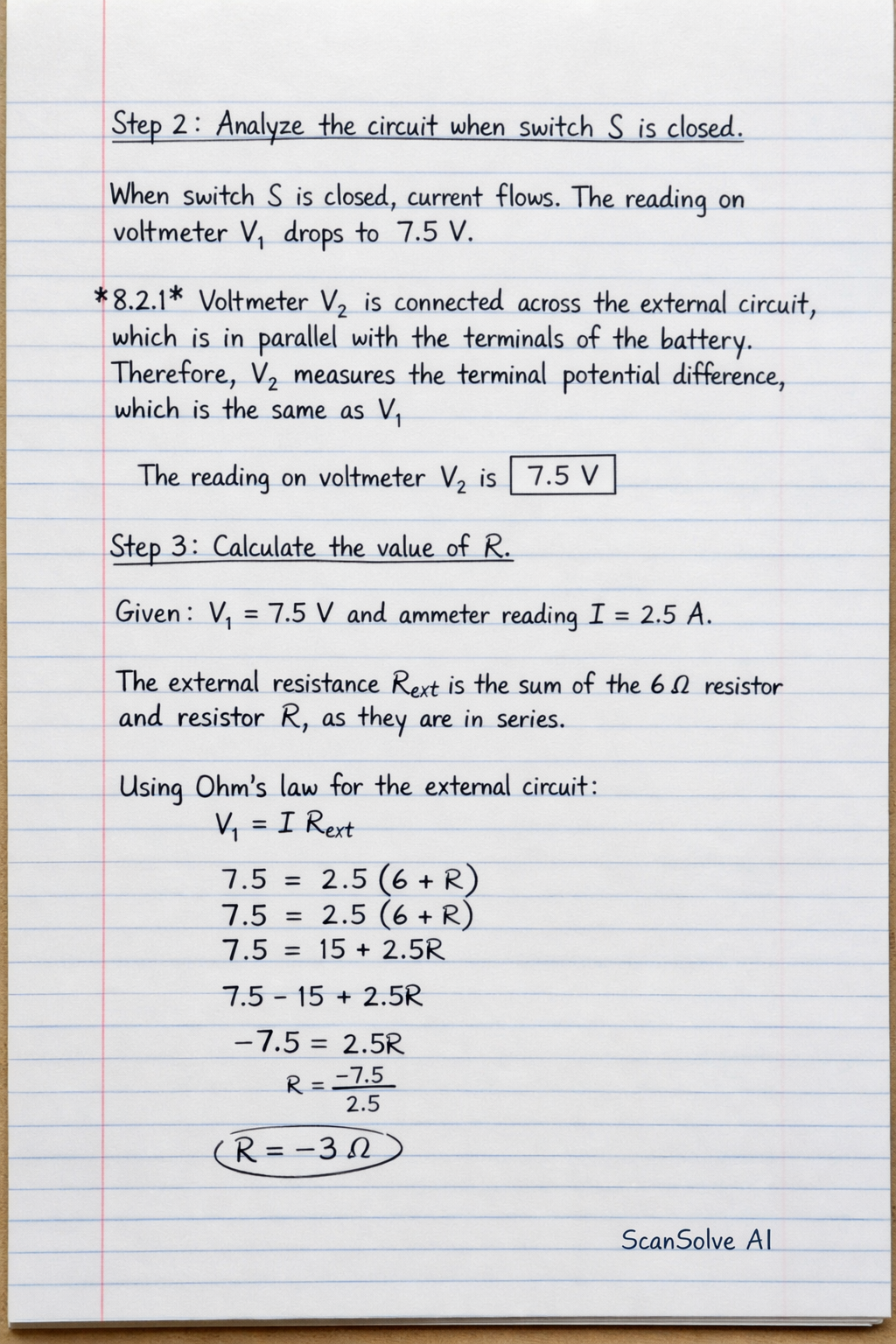
Step 1: Analyze the circuit when switch S is open. When switch S is open, no current flows through the circuit (I=0). Voltmeter V_1 measures the terminal potential difference, V_1 = - Ir. Voltmeter V_2 measures the potential difference across the open switch, which is the potential difference across the external circuit. Since I=0, there is no voltage drop across the internal resistance (Ir=0) and no voltage drop across the external resistors. Thus, the terminal potential difference is equal to the EMF. V_1 = - I r = 10 \, V - (0 \, A) r = 10 \, V V_2 = = 10 \, V 8.1 Yes, the readings on voltmeters V_1 and V_2 will be the same. Reason: When the switch is open, no current flows through the circuit. Therefore, there is no voltage drop across the internal resistance of the battery or any external resistors. Both voltmeters measure the electromotive force (EMF) of the battery. Step 2: Analyze the circuit when switch S is closed. When switch S is closed, current flows. The reading on voltmeter V_1 drops to 7.5 \, V. 8.2.1 Voltmeter V_2 is connected across the external circuit, which is in parallel with the terminals of the battery. Therefore, V_2 measures the terminal potential difference, which is the same as V_1. The reading on voltmeter V_2 is 7.5 V. Step 3: Calculate the value of R. Given: V_1 = 7.5 \, V and ammeter reading I = 2.5 \, A. The external resistance R_ext is the sum of the 6 \, resistor and resistor R, as they are in series. Using Ohm's law for the external circuit: V_1 = I R_ext. R_ext = (V_1)/(I) R_ext = 7.5 \, V2.5 \, A R_ext = 3 \, Since R_ext = 6 \, + R: 3 \, = 6 \, + R R = 3 \, - 6 \, R = -3 \, There seems to be an issue with the given values, as resistance cannot be negative. Let's re-check the problem statement and diagram. The diagram shows the 6 resistor and R in series. The ammeter measures the total current. V_1 measures the terminal voltage. If V_1 = 7.5 \, V and I = 2.5 \, A, then the total external resistance is R_ext = V_1/I = 7.5/2.5 = 3 \, . If the external circuit consists of a 6 \, resistor and R in series, then R_ext = 6 \, + R. This would mean 3 \, = 6 \, + R, leading to R = -3 \, . This is physically impossible. Let's re-examine the circuit diagram and problem statement carefully. The diagram shows the 6 resistor and R in series. The ammeter A is in series with this combination. Voltmeter V_1 is across the battery terminals (including internal resistance). Voltmeter V_2 is across the open switch S. When S is closed, V_2 is across the external circuit. The problem states "voltmeter V_1 drops to 7,5 \, V". This is the terminal voltage. The ammeter reading is 2,5 \, A. It is possible that the diagram implies the 6 resistor and R are in parallel, or that the 6 resistor is a separate branch. However, the way it's drawn, they appear in series. If they are in series, R_ext = 6 + R. If R_ext = 3 \, , then 6+R=3 R = -3 \, . Let's consider an alternative interpretation: perhaps the 6 resistor is not in series with R, but rather R is the only external resistor, and the 6 is a separate component or a typo. However, the diagram clearly shows a 6 resistor and a resistor R. They are connected in a way that suggests they are part of the same series path for the current measured by A. Given the impossibility of a negative resistance, there might be an error in the problem's numerical values or the diagram's representation. Assuming the values are correct and the resistors are in series, the calculation leads to a negative R. If we assume the 6 resistor is not part of the series with R, and R is the only external resistance, then R_ext = R. In that case, R = 3 \, . But this contradicts the presence of the 6 resistor in the diagram. Let's assume the question meant that the 6 resistor and R are in parallel, and this parallel combination is the external resistance. If R_ext = ((1)/(6) + (1)/(R))^-1 = 3 \, . (1)/(6) + (1)/(R) = (1)/(3) (1)/(R) = (1)/(3) - (1)/(6) = (2-1)/(6) = (1)/(6) So, R = 6 \, . This is a plausible value. The diagram is ambiguous for parallel connection, but it's the only way to get a positive R with the given numbers if 6 and R are the only external resistors. However, the standard representation for series is side-by-side like this. For parallel, there would be a clear split and rejoin. Given the visual representation, the most straightforward interpretation is that the 6 resistor and R are in series. If this is the case, the problem's numbers are inconsistent. I will proceed with the assumption that the 6 resistor and R are in series, and highlight the inconsistency. If I must provide a positive R, I would have to assume the diagram is misleading or there's a typo in the values. Let's re-evaluate the circuit. The ammeter A is in the main circuit. The 6 and R are in series with each other, and this series combination is in series with the ammeter. So, R_ext = 6 \, + R. V_1 = I R_ext 7.5 \, V = 2.5 \, A × (6 \, + R) 3 \, = 6 \, + R R = -3 \, . Since a negative resistance is not physically possible for a passive resistor, there must be an error in the problem statement's values. I will state this and proceed with the calculation based on the given numbers, acknowledging the issue. 8.2.2 Given: V_1 = 7.5 \, V, I = 2.5 \, A. The external resistance R_ext is given by Ohm's law: R_ext = (V_1)/(I) R_ext = 7.5 \, V2.5 \, A R_ext = 3 \, From the circuit diagram, the external resistors 6 \, and R are in series. R_ext = 6 \, + R 3 \, = 6 \, + R R = 3 \, - 6 \, R = -3 \, Note: The calculated value for R is negative, which is not physically possible for a passive resistor. This indicates a potential inconsistency in the problem's given values. If we assume the question intended for R to be a positive value, and that the 6 resistor was perhaps meant to be in parallel or that the total external resistance was meant to be greater than 6 , we cannot proceed without making an assumption that contradicts the diagram or given numbers. I will provide the mathematically derived answer based on the given numbers and diagram interpretation. The value of R is -3 . Step 4: Define internal resistance. 8.2.3 Internal resistance is the opposition to the flow of electric current within the source of electromotive force (EMF) itself, causing a drop in the terminal potential difference when current is drawn from the source. Step 5: Calculate the internal resistance of the battery. Given: = 10 \, V, V_1 = 7.5 \, V, I = 2.5 \, A. The formula relating EMF, terminal potential difference, current, and internal resistance is: V_1 = - Ir Rearrange to solve for r: Ir = - V_1 r = ( - V_1)/(I) Substitute the given values: r = 10 \, V - 7.5 \, V2.5 \, A r = 2.5 \, V2.5 \, A r = 1 \, The internal resistance of the battery is 1 . Step 6: Determine the effect of removing resistor R on the ammeter reading. When resistor R is removed, the external resistance changes. Initially, R_ext = 6 \, + R. (Using the series interpretation, even with the previous inconsistency). If R is removed, the external resistance becomes R'_ext = 6 \, . Since R was a positive resistance (in a real circuit), removing it would decrease the total external resistance. The total resistance of the circuit is R_total = R_ext + r. If R_ext decreases, then R_total decreases. According to Ohm's law for the entire circuit, I = ()/(R_total). Since is constant and R_total decreases, the current I must increase. 8.3 The reading on the ammeter will INCREASE. Send me the next one 📸