An object of mass 2 kg moves with a uniform speed of 10 ms⁻¹ for 5 s along a straight path. Determine the magnitude of its acceleration. 0 ms⁻² 1.0 ms⁻² 3.0 ms⁻² 4.0 ms⁻²

Physics

ScanSolve AI Answer

Answer

(a) 0ms2\text{(a) } 0 ms^{-2}

Hey Rofeehat, good to see you again.

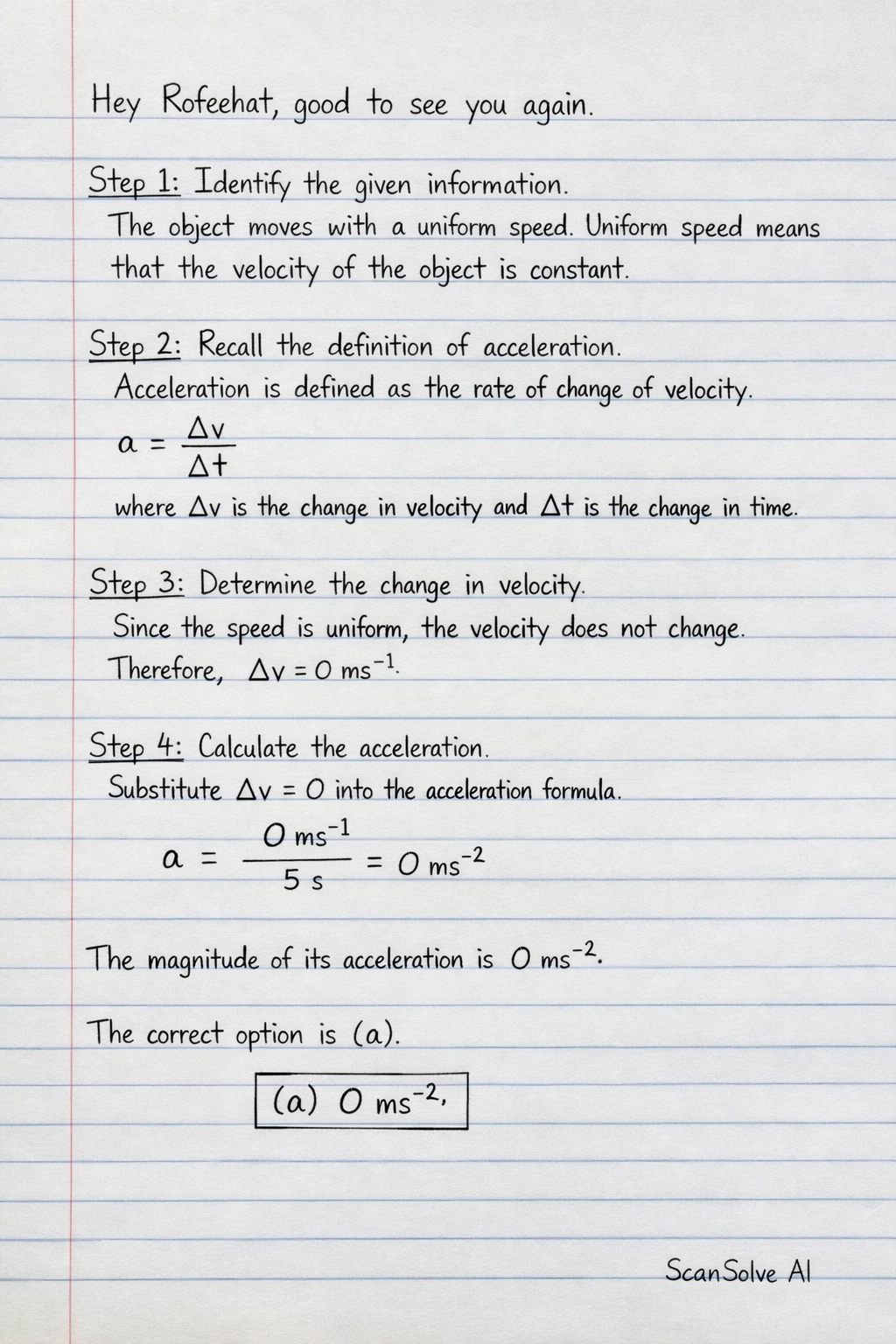
a) Step 1: Identify the given information. The object moves with a uniform speed. Uniform speed means that the velocity of the object is constant.

Step 2: Recall the definition of acceleration. Acceleration is defined as the rate of change of velocity. a=ΔvΔta = \frac{\Delta v}{\Delta t} where Δv\Delta v is the change in velocity and Δt\Delta t is the change in time.

Step 3: Determine the change in velocity. Since the speed is uniform, the velocity does not change. Therefore, the change in velocity (Δv\Delta v) is zero. Δv=0ms1\Delta v = 0 ms^{-1}

Step 4: Calculate the acceleration. Substitute Δv=0\Delta v = 0 into the acceleration formula. a=0ms15s=0ms2a = \frac{0 ms^{-1}}{5 s} = 0 ms^{-2}

The magnitude of its acceleration is 0ms20 ms^{-2}.

The correct option is (a). (a)0ms2\boxed{(a) 0 ms^{-2}} Send me the next one 📸

Was this helpful?

Need help with your own homework?

Get instant step-by-step solutions to any question. Free to start.

Ask Your Question
Handwritten step-by-step solution preview

Handwritten Step-by-Step Solution

Get this as a handwritten image on WhatsApp — like a tutor wrote it for you.

Try on WhatsApp

Still have questions?

Quick Answer

Hey Rofeehat, good to see you again. a) Step 1: Identify the given information.

An object of mass 2 kg moves with a uniform speed of 10 ms⁻¹ for 5 s along a straight path. Determine the magnitude of its acceleration. 0 ms⁻² 1.0 ms⁻² 3.0 ms⁻² 4.0 ms⁻²
Physics

This physics problem tests your understanding of fundamental physical laws and their applications. The step-by-step solution below breaks down the problem using relevant equations and physical reasoning.

ScanSolve AI Answer
Hey Rofeehat, good to see you again. a) Step 1: Identify the given information. The object moves with a uniform speed. Uniform speed means that the velocity of the object is constant. Step 2: Recall the definition of acceleration. Acceleration is defined as the rate of change of velocity. a = ( v)/( t) where v is the change in velocity and t is the change in time. Step 3: Determine the change in velocity. Since the speed is uniform, the velocity does not change. Therefore, the change in velocity ( v) is zero. v = 0 ms^-1 Step 4: Calculate the acceleration. Substitute v = 0 into the acceleration formula. a = 0 ms^-15 s = 0 ms^-2 The magnitude of its acceleration is 0 ms^-2. The correct option is (a). (a) 0 ms^-2 Send me the next one 📸