
We read your photo as:
A car initially at rest moves with a constant acceleration of 2m.s⁻² east. Calculate the Magnitude of the velocity after 10 s and Distance covered during the first 10 s.
ScanSolve AI Answer
Answers
7 partsStep-by-step solution
16 stepsPart 4
A car initially at rest moves with a constant acceleration of east.
Part 4.1
Magnitude of the velocity after 10 s
Identify the given values.
Initial velocity (at rest).
Acceleration .
Time .Use the kinematic equation to find the final velocity .
The magnitude of the velocity after is .
Part 4.2
Distance covered during the first 10 s
Identify the given values.
Initial velocity .
Acceleration .
Time .Use the kinematic equation to find the distance .
The distance covered during the first is .
Part 6
Part 6.1
Define the term acceleration.
Acceleration is the rate of change of velocity of an object over time. It is a vector quantity, meaning it has both magnitude and direction.
Part 6.2
Convert 77 km.h⁻¹ to m.s⁻¹.
Convert kilometers to meters and hours to seconds.
Apply the conversion factors.
The velocity of car A is .
Part 6.3
Determine the velocity of CAR B while chasing CAR A.
Identify the given values for car B.
Initial velocity (from rest).
Acceleration .
Time .Use the kinematic equation to find the final velocity .
The velocity of car B after is .
Part 6.4
How far has CAR B driven after 6,5 seconds?
Identify the given values for car B.
Initial velocity .
Acceleration .
Time .Use the kinematic equation to find the distance .
Car B has driven (rounded to two decimal places).
Part 6.5
How far did CAR A travel in that 6,5 seconds?
Identify the given values for car A.
Constant velocity (from 6.2).
Time .Use the formula for distance with constant velocity .
Car A traveled (rounded to two decimal places).
Part 6.6· 2 steps
Will CAR B be able to catch up with CAR A? Explain your answer.
Compare the distances covered by both cars after .
Car A's distance .
Car B's distance .
At , Car B is behind Car A ().Compare their velocities after .
Car A's velocity (constant).
Car B's velocity (after , it continues at this constant velocity).
Since Car B's constant velocity () is less than Car A's constant velocity (), Car B will not be able to catch up with Car A.Explanation: ❌ No, Car B will not be able to catch up with Car A. After , Car B is still behind Car A ( vs ). Furthermore, Car B's velocity () is less than Car A's velocity (), and Car B continues at this constant, slower velocity. Therefore, the distance between them will continue to increase.
Part 6.7
What acceleration does CAR A experience to come to a standstill after 2,5 s?
Identify the given values for car A during braking.
Final velocity (comes to a standstill).
Distance .
Time .Use the kinematic equations to find acceleration .
We have and .
From , we can express as .
Substitute this into the distance equation:The acceleration car A experiences is . The negative sign indicates deceleration.
Try one yourself
A new problem that tests the same skill.
Still stuck on this one?
Ask a follow-up, and the answer starts from this question.
More Physics Questions
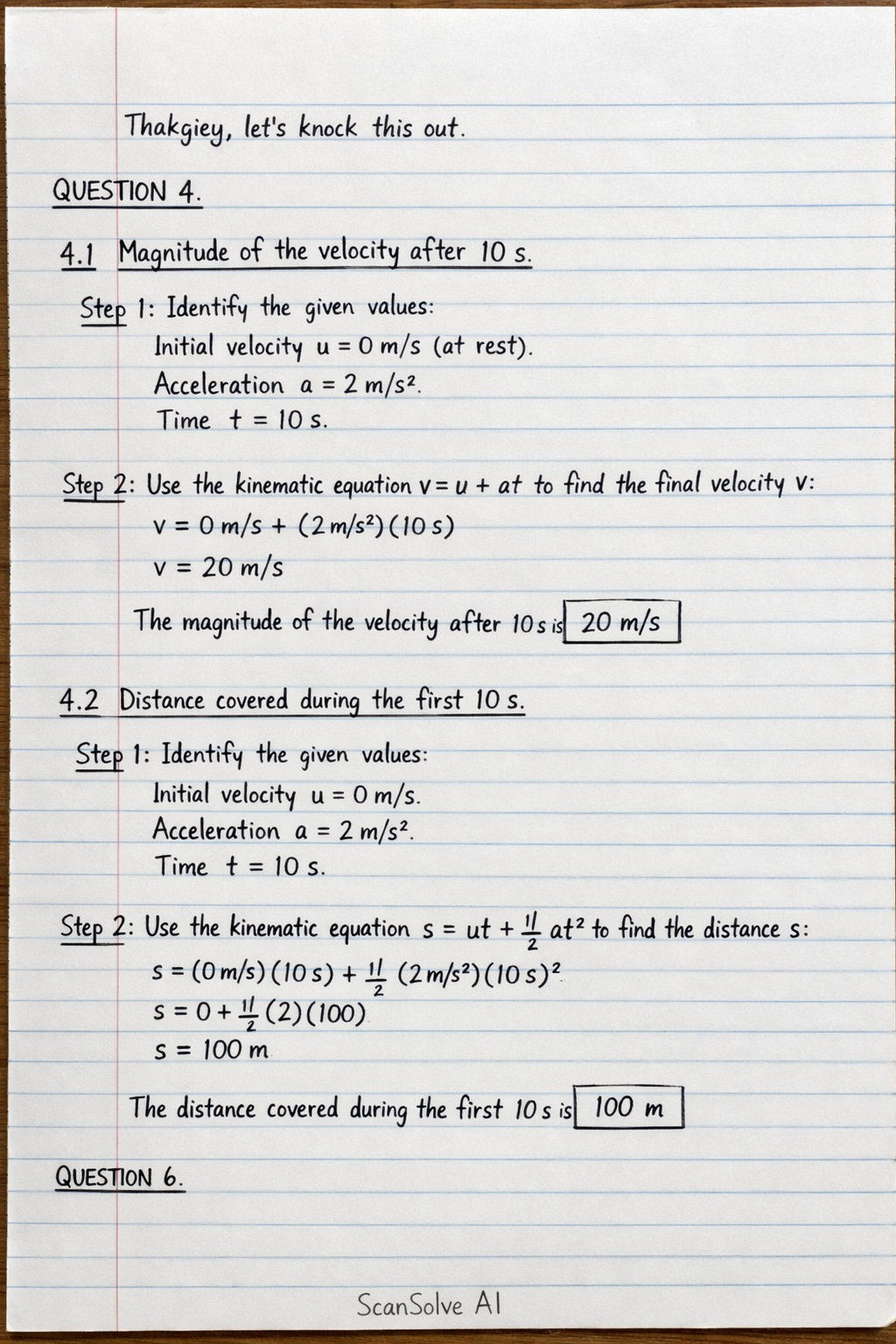
Handwritten Step-by-Step Solution
Get this as a handwritten image on WhatsApp — like a tutor wrote it for you.
Try on WhatsApp