
We read your photo as:
A ray of white light now strikes the prism. (i) On Fig. 3.2, draw what happens to the light as it passes through the prism and strikes the screen. [2] (ii) Describe what is seen on the screen.
ScanSolve AI Answer
Step-by-step solution
5 stepsPart c(i)· 3 steps
Draw the refraction and dispersion at the first surface.
When the white light ray enters the prism, it refracts and disperses into its constituent colors. Violet light bends the most, and red light bends the least.
Draw the refraction at the second surface.
The dispersed light rays then refract again as they exit the prism. The violet ray will be deviated more than the red ray.
Show the spectrum on the screen.
The separated colors will strike the screen, forming a spectrum.
\begin{tikzpicture}[scale=0.8]
% Filament lamp and slit (as given in the image)
\draw (0,3) circle (0.3) node[right] {};
\draw (0,3) -- (0.2,3.2);
\draw (0,3) -- (-0.2,3.2);
\draw (0,3) -- (0.2,2.8);
\draw (0,3) -- (-0.2,2.8);
\draw[fill=gray!20] (-0.5,2.5) rectangle (0.5,2.7);
\node at (0, 2.2) {filament lamp};

% White light ray
\draw[->, thick] (0.5, 2.6) -- (3, 1.5) node[above right] {white light};

% Prism
\draw (3,1.5) -- (6,1.5) -- (4.5,-1) -- cycle;

% Screen
\draw (7,-2) -- (7,-0.5) node[right] {screen};

% Light path through prism
% Entry point
\coordinate (entry) at (3,1.5);
% Exit points
\coordinate (exit_red) at (5.2, 0.2); % Approximate exit for red
\coordinate (exit_violet) at (4.8, -0.4); % Approximate exit for violet

% Inside the prism
\draw[red, thick] (entry) -- (exit_red);
\draw[violet, thick] (entry) -- (exit_violet);

% Exiting rays to screen
\draw[red, ->, thick] (exit_red) -- (7, -0.8) node[above] {Red};
\draw[violet, ->, thick] (exit_violet) -- (7, -1.7) node[below] {Violet};

% Intermediate colors (optional, but good for visual representation of spectrum)
\draw[orange, thick] (entry) -- ($(entry)!0.6! (exit_red)$);
\draw[orange, ->, thick] ($(entry)!0.6! (exit_red)$) -- (7, -1.0);

\draw[yellow, thick] (entry) -- ($(entry)!0.5! (exit_red)$);
\draw[yellow, ->, thick] ($(entry)!0.5! (exit_red)$) -- (7, -1.2);

\draw[green, thick] (entry) -- ($(entry)!0.5! (exit_violet)$);
\draw[green, ->, thick] ($(entry)!0.5! (exit_violet)$) -- (7, -1.3);

\draw[blue, thick] (entry) -- ($(entry)!0.7! (exit_violet)$);
\draw[blue, ->, thick] ($(entry)!0.7! (exit_violet)$) -- (7, -1.5);

\end{tikzpicture}
Part c(ii)· 2 steps
Describe the phenomenon.
When white light passes through a prism, it undergoes dispersion, splitting into its constituent colors.
Describe the appearance on the screen.
A band of colors, known as a spectrum, will be seen on the screen. The colors will be arranged in order from red (least deviated) to violet (most deviated).
Still stuck on this one?
Ask a follow-up, and the answer starts from this question.
More Physics Questions
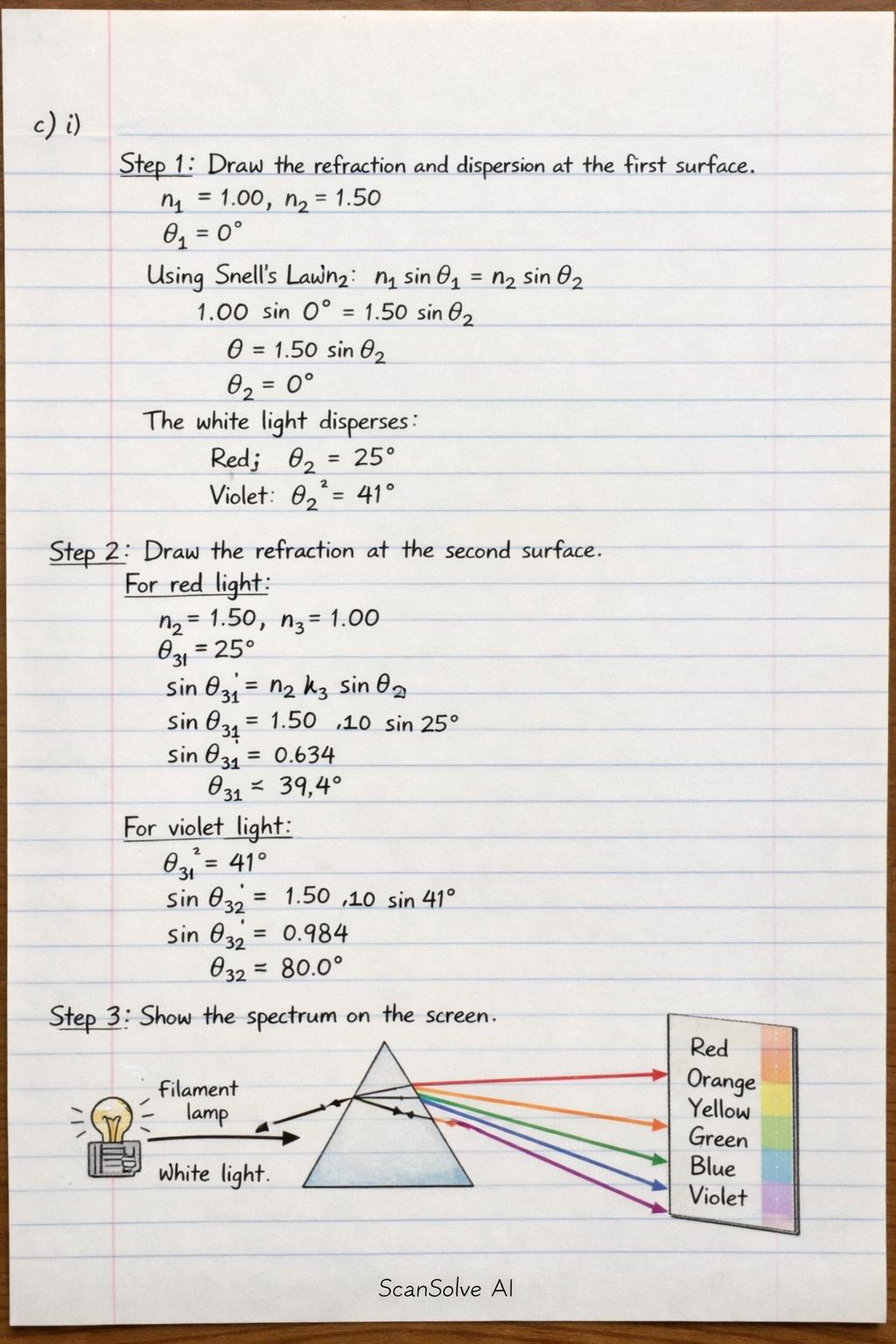
Handwritten Step-by-Step Solution
Get this as a handwritten image on WhatsApp — like a tutor wrote it for you.
Try on WhatsApp