
We read your photo as:
In the gravitational force investigation, the formula F = mg is used. What does 'g' represent?
ScanSolve AI Answer
Answer
Step-by-step solution
5 stepsPart 25
In the gravitational force investigation, the formula is used. What does 'g' represent?
- A) Gravitational field strength (9.8 m/s)
In the formula , represents the gravitational force (weight), is the mass of the object, and is the acceleration due to gravity or gravitational field strength. Its approximate value on Earth is 9.8 m/s.
The correct answer is A).
Part 26
Velocity differs from speed because velocity
- B) Includes both magnitude and direction
Speed is a scalar quantity, meaning it only has magnitude. Velocity is a vector quantity, meaning it has both magnitude (speed) and direction.
The correct answer is B).
Part 27· 2 steps
A car travels 300 km in 5 hours. What is its average speed?
Use the formula for average speed.
Substitute the given values.
The average speed is 60 km/h.
The correct answer is B).
Part 28
Acceleration is defined as
- B) The change in velocity per unit time
Acceleration is the rate at which an object's velocity changes over time.
The correct answer is B).
Part 29· 3 steps
If a car accelerates from 0 m/s to 20 m/s in 5 seconds, what is its acceleration?
Identify the given values.
Initial velocity () =
Final velocity () =
Time () =Use the formula for acceleration.
Substitute the values and calculate.
The acceleration of the car is 4 m/s.
The correct answer is B).
Part 30
Cohesive force refers to
- B) The attraction between molecules of same substance
Cohesive forces are the attractive forces between molecules of the same type. Adhesion refers to the attraction between molecules of different types.
The correct answer is B).
Part 31
In the capillary action experiment with water in a glass tube, water rises because
- B) Adhesion and cohesion work together to pull water up
Capillary action occurs due to the combined effects of adhesive forces (attraction between water molecules and the glass tube) and cohesive forces (attraction between water molecules themselves). Adhesion pulls the water up the sides of the tube, and cohesion pulls the rest of the water column along.
The correct answer is B).
Part 32
Which real-life application of force involves friction allowing us to perform an action?
- B) Gripping an object
Friction is essential for gripping an object, as it provides the necessary resistance to prevent the object from slipping out of your hand.
The correct answer is B).
Part 33
Fossil fuels are best described as
- B) Non-renewable resources derived from ancient plants and animals
Fossil fuels (like coal, oil, and natural gas) are formed over millions of years from the remains of dead organisms and are considered non-renewable because they are consumed much faster than they are formed.
The correct answer is B).
Part 34
Which of the following is NOT an example of a fossil fuel?
- D) Solar energy
Coal, natural gas, and crude oil are all types of fossil fuels. Solar energy is a renewable energy source derived from the sun.
The correct answer is D).
Try one yourself
A new problem that tests the same skill.
Still stuck on this one?
Ask a follow-up, and the answer starts from this question.
More Physics Questions
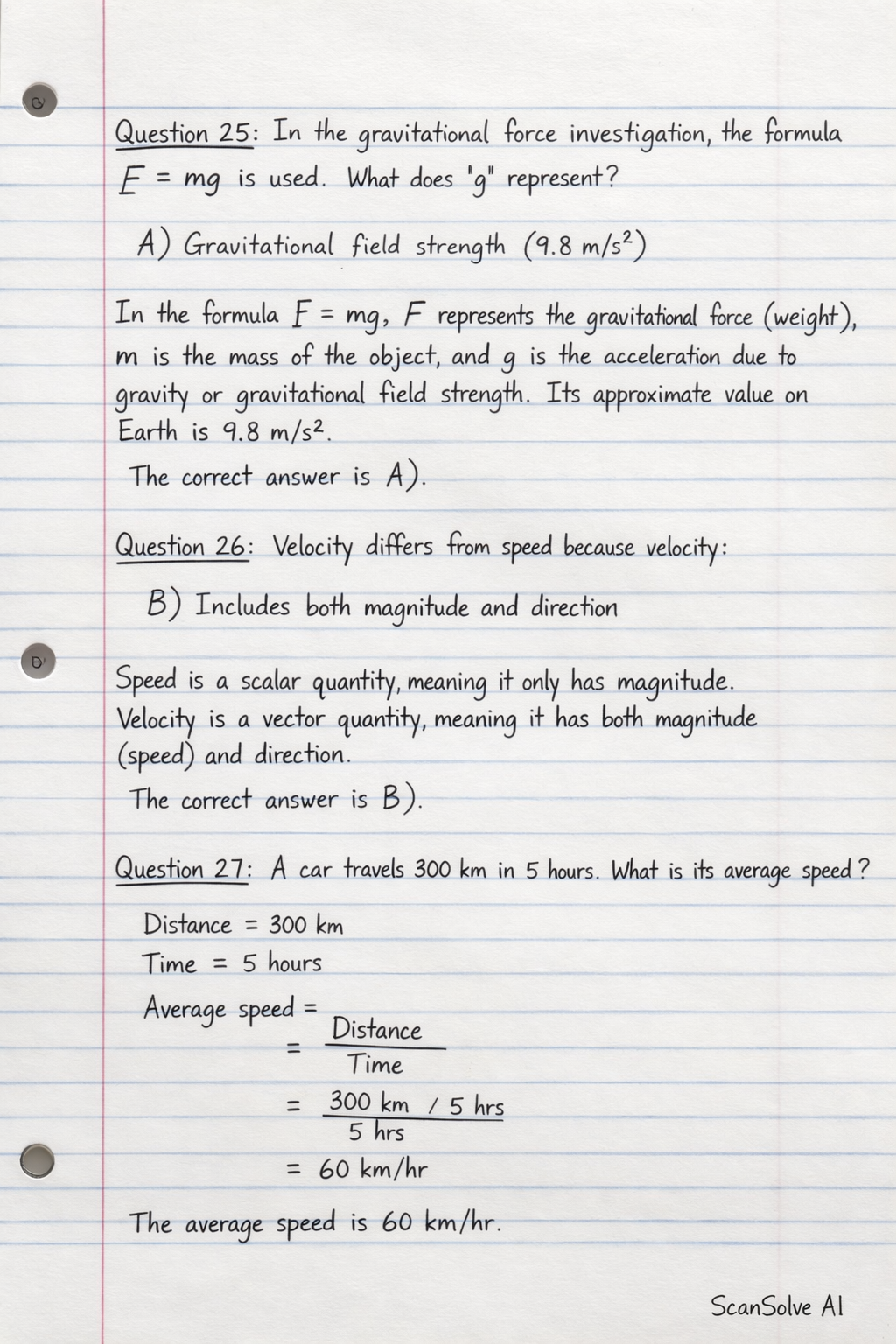
Handwritten Step-by-Step Solution
Get this as a handwritten image on WhatsApp — like a tutor wrote it for you.
Try on WhatsApp