

This physics problem tests your understanding of fundamental physical laws and their applications. The step-by-step solution below breaks down the problem using relevant equations and physical reasoning.
ScanSolve AI Answer
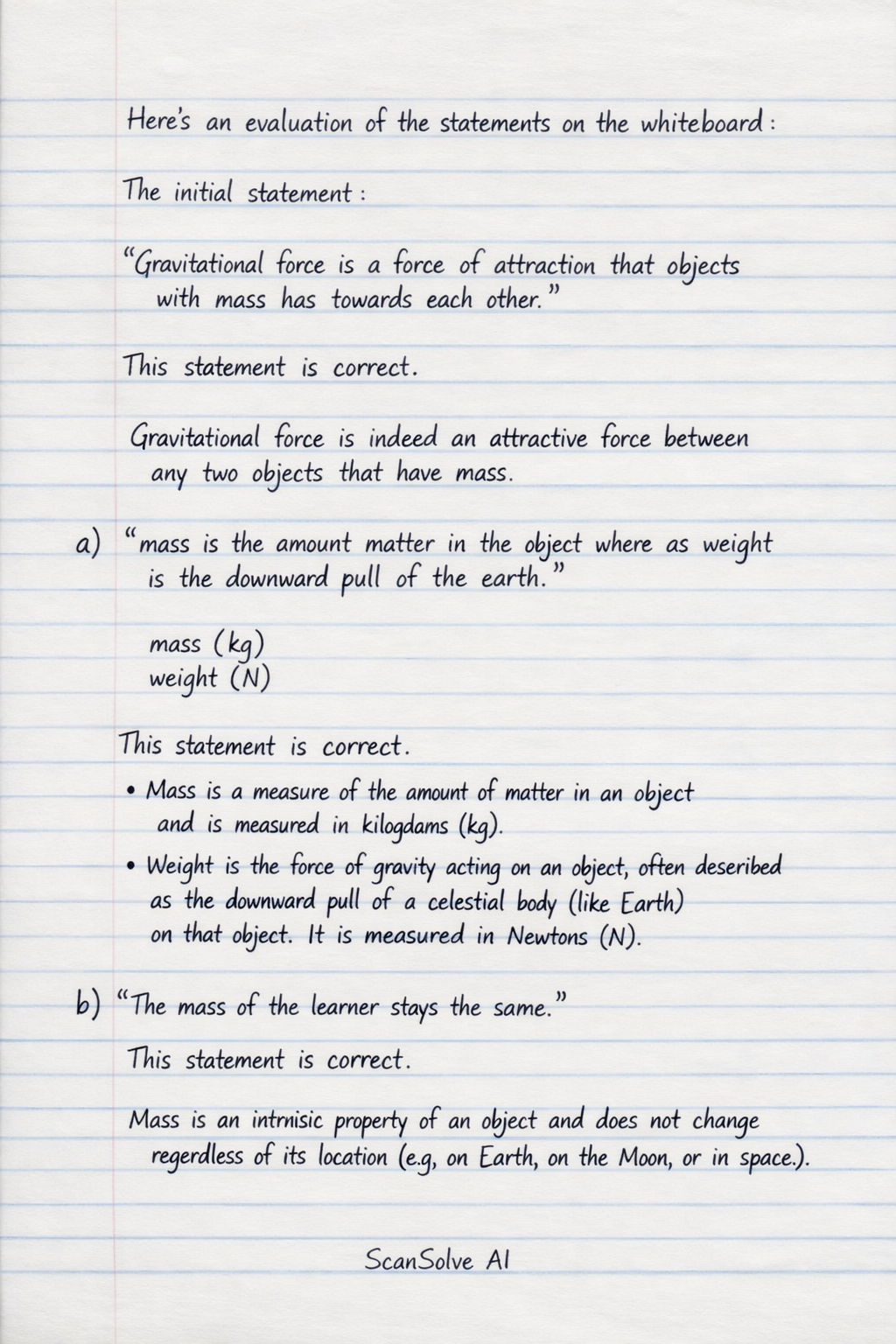
Here's an evaluation of the statements on the whiteboard: The initial statement: "Gravitational force is a force of attraction that objects with mass has towards each other." This statement is correct. Gravitational force is indeed an attractive force between any two objects that have mass. a) "mass is the amount matter in the object where as weight is the downward pull of the earth." "mass (kg)" "weight (N)" This statement is correct. • Mass is a measure of the amount of matter in an object and is measured in kilograms (kg). • Weight is the force of gravity acting on an object, often described as the downward pull of a celestial body (like Earth) on that object. It is measured in Newtons (N). b) "The mass of the learner stays the same." This statement is correct. Mass is an intrinsic property of an object and does not change regardless of its location (e.g., on Earth, on the Moon, or in space). c) "The weight on earth is greater than on the moon." This statement is correct. Weight is calculated as mass multiplied by the acceleration due to gravity (W = mg). Since the acceleration due to gravity on Earth (≈ 9.8 \, m/s^2) is much greater than on the Moon (≈ 1.62 \, m/s^2), an object's weight will be greater on Earth than on the Moon. All the statements on the whiteboard are correct. Send me the next one 📸