

This physics problem tests your understanding of fundamental physical laws and their applications. The step-by-step solution below breaks down the problem using relevant equations and physical reasoning.
ScanSolve AI Answer
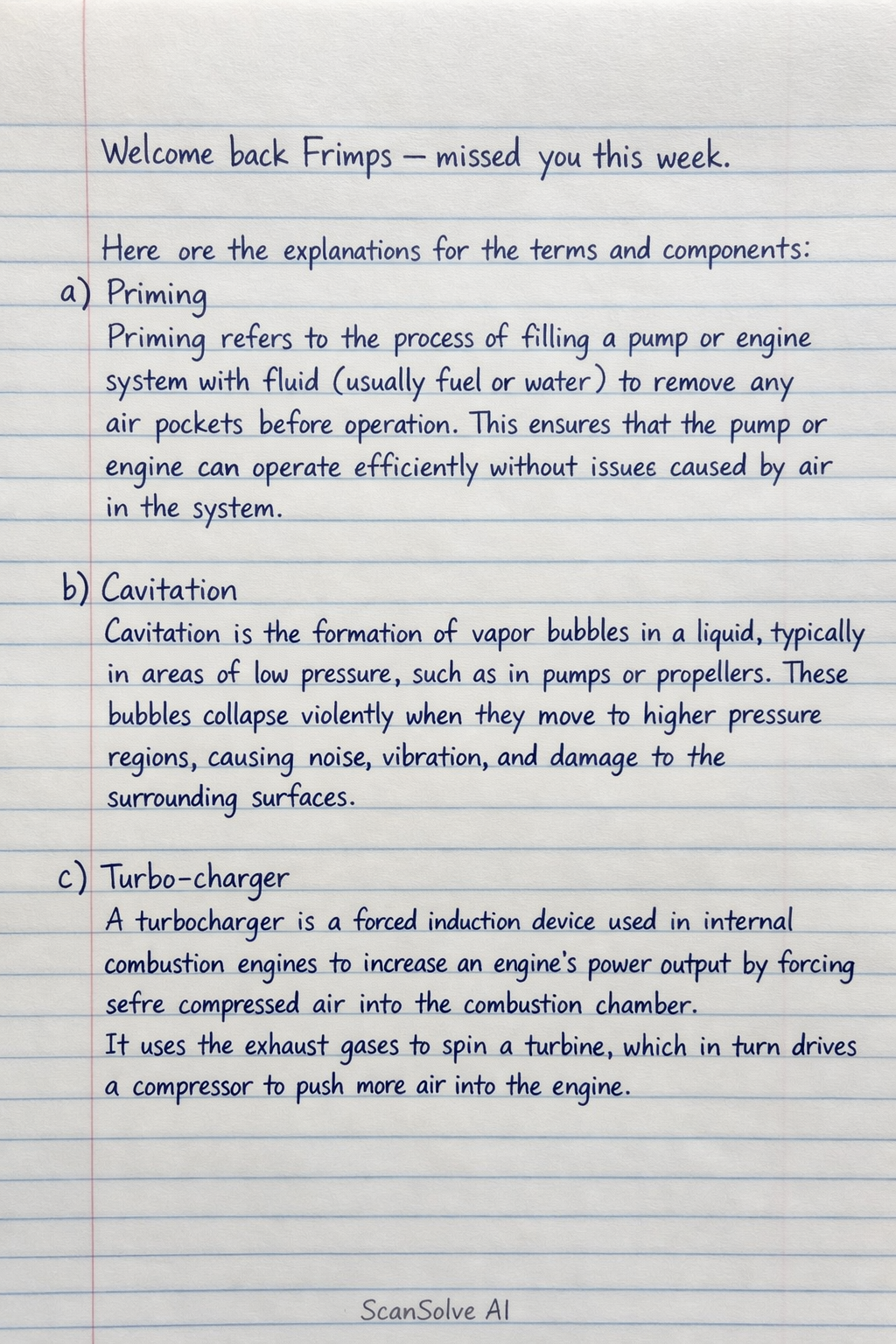
Here are the explanations for the terms and components: a) Priming Priming refers to the process of filling a pump or engine system with fluid (usually fuel or water) to remove any air pockets before operation. This ensures that the pump or engine can operate efficiently without issues caused by air in the system. b) Cavitation Cavitation is the formation of vapor bubbles in a liquid, typically in areas of low pressure, such as in pumps or propellers. These bubbles collapse violently when they move to higher pressure regions, causing noise, vibration, and damage to the surrounding surfaces. c) Turbo-charger A turbocharger is a forced induction device used in internal combustion engines to increase an engine's power output by forcing extra compressed air into the combustion chamber. It uses the exhaust gases to spin a turbine, which in turn drives a compressor to push more air into the engine. d) Flywheel A flywheel is a mechanical device that stores rotational energy. In an engine, it smooths out the power delivery by absorbing energy during power strokes and releasing it during non-power strokes, thus maintaining a more constant rotational speed and reducing vibrations. Send me the next one 📸