
We read your photo as:
Describe the four strokes of a four-stroke engine and list five key components. Calculate the final pressure of steam after adiabatic expansion.
ScanSolve AI Answer
Step-by-step solution
2 stepsQ1.
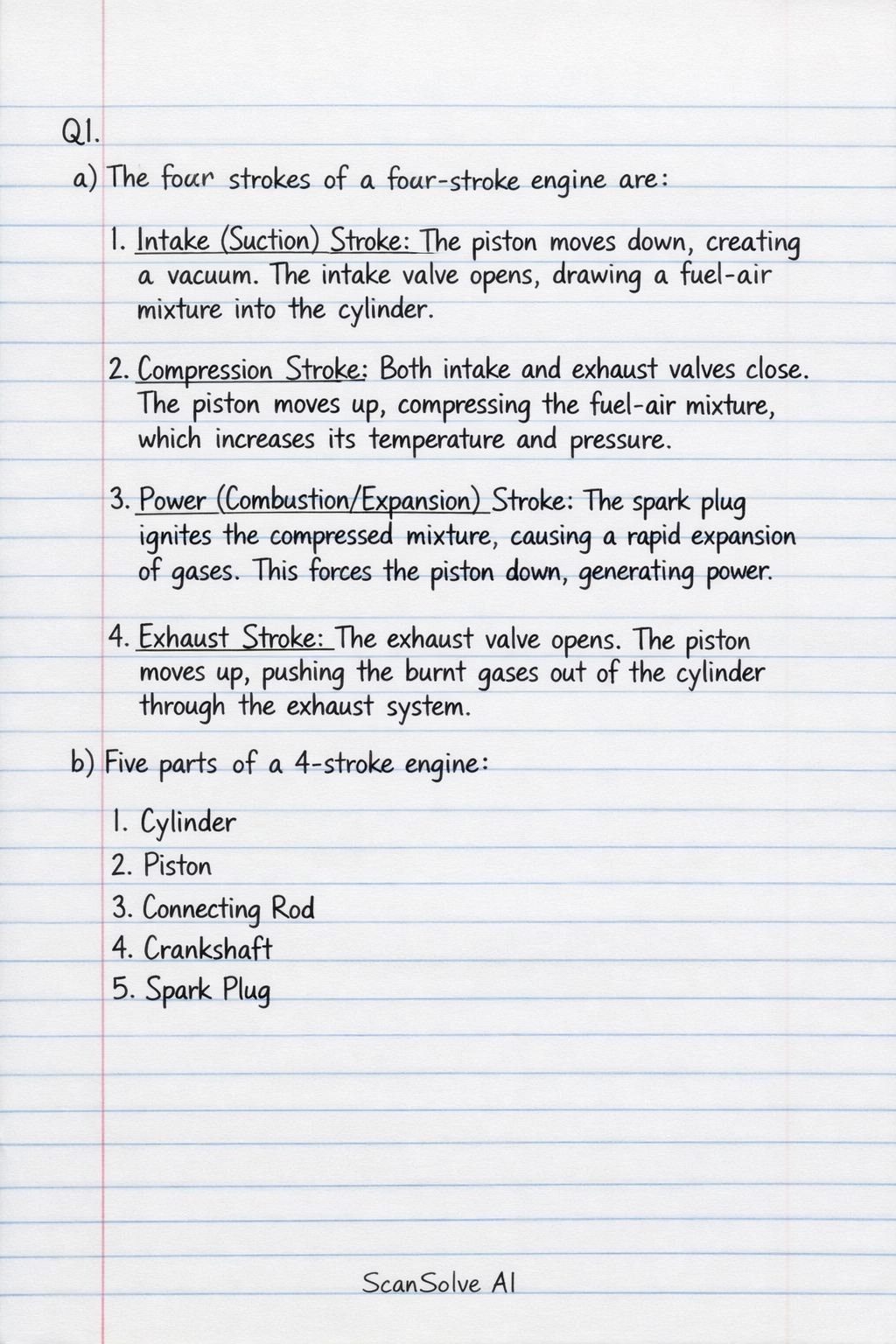
a) The four strokes of a four-stroke engine are:
- Intake (Suction) Stroke: The piston moves down, creating a vacuum. The intake valve opens, drawing a fuel-air mixture into the cylinder.
- Compression Stroke: Both intake and exhaust valves close. The piston moves up, compressing the fuel-air mixture, which increases its temperature and pressure.
- Power (Combustion/Expansion) Stroke: The spark plug ignites the compressed mixture, causing a rapid expansion of gases. This forces the piston down, generating power.
- Exhaust Stroke: The exhaust valve opens. The piston moves up, pushing the burnt gases out of the cylinder through the exhaust system.
b) Five parts of a 4-stroke engine:
- Cylinder
- Piston
- Connecting Rod
- Crankshaft
- Spark Plug
Q2.
Calculate the steam pressure after adiabatic expansion.
For an adiabatic process, the relationship between pressure and volume is given by:
Given:
Rearranging the formula to solve for :
Substitute the given values:
Calculate the greatest possible efficiency of the engine (Carnot efficiency).
The greatest possible efficiency for a heat engine operating between two temperatures is given by the Carnot efficiency formula:
Where is the absolute temperature of the hot reservoir and is the absolute temperature of the cold reservoir.
The steam enters at . The saturation temperature of steam at (approximately ) is about .
The steam exhausts to the atmosphere, which implies a cold reservoir temperature corresponding to atmospheric pressure (). The saturation temperature of steam at () is .Convert temperatures to Kelvin:
Now, calculate the efficiency:
To express as a percentage:
The steam pressure after expansion is and the greatest possible efficiency of the engine is
\boxed{\text{19.09%}}.Q3.
a) The four thermodynamic changes are:
- Isothermal Process: A process where the temperature of the system remains constant ().
- Equation: (Boyle's Law)
- Graph (P-V diagram): A hyperbolic curve. Work is done by or on the system, and heat is exchanged to maintain constant temperature.
- Adiabatic Process: A process where no heat is exchanged between the system and its surroundings ().
- Equation:
- Graph (P-V diagram): A steeper hyperbolic curve than an isothermal process. Temperature changes during an adiabatic process.
- Isobaric Process: A process where the pressure of the system remains constant ().
- Equation: (Charles's Law)
- Graph (P-V diagram): A horizontal line. Work is done as the volume changes, and heat is exchanged.
- Isochoric (Isovolumetric) Process: A process where the volume of the system remains constant ().
- Equation: (Gay-Lussac's Law)
- Graph (P-V diagram): A vertical line. No work is done by or on the system, and all heat exchanged goes into changing the internal energy.
b) The adiabatic index (or heat capacity ratio, ) is the ratio of the specific heat capacity at constant pressure () to the specific heat capacity at constant volume () for a gas. It is a dimensionless quantity that indicates how much the temperature of a gas changes when it is compressed or expanded adiabatically.
Q4.
a) The Zeroth Law of Thermodynamics states that if two thermodynamic systems are each in thermal equilibrium with a third system, then they are in thermal equilibrium with each other. This law establishes the concept of temperature as a fundamental property.
b) The Carnot cycle graph (P-V diagram) consists of four reversible processes:
- Isothermal Expansion (A to B): The working substance expands at a constant high temperature (), absorbing heat () from the hot reservoir. (Curve sloping downwards and to the right).
- Adiabatic Expansion (B to C): The working substance continues to expand, but without heat exchange (). Its temperature drops from to . (Steeper curve sloping downwards and to the right).
- Isothermal Compression (C to D): The working substance is compressed at a constant low temperature (), rejecting heat () to the cold reservoir. (Curve sloping upwards and to the left).
- Adiabatic Compression (D to A): The working substance is further compressed without heat exchange (). Its temperature rises from back to . (Steeper curve sloping upwards and to the left, completing the cycle). The area enclosed by the cycle represents the net work done () by the engine.
c) The principles of heat engines are:
- A heat engine operates by taking heat from a high-temperature reservoir (source).
- It converts a portion of this heat into mechanical work.
- It rejects the remaining heat to a low-temperature reservoir (sink).
- The engine operates in a cyclic process, returning to its initial state after each cycle.
Q5.
a) The Fleming's Left-Hand Rule is used to determine the direction of the force on a current-carrying conductor placed in a magnetic field.
- Thumb: Represents the direction of the Force (or motion) on the conductor.
- Forefinger: Represents the direction of the Magnetic Field (North to South).
- Middle Finger: Represents the direction of the Current (positive to negative).
b) The force on a current-carrying conductor in a uniform magnetic field depends on three factors:
- Strength of the magnetic field ()
- Magnitude of the current ()
- Length of the conductor () within the magnetic field (and the angle between the current and the magnetic field).
c)
i. isolated north pole: Magnetic field lines would originate from the pole and radiate outwards in all directions.
ii. isolated south pole: Magnetic field lines would converge towards the pole from all directions.
iii. two dissimilar poles together (North and South): Magnetic field lines would emerge from the North pole and enter the South pole, forming continuous loops outside the magnets, indicating attraction.
iv. two like poles together (North and North, or South and South): Magnetic field lines would emerge from both North poles (or enter both South poles) and repel each other, bending away from the region between the poles, indicating repulsion.Q6.
a) A step-down transformer is an electrical device that converts high-voltage, low-current alternating current (AC) from its primary coil into low-voltage, high-current AC in its secondary coil. This is achieved by having fewer turns in the secondary winding compared to the primary winding.
b) Five losses in a transformer:
- Copper Losses (I²R Losses): Heat generated due to the resistance of the primary and secondary windings when current flows through them.
- Eddy Current Losses: Circulating currents induced in the transformer core by the changing magnetic flux, leading to heat generation.
- Hysteresis Losses: Energy loss due to the repeated magnetization and demagnetization of the transformer core material as the AC current reverses direction.
- Flux Leakage: A portion of the magnetic flux produced by the primary winding does not link with the secondary winding, reducing efficiency.
- Mechanical Losses (Humming Losses): Vibrations and noise produced by
- Isothermal Process: A process where the temperature of the system remains constant ().
Still stuck on this one?
Ask a follow-up, and the answer starts from this question.
More Physics Questions
Handwritten Step-by-Step Solution
Get this as a handwritten image on WhatsApp — like a tutor wrote it for you.
Try on WhatsApp