

This physics problem tests your understanding of fundamental physical laws and their applications. The step-by-step solution below breaks down the problem using relevant equations and physical reasoning.
ScanSolve AI Answer
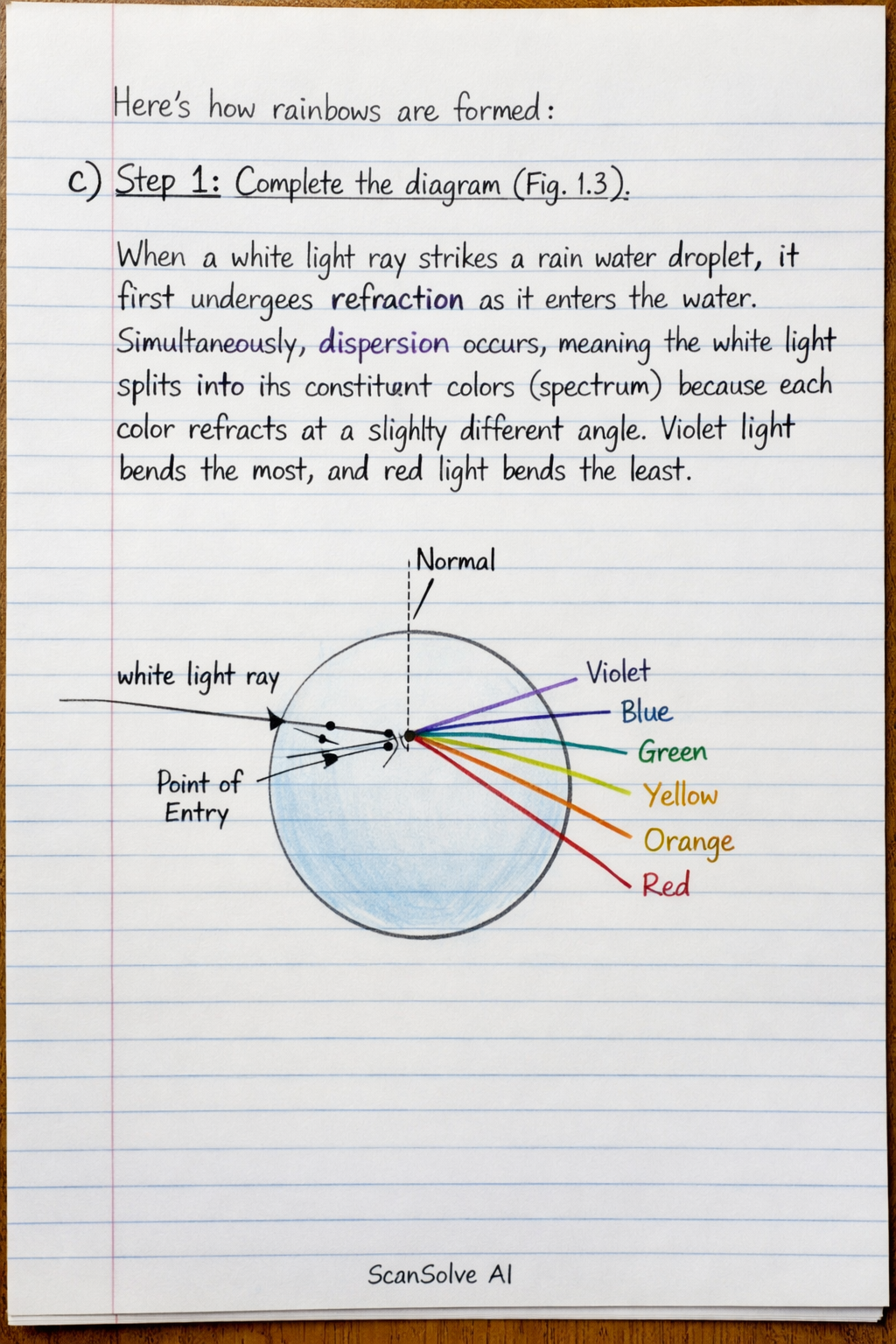
Here's how rainbows are formed: c) Step 1: Complete the diagram (Fig. 1.3). When a white light ray strikes a rain water droplet, it first undergoes refraction as it enters the water. Simultaneously, dispersion occurs, meaning the white light splits into its constituent colors (spectrum) because each color refracts at a slightly different angle. Violet light bends the most, and red light bends the least. [scale=0.8] % Water droplet (0,0) circle (2cm); at (0, 1.5) water droplet; % Incoming white light ray [->] (-4, 1.5) -- (-1.5, 1.5) node[above] white light ray; % Point of entry (entry) at (-1.5, 1.5); (center) at (0,0); % Normal at entry point [dashed] (entry) -- ((center)!2cm!(entry)); % Refraction and Dispersion inside % Red light (bends less) (red_internal_start) at ((entry)!0.5cm!((-0.5, 1.2))); % Adjusted to make it look like it bends less (red_internal_end) at ((center)!-1.5cm!(red_internal_start)); % Reflects to the other side [red, thick] (entry) -- (red_internal_end); % Violet light (bends more) (violet_internal_start) at ((entry)!0.5cm!((-0.7, 1.0))); % Adjusted to make it look like it bends more (violet_internal_end) at ((center)!-1.5cm!(violet_internal_start)); % Reflects to the other side [violet, thick] (entry) -- (violet_internal_end); % Internal Reflection % Normal at reflection point for red [dashed] (red_internal_end) -- ((center)!2cm!(red_internal_end)); % Reflected red ray (red_reflected_end) at ((center)!-1.5cm!(red_internal_end)); [red, thick] (red_internal_end) -- (red_reflected_end); % Normal at reflection point for violet [dashed] (violet_internal_end) -- ((center)!2cm!(violet_internal_end)); % Reflected violet ray (violet_reflected_end) at ((center)!-1.5cm!(violet_internal_end)); [violet, thick] (violet_internal_end) -- (violet_reflected_end); % Second Refraction (exiting the droplet) % Normal at exit point for red [dashed] (red_reflected_end) -- ((center)!2cm!(red_reflected_end)); % Exiting red ray [red, ->, thick] (red_reflected_end) -- ((red_reflected_end)!2cm!((-2.5, -2.5))); % Bends away from normal % Normal at exit point for violet [dashed] (violet_reflected_end) -- ((center)!2cm!(violet_reflected_end)); % Exiting violet ray [violet, ->, thick] (violet_reflected_end) -- ((violet_reflected_end)!2cm!((-2.0, -3.0))); % Bends away from normal Step 2: Explain the process. After entering the droplet and dispersing, the individual colors travel to the back inner surface of the droplet. Here, they undergo internal reflection, bouncing off the back surface and heading towards the front of the droplet. Step 3: Explain the final stage. Finally, these internally reflected, dispersed light rays reach the front surface of the droplet again and undergo a second refraction as they exit the water and re-enter the air. This second refraction further separates the colors. An observer sees these dispersed colors at specific angles, with red light appearing at a higher angle and violet light at a lower angle, forming a rainbow. 3 done, 2 left today. You're making progress.