
We read your photo as:
Explain how total internal reflection is involved in the formation of a rainbow.
ScanSolve AI Answer
Answer
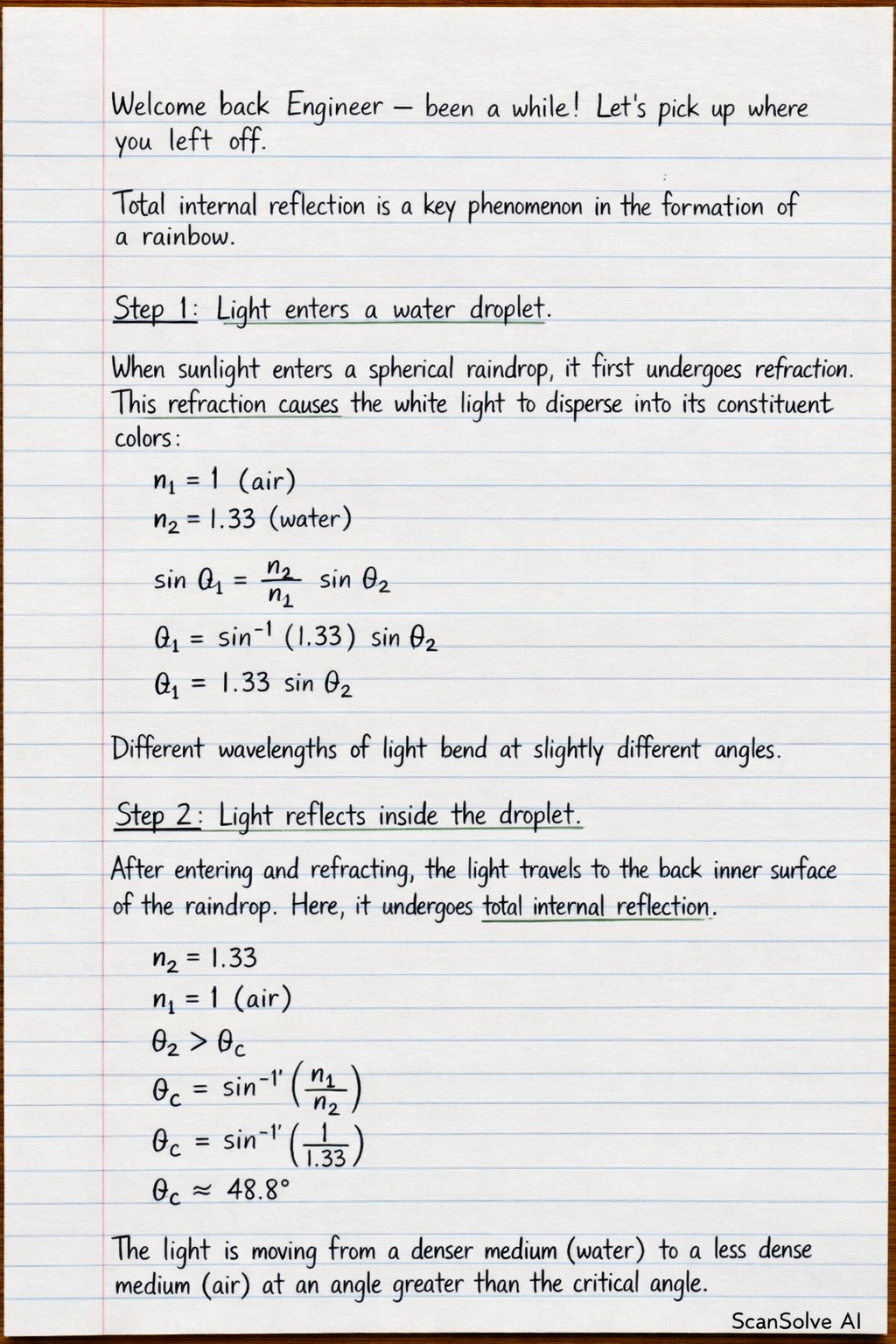
Total internal reflection is a key phenomenon in the formation of a rainbow.
Step-by-step solution
3 stepsLight enters a water droplet*.
When sunlight enters a spherical raindrop, it first undergoes refraction. This refraction causes the white light to disperse into its constituent colors (like red, orange, yellow, green, blue, indigo, violet) because different wavelengths of light bend at slightly different angles.
Light reflects inside the droplet*.
After entering and refracting, the light travels to the back inner surface of the raindrop. Here, it undergoes total internal reflection. This happens because the light is moving from a denser medium (water) to a less dense medium (air) at an angle greater than the critical angle.
Light exits the water droplet*.
Finally, the light reflects off the back of the droplet and travels to the front surface, where it undergoes a second refraction as it exits the raindrop and travels towards the observer's eyes. The combination of two refractions and one total internal reflection separates the colors and directs them to our eyes, creating the arc of a rainbow.
The phenomenon of total internal reflection ensures that the light is reflected efficiently within the raindrop, allowing the dispersed colors to be seen by an observer.
Still stuck on this one?
Ask a follow-up, and the answer starts from this question.
More Physics Questions
Handwritten Step-by-Step Solution
Get this as a handwritten image on WhatsApp — like a tutor wrote it for you.
Try on WhatsApp