

This physics problem tests your understanding of fundamental physical laws and their applications. The step-by-step solution below breaks down the problem using relevant equations and physical reasoning.
ScanSolve AI Answer
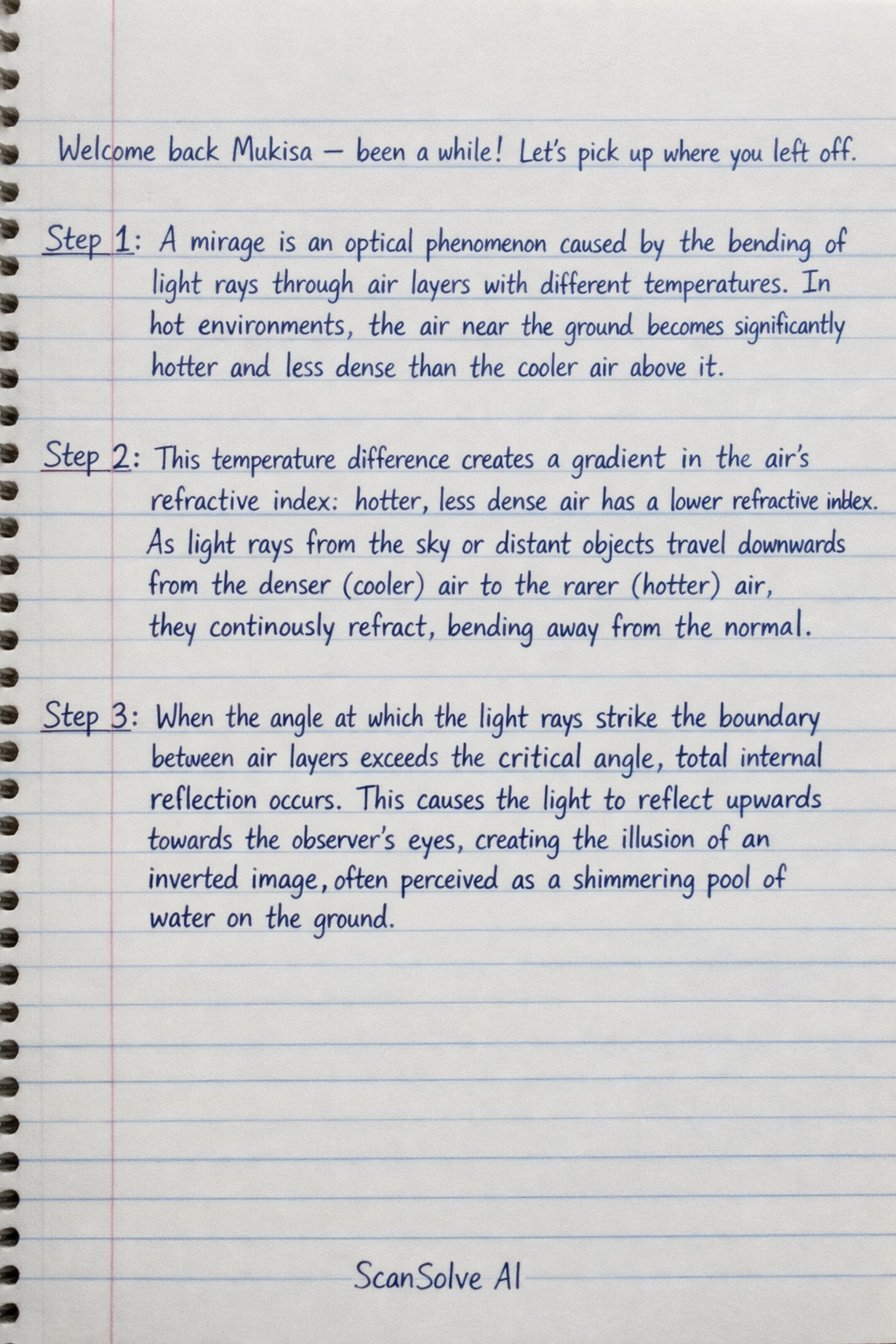
Step 1: A mirage is an optical phenomenon caused by the bending of light rays through air layers with different temperatures. In hot environments, such as over a desert or a hot road, the air near the ground becomes significantly hotter and less dense than the cooler air above it. Step 2: This temperature difference creates a gradient in the air's refractive index; hotter, less dense air has a lower refractive index. As light rays from the sky or distant objects travel downwards from the denser (cooler) air to the rarer (hotter) air, they continuously refract, bending away from the normal. Step 3: When the angle at which the light rays strike the boundary between air layers exceeds the critical angle, total internal reflection occurs. This causes the light to reflect upwards towards the observer's eyes, creating the illusion of an inverted image, often perceived as a shimmering pool of water on the ground. Send me the next one 📸