
We read your photo as:
Explain the process of rainbow formation, including the roles of refraction, reflection, and dispersion.
ScanSolve AI Answer
Step-by-step solution
4 stepsIdentify the key components for rainbow formation.
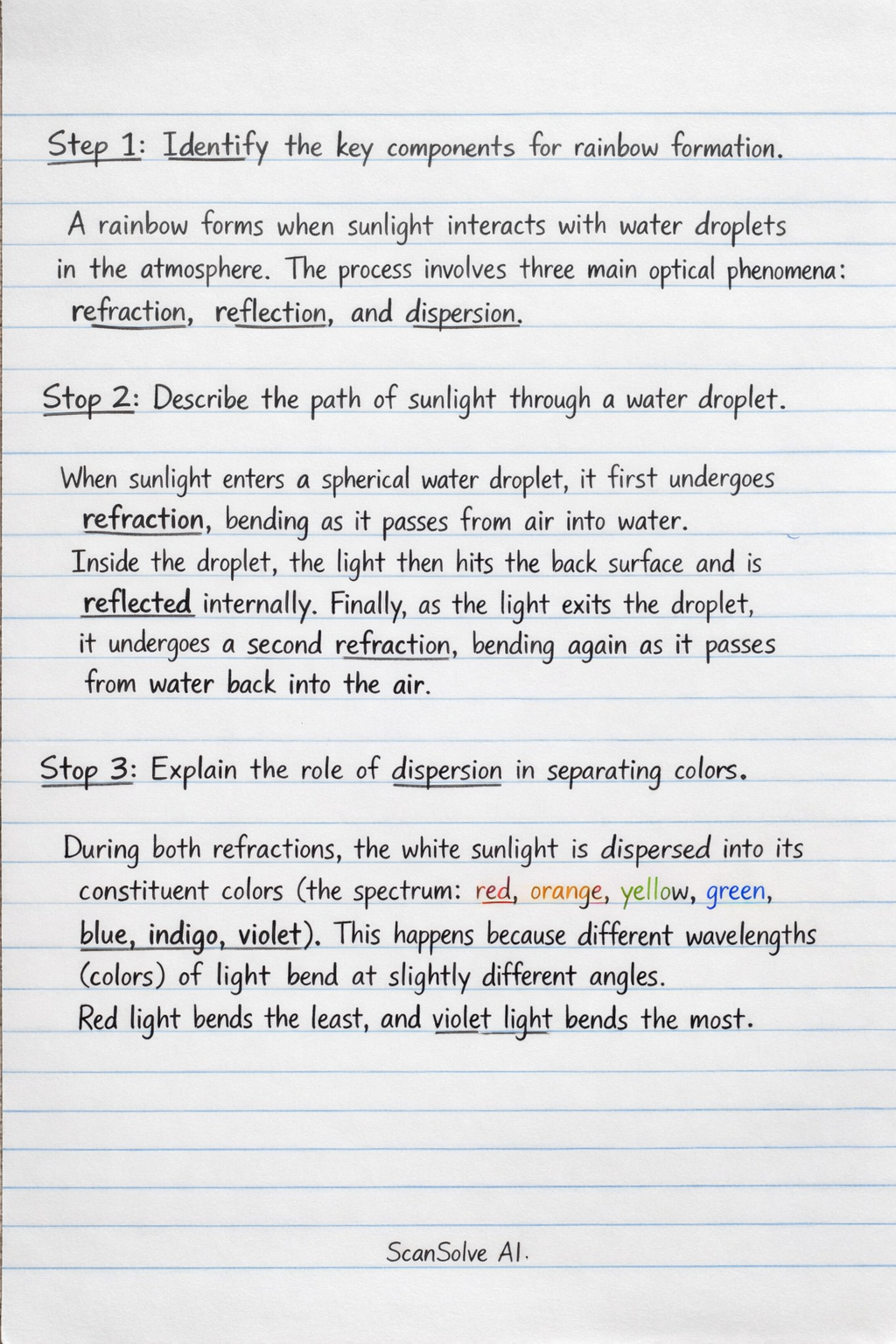
A rainbow forms when sunlight interacts with water droplets in the atmosphere. The process involves three main optical phenomena: refraction, reflection, and dispersion.
Describe the path of sunlight through a water droplet.
When sunlight enters a spherical water droplet, it first undergoes refraction, bending as it passes from air into water. Inside the droplet, the light then hits the back surface and is reflected internally. Finally, as the light exits the droplet, it undergoes a second refraction, bending again as it passes from water back into the air.
Explain the role of dispersion in separating colors.
During both refractions, the white sunlight is dispersed into its constituent colors (the spectrum: red, orange, yellow, green, blue, indigo, violet). This happens because different wavelengths (colors) of light bend at slightly different angles. Red light bends the least, and violet light bends the most.
Explain how the observer perceives the rainbow.
An observer sees a rainbow when their back is to the sun and they are facing the rain. Each water droplet acts like a tiny prism, sending specific colors of light back to the observer's eye at particular angles. The combined effect of millions of droplets, each refracting, reflecting, and dispersing light, creates the arc of colors we perceive as a rainbow.
Still stuck on this one?
Ask a follow-up, and the answer starts from this question.
More Physics Questions
Handwritten Step-by-Step Solution
Get this as a handwritten image on WhatsApp — like a tutor wrote it for you.
Try on WhatsApp