
We read your photo as:
A ray of light travels from air to glass. i) Determine the angle of incidence. ii) Calculate the angle of refraction if the refractive index of glass is 1.5. iii) Can total internal reflection occur f
ScanSolve AI Answer
Answers
3 partsStep-by-step solution
5 steps7) Figure 8 shows a ray of light ray traveling from air to glass.
Part i· 1 step
Determine the angle of incidence
The angle of incidence is the angle between the incident ray and the normal. From Figure 8, this angle is directly given.
Identify the angle of incidence from the diagram.
The angle between the incident ray and the normal is .
The angle of incidence is .
Part ii
Calculate the angle of refraction, if the refractive index of glass is 1.5
We use Snell's Law: .
Given:
Refractive index of air ()
Angle of incidence () (from part i)
Refractive index of glass ()
Substitute the values into Snell's Law.
Solve for .
Calculate .
The angle of refraction is .
Part iii
Can total internal reflection occur for light traveling from air to glass?
Total internal reflection (TIR) occurs when light travels from an optically denser medium to an optically rarer medium, and the angle of incidence exceeds the critical angle.
Analyze the conditions for total internal reflection.
In this scenario, light is traveling from air (optically rarer medium, ) to glass (optically denser medium, ). For total internal reflection to occur, the light must travel from the denser medium to the rarer medium. Since the light is traveling from air to glass, total internal reflection cannot occur.
The answer is .
Try one yourself
A new problem that tests the same skill.
Still stuck on this one?
Ask a follow-up, and the answer starts from this question.
More Physics Questions
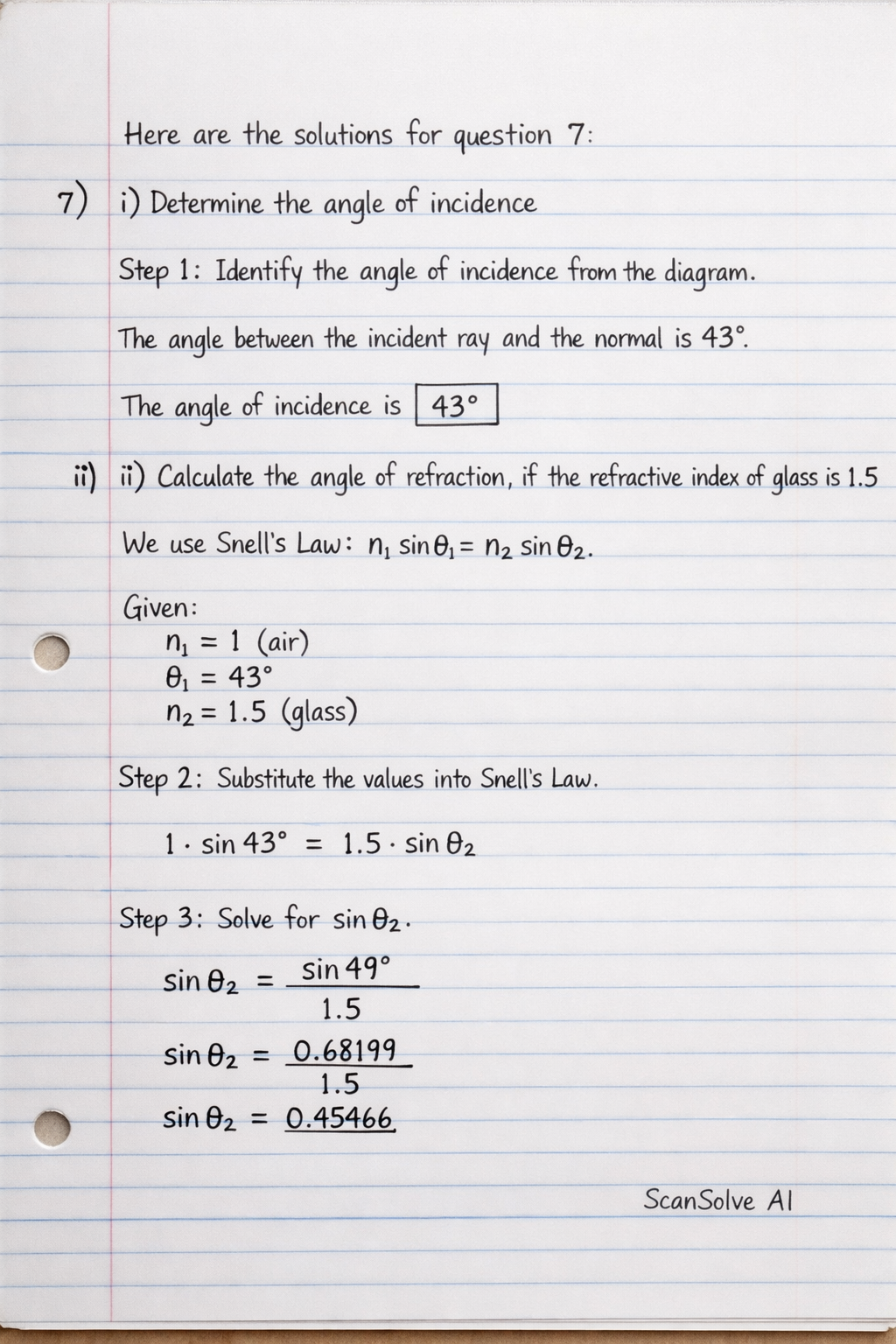
Handwritten Step-by-Step Solution
Get this as a handwritten image on WhatsApp — like a tutor wrote it for you.
Try on WhatsApp