

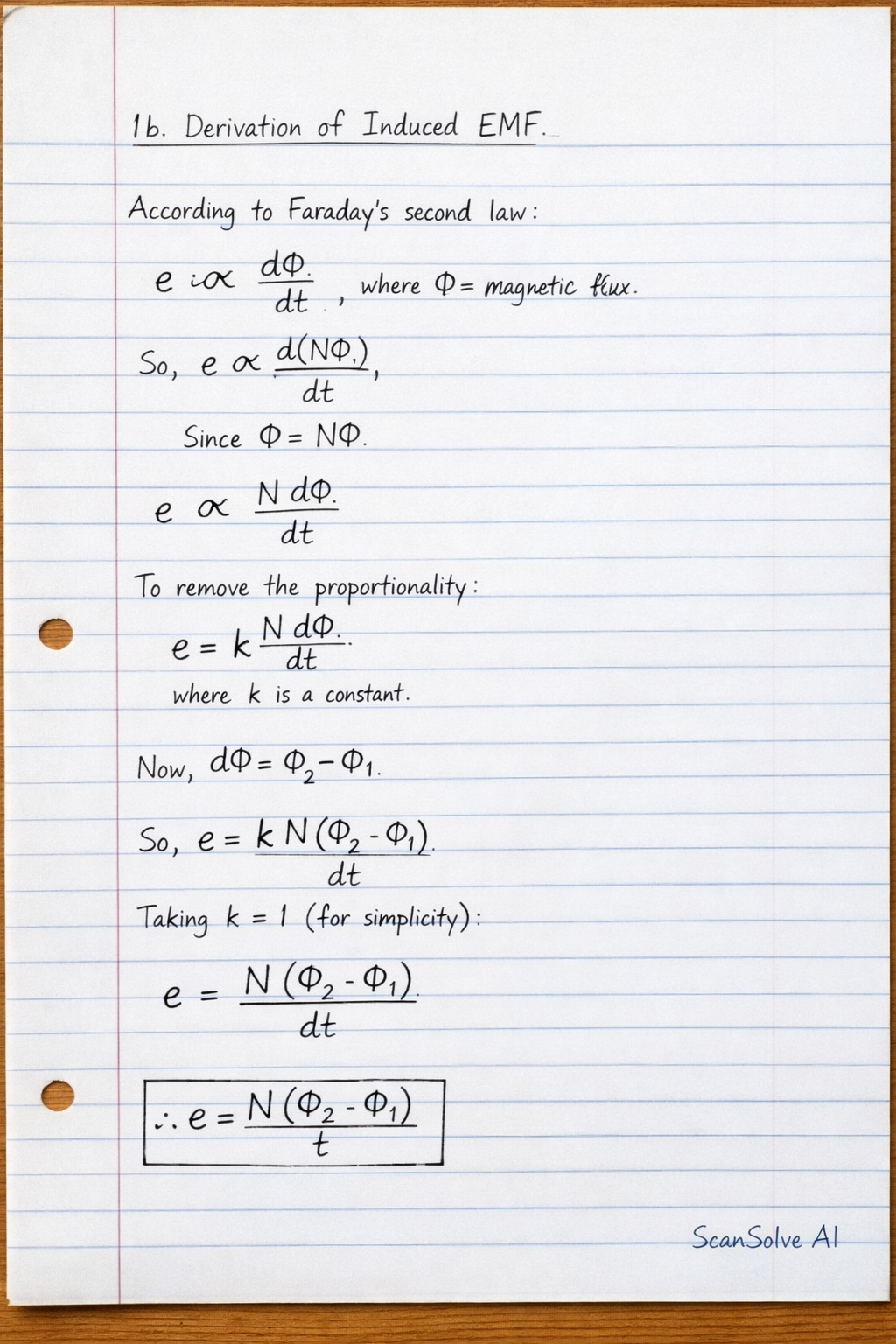
This physics problem tests your understanding of fundamental physical laws and their applications. The step-by-step solution below breaks down the problem using relevant equations and physical reasoning.
ScanSolve AI Answer
1a. States Faraday's laws of electro-magnetic induction. Faraday's laws of electromagnetic induction describe how a changing magnetic field creates an electromotive force (EMF) in a conductor. First Law: Whenever a conductor is placed in a varying magnetic field, an electromotive force (EMF) is induced. If the conductor circuit is closed, a current is induced. Second Law: The magnitude of the induced EMF is directly proportional to the rate of change of magnetic flux linkage with the circuit. 1b. From the second law shown that the induce emf is given by e = (N(_2 - _1))/(t). Faraday's second law states that the induced EMF (e) is proportional to the rate of change of magnetic flux linkage. Magnetic flux linkage is the product of the number of turns (N) and the magnetic flux () through each turn. So, flux linkage = N. Step 1: Express the change in magnetic flux linkage. If the magnetic flux changes from an initial value _1 to a final value _2 over a time interval t, the change in magnetic flux linkage is N_2 - N_1 = N(_2 - _1). Step 2: Apply Faraday's second law. The induced EMF is proportional to the rate of change of magnetic flux linkage: e (N(_2 - _1))/(t) Introducing a constant of proportionality (which is 1 in SI units, and the negative sign indicates Lenz's law direction, but for magnitude, we often consider the absolute value): e = (N(_2 - _1))/(t) This formula represents the average induced EMF over the time interval t. 1c. State the following laws: i. Fleming's Right Hand Rule: This rule is used to determine the direction of induced current or EMF when a conductor moves in a magnetic field. If the thumb, forefinger, and middle finger of the right hand are held mutually perpendicular, and the forefinger points in the direction of the magnetic field, the thumb points in the direction of motion of the conductor, then the middle finger points in the direction of the induced current. ii. Lenz's Law: This law states that the direction of the induced current or EMF is always such that it opposes the change in magnetic flux that produced it. It is a consequence of the principle of conservation of energy. 2a. A coil of 500 turns in link with a flux of 4 mWb. If this flux is reversed in 8 ms, calculate the average emf induced in the coil. Step 1: Identify the given values and convert units. Number of turns, N = 500 Initial magnetic flux, _1 = 4 mWb = 4 × 10^-3 Wb Since the flux is reversed, the final magnetic flux, _2 = -4 mWb = -4 × 10^-3 Wb Time taken for reversal, t = 8 ms = 8 × 10^-3 s Step 2: Calculate the change in magnetic flux. = _2 - _1 = (-4 × 10^-3 Wb) - (4 × 10^-3 Wb) = -8 × 10^-3 Wb Step 3: Calculate the average induced EMF using Faraday's law. The magnitude of the average induced EMF is given by: e = N (| |)/( t) Substitute the values: e = 500 × |-8 × 10^-3 Wb|8 × 10^-3 s e = 500 × 8 × 10^-38 × 10^-3 e = 500 × 1 e = 500 V 2b. A coil of 500 turns is wound on a magnetic circuit of reluctance 200000 AT/Wb. If a current of 2A flowing in the coil is reversed in 10 ms, find the average emf induce in the coil. Step 1: Identify the given values and convert units. Number of turns, N = 500 Reluctance, S = 200000 AT/Wb Initial current, I_1 = 2 A Since the current is reversed, the final current, I_2 = -2 A Time taken for reversal, t = 10 ms = 10 × 10^-3 s Step 2: Calculate the initial and final magnetic flux. The magnetic flux () in a magnetic circuit is given by = (MMF)/(S) = (NI)/(S). Initial flux: _1 = (N I_1)/(S) = 500 × 2 A200000 AT/Wb = (1000)/(200000) Wb = 0.005 Wb Final flux: _2 = (N I_2)/(S) = 500 × (-2 A)200000 AT/Wb = (-1000)/(200000) Wb = -0.005 Wb Step 3: Calculate the change in magnetic flux. = _2 - _1 = (-0.005 Wb) - (0.005 Wb) = -0.01 Wb Step 4: Calculate the average induced EMF using Faraday's law. The magnitude of the average induced EMF is given by: e = N (| |)/( t) Substitute the values: e = 500 × |-0.01 Wb|10 × 10^-3 s e = 500 × (0.01)/(0.01) e = 500 × 1 e = 500 V 2c. An air cored solenoid has 600 turns its length is 50 cm and its cross section is 3 cm². calculate the self- inductance in henry. Step 1: Identify the given values and convert units to SI. Number of turns, N = 600 Length of the solenoid, l = 50 cm = 0.50 m Cross-sectional area, A = 3 cm^2 = 3 × (10^-2 m)^2 = 3 × 10^-4 m^2 Permeability of free space (for air core), _0 = 4 × 10^-7 H/m Step 2: Use the formula for self-inductance of a solenoid. The self-inductance (L) of an air-cored solenoid is given by: L = (_0 N^2 A)/(l) Step 3: Substitute the values and calculate. L = (4 × 10^-7 H/m) × (600)^2 × (3 × 10^-4 m^2)0.50 m L = 4 × 10^-7 × 360000 × 3 × 10^-40.50 H L = 4 × 3.6 × 10^5 × 3 × 10^-4 × 10^-70.50 H L = 4 × 10.8 × 10^-60.50 H L = 135.7168 × 10^-60.50 H L = 271.4336 × 10^-6 H L ≈ 2.71 × 10^-4 H L = 0.271 mH Drop the next question.