
We read your photo as:
A particle of mass 2 kg moves in a circular path of radius 5 m with uniform speed 5 m/s. Calculate the magnitude of the average acceleration when it completes half a revolution.
ScanSolve AI Answer
Answer
Step-by-step solution
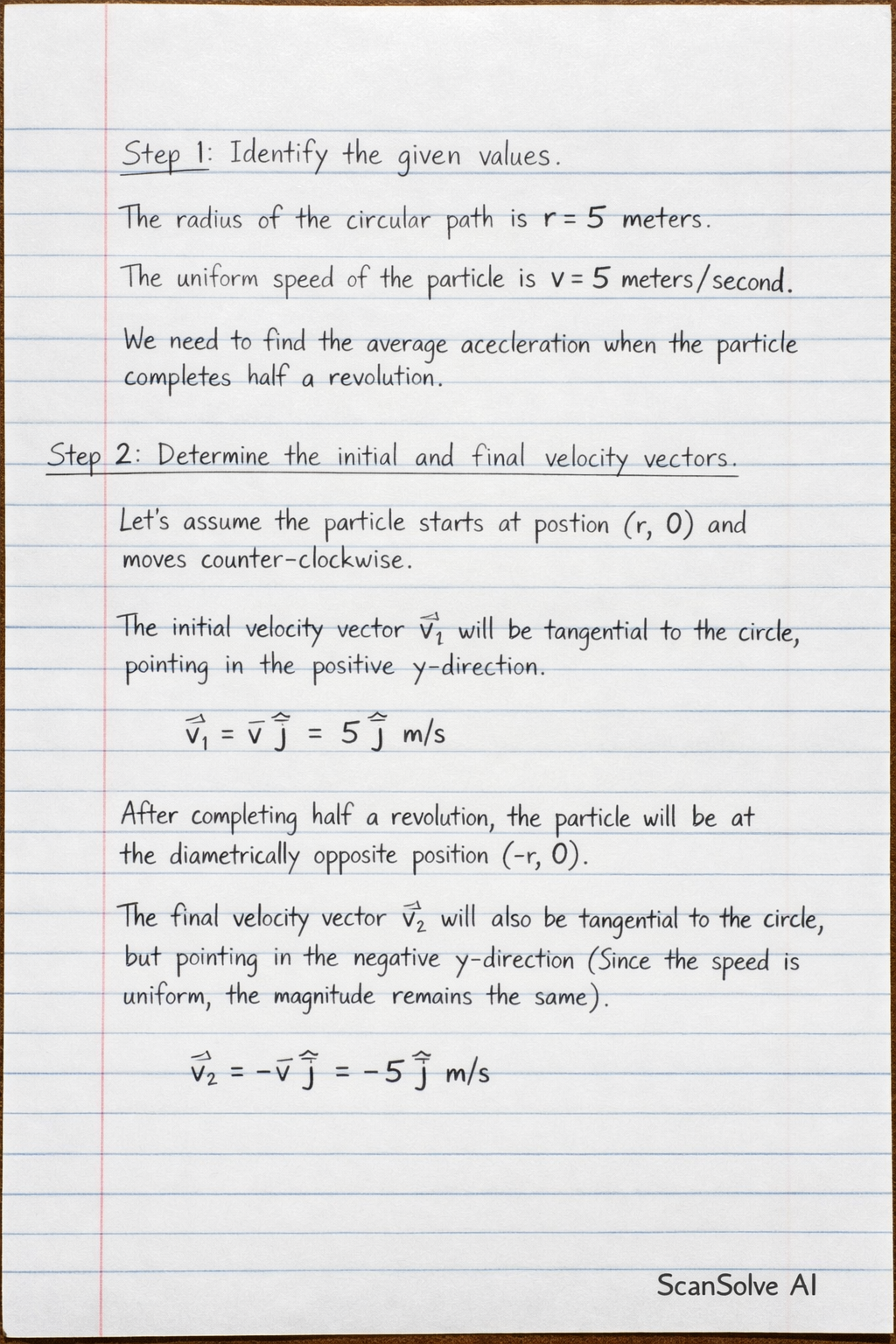
5 stepsIdentify the given values.
The radius of the circular path is meters.
The uniform speed of the particle is meters/second.
We need to find the average acceleration when the particle completes half a revolution.Determine the initial and final velocity vectors.
Let's assume the particle starts at position and moves counter-clockwise.
The initial velocity vector will be tangential to the circle, pointing in the positive y-direction.After completing half a revolution, the particle will be at the diametrically opposite position .
The final velocity vector will also be tangential to the circle, but pointing in the negative y-direction (since the speed is uniform, the magnitude remains the same).Calculate the change in velocity.
The change in velocity is the difference between the final and initial velocity vectors.
The magnitude of the change in velocity is:
Calculate the time taken for half a revolution.
The distance covered in half a revolution is half the circumference of the circle.
Substitute the given radius m:
The time taken is the distance divided by the speed:
Calculate the average acceleration.
Average acceleration is defined as the change in velocity divided by the time taken.
The magnitude of the average acceleration is:
Comparing this result with the given options:
(a) शून्य
(b)
(c)
(d) कोई नहीं
The calculated average acceleration matches option (b).
The final answer is .
Try one yourself
A new problem that tests the same skill.
Still stuck on this one?
Ask a follow-up, and the answer starts from this question.
More Physics Questions
Handwritten Step-by-Step Solution
Get this as a handwritten image on WhatsApp — like a tutor wrote it for you.
Try on WhatsApp