
We read your photo as:
A particle goes from point A to point B, moving in a semicircle of radius 1 m in 1 second. Find the magnitude of its average velocity.
ScanSolve AI Answer
Answer
स्टेप 1: औसत वेग की परिभाषा को समझें।
औसत वेग कुल विस्थापन को कुल समय से विभाजित करने पर प्राप्त होता है।
स्टेप 2: विस्थापन और समय की पहचान करें।
कण बिंदु A से बिंदु B तक एक अर्धवृत्त में चलता है। अर्धवृत्त की त्रिज्या m है।
कण द्वारा लिया गया कुल समय s है।
विस्थापन प्रारंभिक बिंदु (A) से अंतिम बिंदु (B) तक की सीधी दूरी है। चित्र के अनुसार, A और B अर्धवृत्त के व्यास के सिरे हैं।
इसलिए, विस्थापन का परिमाण व्यास के बराबर होगा, जो है।
स्टेप 3: औसत वेग के परिमाण की गणना करें।
स्टेप 4: दिए गए विकल्पों से मिलान करें।
गणना किया गया औसत वेग का परिमाण है, जो विकल्प (2) से मेल खाता है।
Try one yourself
A new problem that tests the same skill.
Still stuck on this one?
Ask a follow-up, and the answer starts from this question.
More Physics Questions
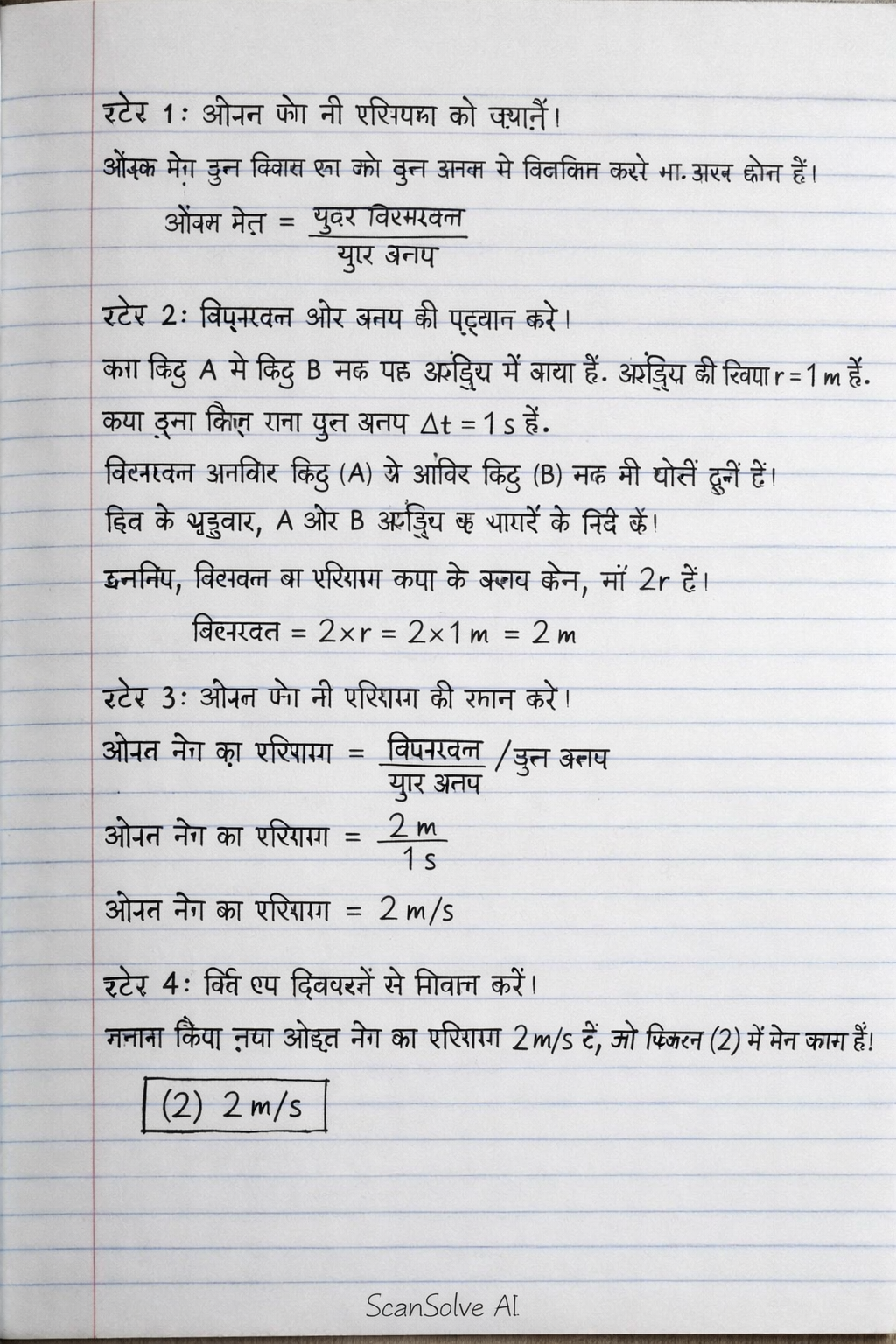
Handwritten Step-by-Step Solution
Get this as a handwritten image on WhatsApp — like a tutor wrote it for you.
Try on WhatsApp