We read your photo as:

Q. A particle moves through an angle to 1.5 radians in 3 sec. Calculate its angular velocity.

Physics

ScanSolve AI Answer

Answer

0.75 revolutions0.75 \text{ revolutions}

0.5π rad/s0.5\pi \text{ rad/s}

1.57 rad/s1.57 \text{ rad/s}

Step-by-step solution

4 steps

here's the solution to the question:

Question:
A stone moves through an angle equal to 1.5π1.5\pi radians in 3 seconds.
[i] Complete revolutions = ?
[ii] Find the angular velocity.

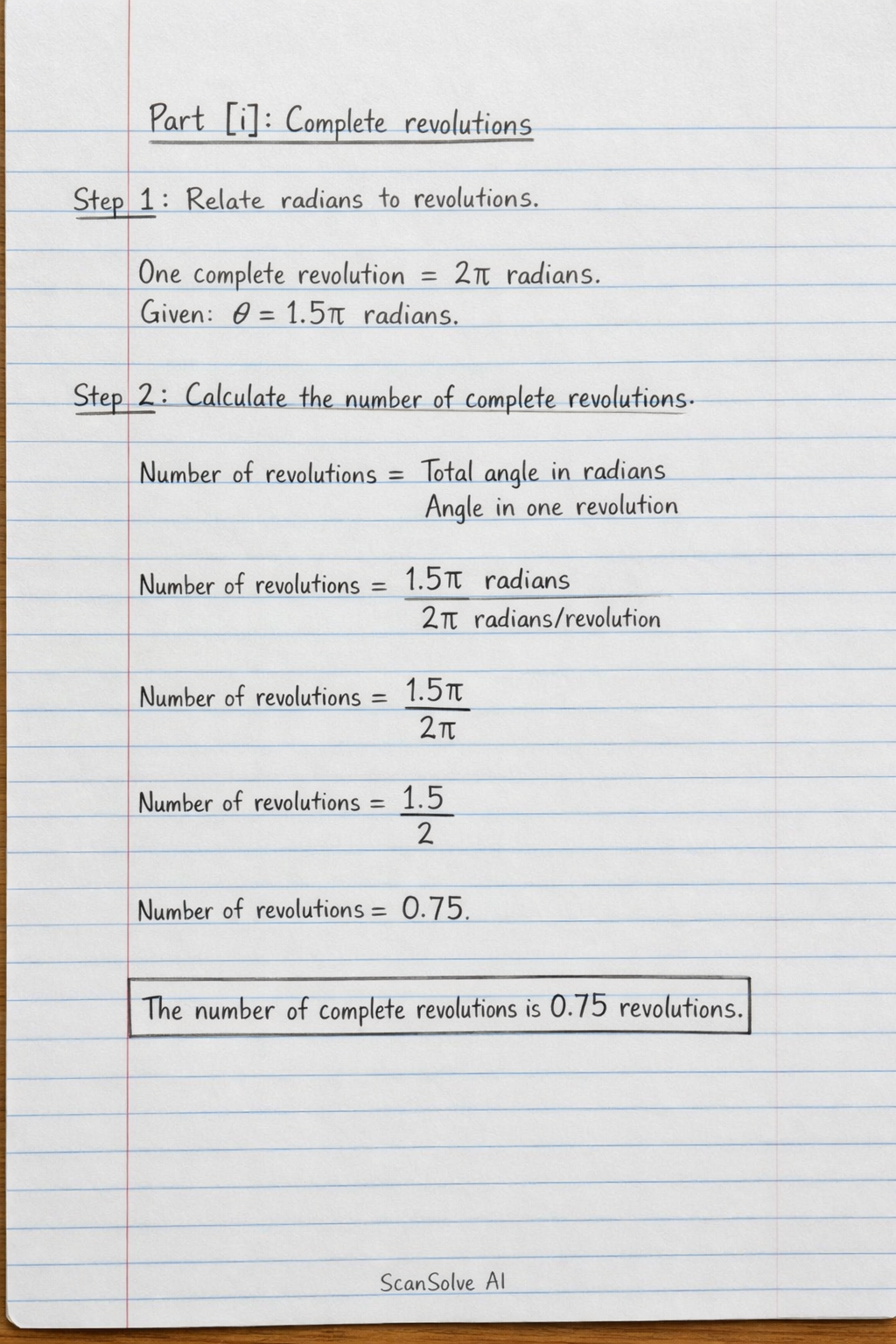
Part [i]: Complete revolutions

  1. Relate radians to revolutions.

    One complete revolution is equal to 2π2\pi radians.
    Given the angle moved θ=1.5π\theta = 1.5\pi radians.

  2. Calculate the number of complete revolutions.

    Number of revolutions=Total angle in radiansAngle in one revolution\text{Number of revolutions} = \frac{\text{Total angle in radians}}{\text{Angle in one revolution}} Number of revolutions=1.5π radians2π radians/revolution\text{Number of revolutions} = \frac{1.5\pi \text{ radians}}{2\pi \text{ radians/revolution}} Number of revolutions=1.52\text{Number of revolutions} = \frac{1.5}{2} Number of revolutions=0.75 revolutions\text{Number of revolutions} = 0.75 \text{ revolutions}

    The number of complete revolutions is 0.75 revolutions\boxed{0.75 \text{ revolutions}}.

    Part [ii]: Angular velocity

  3. Define angular velocity.

    Angular velocity (ω\omega) is the rate of change of angular displacement.

    ω=Angular displacementTime taken\omega = \frac{\text{Angular displacement}}{\text{Time taken}}

    Given angular displacement θ=1.5π\theta = 1.5\pi radians.
    Given time taken t=3t = 3 seconds.

  4. Calculate the angular velocity.

    ω=1.5π radians3 s\omega = \frac{1.5\pi \text{ radians}}{3 \text{ s}} ω=0.5π rad/s\omega = 0.5\pi \text{ rad/s}

    Using π≈3.14159\pi \approx 3.14159:

    ω=0.5×3.14159 rad/s\omega = 0.5 \times 3.14159 \text{ rad/s} ω≈1.57 rad/s\omega \approx 1.57 \text{ rad/s}

    The angular velocity is 0.5π rad/s\boxed{0.5\pi \text{ rad/s}} or approximately 1.57 rad/s\boxed{1.57 \text{ rad/s}}.

Was this helpful?

Try one yourself

A new problem that tests the same skill.

Still stuck on this one?

Ask a follow-up, and the answer starts from this question.

Got a different question?Ask your own question
Handwritten step-by-step solution preview

Handwritten Step-by-Step Solution

Get this as a handwritten image on WhatsApp — like a tutor wrote it for you.

Try on WhatsApp