
We read your photo as:
An aircraft with a mass of 500 kg is flying in a horizontal circle of radius 2000 m at a speed of 120 m/s. Calculate its centripetal acceleration and centripetal force. A ball with mass 4.5 x 10⁻² kg
ScanSolve AI Answer
Answers
6 partsStep-by-step solution
2 stepsPart d(i)
Step 1: Calculate the centripetal acceleration.
Given:
Mass of aircraft,
Radius of circular path,
Speed,
The formula for centripetal acceleration is .
The centripetal acceleration is .
Part d(ii)
Step 1: Calculate the centripetal force.
The formula for centripetal force is .
The centripetal force is .
Part e(i)
Step 1: Calculate the change in momentum of the ball.
Given:
Initial velocity of ball, (stationary)
Final velocity of ball,
Contact time,
Mass of ball,
The formula for change in momentum is .
The change in momentum of the ball is .
Part e(ii)
Step 1: Calculate the average force.
The formula for average force is .
The average force is .
Part f(i)
Step 1: Define centripetal force.
Given:
Weight of car,
Linear velocity,
Centripetal force,
Assume acceleration due to gravity, .
Centripetal force is the force that acts on an object moving in a circular path, directed towards the center of the circle, and is responsible for maintaining the circular motion.
Part f(ii)
Step 1: Convert linear velocity to .
Calculate the mass of the car.
The formula for weight is , so .
Calculate the radius of the circular path.
The formula for centripetal force is . Rearranging for :
The radius of the circular path is .
Part f(iii)
Step 1: Calculate the angular velocity of the car.
The relationship between linear velocity and angular velocity is . Rearranging for :
The angular velocity of the car is .
Try one yourself
A new problem that tests the same skill.
Still stuck on this one?
Ask a follow-up, and the answer starts from this question.
More Physics Questions
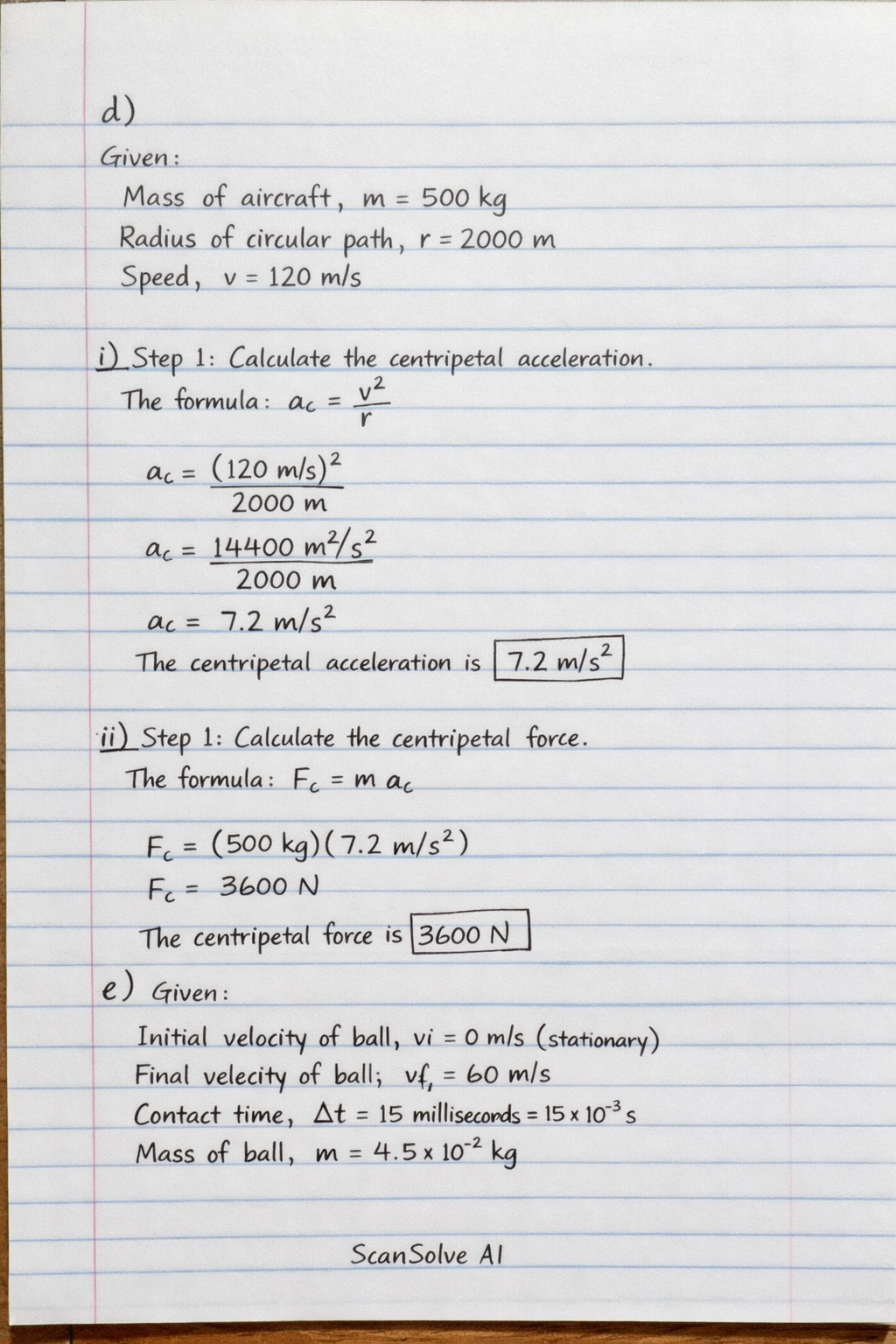
Handwritten Step-by-Step Solution
Get this as a handwritten image on WhatsApp — like a tutor wrote it for you.
Try on WhatsApp