
We read your photo as:
The required number of teeth in wheel A.
ScanSolve AI Answer
Step-by-step solution
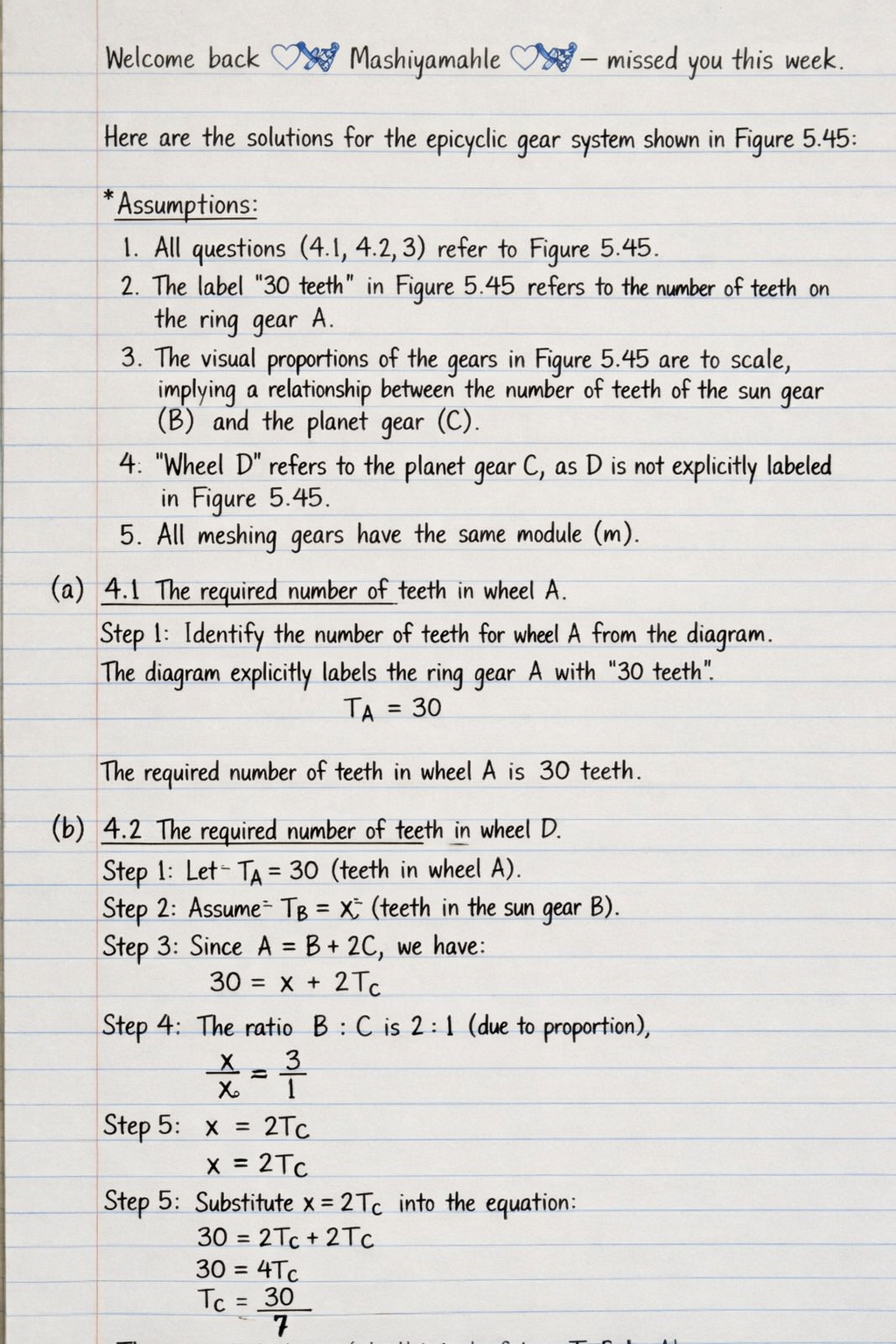
7 stepsHere are the solutions for the epicyclic gear system shown in Figure 5.45:
Assumptions:
- All questions (4.1, 4.2, 4.3) refer to Figure 5.45.
- The label "30 teeth" in Figure 5.45 refers to the number of teeth on the ring gear A.
- The visual proportions of the gears in Figure 5.45 are to scale, implying a relationship between the number of teeth of the sun gear (B) and the planet gear (C).
- "Wheel D" refers to the planet gear C, as D is not explicitly labeled in Figure 5.45.
- All meshing gears have the same module ().
- a) 4.1 The required number of teeth in wheel A.
Identify the number of teeth for wheel A from the diagram.
The diagram explicitly labels the ring gear A with "30 teeth".
The required number of teeth in wheel A is 30 teeth.
- b) 4.2 The required number of teeth in wheel D.
State the relationship between the number of teeth in an epicyclic gear train.
For an epicyclic gear train with a ring gear (A), sun gear (B), and planet gear (C), the relationship between their number of teeth is:
Substitute the value of :
Determine the relationship between and from the diagram.
By visual inspection of Figure 5.45, the diameter of the planet gear C appears to be twice the diameter of the sun gear B. Since the number of teeth is proportional to the diameter for gears with the same module (), we can write:
Solve for and .
Substitute equation (2) into equation (1):
Now, calculate using equation (2):
So, the sun gear B has 6 teeth, and the planet gear C has 12 teeth.
Identify wheel D.
Assuming "wheel D" refers to the planet gear C:
The required number of teeth in wheel D is 12 teeth.
- c) 4.3 The pitch circle diameter (PCD) of D.
State the formula for Pitch Circle Diameter (PCD).
The PCD of a gear is given by the formula:
where is the module and is the number of teeth.
Calculate the PCD of D.
From 4.2, we found . The module is not provided in the problem. Therefore, the PCD of D must be expressed in terms of .
The pitch circle diameter (PCD) of D is .
Still stuck on this one?
Ask a follow-up, and the answer starts from this question.
Handwritten Step-by-Step Solution
Get this as a handwritten image on WhatsApp — like a tutor wrote it for you.
Try on WhatsApp