We read your photo as:

Use engineering calculations or physics

Physics

ScanSolve AI Answer

Step-by-step solution

13 steps

Part i· 2 steps

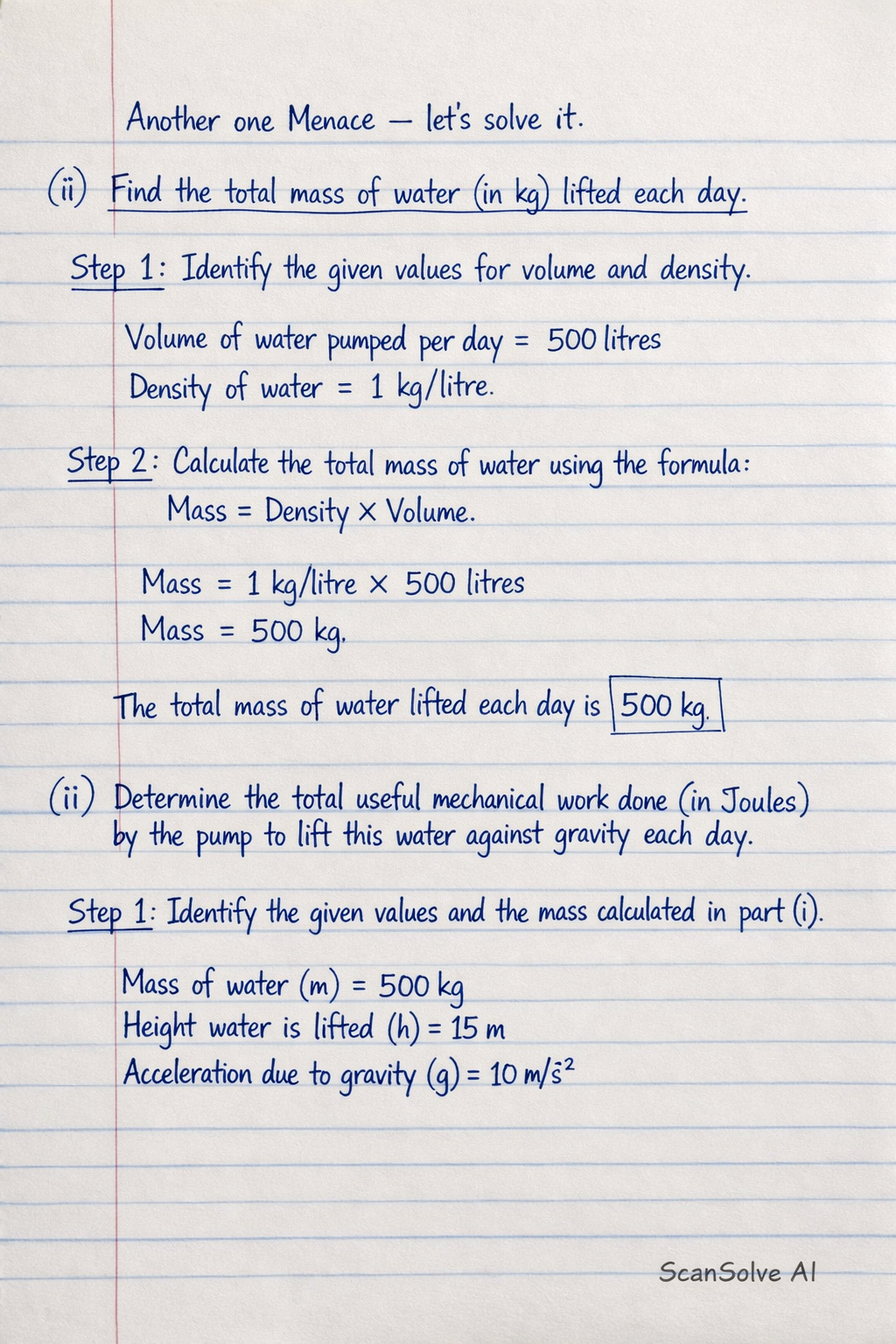
Drive the total mass of water (in kg) lifted each day.

  1. Identify the given values for volume and density.

    Volume of water pumped per day =500 litres= 500 \text{ litres}
    Density of water =1 kg/litre= 1 \text{ kg/litre}

  2. Calculate the total mass of water using the formula

    Mass = Density ×\times Volume.

    Mass=1 kg/litre×500 litres\text{Mass} = 1 \text{ kg/litre} \times 500 \text{ litres} Mass=500 kg\text{Mass} = 500 \text{ kg}

    The total mass of water lifted each day is 500 kg\boxed{\text{500 kg}}.

Part ii· 2 steps

Determine the total useful mechanical work done (in Joules) by the pump to lift this water against gravity each day.

  1. Identify the given values and the mass calculated in part (i).

    Mass of water (m)=500 kg(m) = 500 \text{ kg}
    Height water is lifted (h)=15 m(h) = 15 \text{ m}
    Acceleration due to gravity (g)=10 m/s2(g) = 10 \text{ m/s}^2

  2. Calculate the work done using the formula for gravitational potential energy

    PE=mghPE = mgh.

    PE=(500 kg)×(10 m/s2)×(15 m)PE = (500 \text{ kg}) \times (10 \text{ m/s}^2) \times (15 \text{ m}) PE=5000 N×15 mPE = 5000 \text{ N} \times 15 \text{ m} PE=75000 JPE = 75000 \text{ J}

    The total useful mechanical work done is 75000 J\boxed{\text{75000 J}}.

Part iii· 2 steps

If the battery stores 1200 Wh of usable energy, and it is fully charged at the start of the day, what percentage of its stored energy will be used by the pump's daily operation?

  1. Identify the given values for battery storage and daily consumption.

    Battery usable energy storage =1200 Wh= 1200 \text{ Wh}
    Daily energy consumed by pump =120 Wh= 120 \text{ Wh}

  2. Calculate the percentage of stored energy used.

    Percentage used=(Energy consumedTotal stored energy)×100%\text{Percentage used} = \left( \frac{\text{Energy consumed}}{\text{Total stored energy}} \right) \times 100\% Percentage used=(120 Wh1200 Wh)×100%\text{Percentage used} = \left( \frac{120 \text{ Wh}}{1200 \text{ Wh}} \right) \times 100\% Percentage used=0.1×100%\text{Percentage used} = 0.1 \times 100\% Percentage used=10%\text{Percentage used} = 10\%

    The percentage of stored energy used by the pump's daily operation is 10%\boxed{\text{10\%}}.

Part iv· 2 steps

Calculate the induced EMF using Faraday's Law: E=−NdϕdtE = -N \frac{d\phi}{dt}.

  1. Identify the given values.

    Number of turns (N)=200 turns(N) = 200 \text{ turns}
    Change in magnetic flux (dϕ)=0.02 Wb(d\phi) = 0.02 \text{ Wb}
    Time taken for flux change (dt)=0.5 s(dt) = 0.5 \text{ s}

  2. Substitute the values into Faraday's Law formula.

    E=−NdϕdtE = -N \frac{d\phi}{dt} E=−(200)×(0.02 Wb0.5 s)E = -(200) \times \left( \frac{0.02 \text{ Wb}}{0.5 \text{ s}} \right) E=−(200)×(0.04 V)E = -(200) \times (0.04 \text{ V}) E=−8 VE = -8 \text{ V}

    The induced EMF is -8 V\boxed{\text{-8 V}}.

Part v· 2 steps

If the coil has an inductance of 0.5H and the current changes from 0A to 5A in 0.1s, calculate the induced EMF using E=−LdIdtE = -L \frac{dI}{dt}.

  1. Identify the given values.

    Coil inductance (L)=0.5 H(L) = 0.5 \text{ H}
    Change in current (dI)=5 A−0 A=5 A(dI) = 5 \text{ A} - 0 \text{ A} = 5 \text{ A}
    Time for current change (dt)=0.1 s(dt) = 0.1 \text{ s}

  2. Substitute the values into the formula for self-induced EMF.

    E=−LdIdtE = -L \frac{dI}{dt} E=−(0.5 H)×(5 A0.1 s)E = -(0.5 \text{ H}) \times \left( \frac{5 \text{ A}}{0.1 \text{ s}} \right) E=−(0.5 H)×(50 A/s)E = -(0.5 \text{ H}) \times (50 \text{ A/s}) E=−25 VE = -25 \text{ V}

    The induced EMF is -25 V\boxed{\text{-25 V}}.

Part vi· 3 steps

The AC mains supply is 230V RMS. Determine the peak voltage and peak-to-peak voltage.

  1. Identify the given RMS voltage.

    RMS voltage (VRMS)=230 V(V_{RMS}) = 230 \text{ V}

  2. Calculate the peak voltage using the formula Vpeak=VRMS×2V_{peak} = V_{RMS} \times \sqrt{2}.

    Vpeak=230 V×2V_{peak} = 230 \text{ V} \times \sqrt{2} Vpeak≈230 V×1.4142V_{peak} \approx 230 \text{ V} \times 1.4142 Vpeak≈325.266 VV_{peak} \approx 325.266 \text{ V}
  3. Calculate the peak-to-peak voltage using the formula Vp−p=2×VpeakV_{p-p} = 2 \times V_{peak}.

    Vp−p=2×325.266 VV_{p-p} = 2 \times 325.266 \text{ V} Vp−p≈650.532 VV_{p-p} \approx 650.532 \text{ V}

    The peak voltage is approximately 325.27 V\boxed{\text{325.27 V}} and the peak-to-peak voltage is approximately 650.53 V\boxed{\text{650.53 V}}.

Was this helpful?

Still stuck on this one?

Ask a follow-up, and the answer starts from this question.

Got a different question?Ask your own question
Handwritten step-by-step solution preview

Handwritten Step-by-Step Solution

Get this as a handwritten image on WhatsApp — like a tutor wrote it for you.

Try on WhatsApp