

This biology question covers important biological concepts and processes. The step-by-step explanation below helps you understand the underlying mechanisms and reasoning.
ScanSolve AI Answer
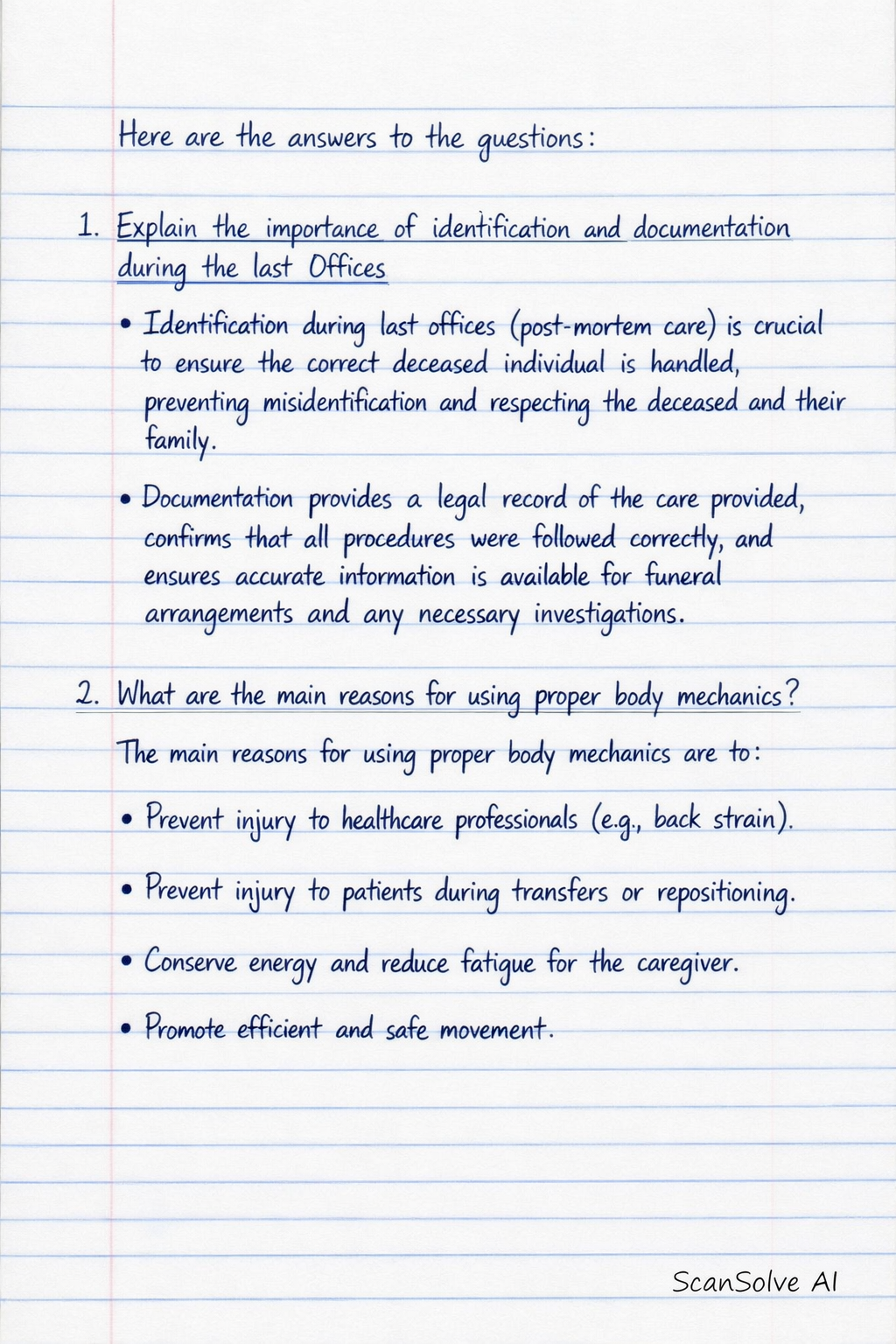
Here are the answers to the questions: 1. Explain the importance of identification and documentation during the last Offices Identification* during last offices (post-mortem care) is crucial to ensure the correct deceased individual is handled, preventing misidentification and respecting the deceased and their family. Documentation* provides a legal record of the care provided, confirms that all procedures were followed correctly, and ensures accurate information is available for funeral arrangements and any necessary investigations. 2. What are the main reasons for using proper body mechanics? The main reasons for using proper body mechanics are to: Prevent injury to healthcare professionals (e.g., back strain). Prevent injury to patients during transfers or repositioning. Conserve energy and reduce fatigue for the caregiver. Promote efficient and safe movement. 3. Differentiate between the Orthodox lift and the Australian lift. The Orthodox lift* is typically a two-person or multi-person lift used to move a patient, often from a bed to a stretcher or vice versa, emphasizing coordinated effort and communication. The Australian lift* is a specific technique, often performed by one nurse, to move a patient up in bed. The nurse stands at the head of the bed, uses their body weight and leverage, and the patient's cooperation (if possible) to slide the patient upwards. 4. State five reasons for using various positions in nursing care. 1. To promote patient comfort and relaxation. 2. To prevent pressure injuries (bedsores) by redistributing weight. 3. To facilitate breathing and improve respiratory function. 4. To aid in specific medical procedures, examinations, or treatments. 5. To improve circulation and prevent complications like deep vein thrombosis. 5. Why is it important to document and report findings after tepid sponging? It is important to document and report findings after tepid sponging to: Record the intervention performed and the patient's response, such as changes in temperature. Evaluate the effectiveness of the sponging in reducing fever. Inform the healthcare team of the patient's current condition and guide further care decisions. Provide a legal record of care. 6. Define a specimen in nursing practice. A specimen in nursing practice is a sample of body fluid (e.g., blood, urine, sputum), tissue, or waste product collected from a patient for diagnostic testing, analysis, or culture to aid in diagnosis, treatment, or monitoring of a medical condition. 7. State five general principles for specimen collection. 1. Patient Identification: Always verify the patient's identity using at least two identifiers before collection. 2. Correct Specimen: Collect the appropriate type and amount of specimen required for the ordered test. 3. Aseptic Technique: Maintain sterility during collection to prevent contamination, especially for cultures. 4. Proper Labeling: Label the specimen container accurately and immediately after collection with patient details, date, and time. 5. Timely Transport: Transport the specimen to the laboratory promptly and under appropriate conditions (e.g., refrigeration) to maintain its integrity.